The defensive forts of Bucharest: King Carol I’s belt of fortifications
By Eddie Țone
- Articles
- 19 MAY 26
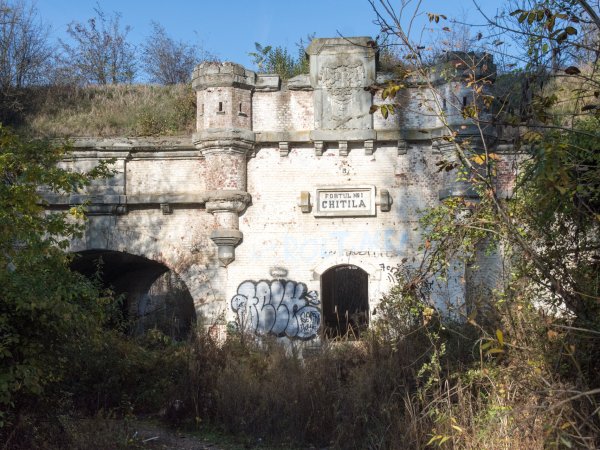
Today’s Bucharest looks like a capital that has almost completely forgotten the military defense system built at the end of the 19th century. Among ring roads, industrial areas, military land, residential neighborhoods, and constructions that appeared much later, the traces of a large-scale defensive work can still be glimpsed: the Fortress of Bucharest, the belt of forts and batteries built during the reign of King Carol I.
Photo credit: Forturi.ro
This page of military engineering remains one of the lesser-known stories of the capital. The system was conceived for a world in which capitals had to be defended by rings of fortifications, artillery, ditches, galleries, and rapid communications. Yet the military world of the late 19th century was changing at speed: projectiles, artillery, and attack techniques were evolving precisely during the years in which such systems were being designed and built.
The genesis of a strategic idea
The idea of fortifying Bucharest must be placed in the context of Romania after gaining independence, when the state was rethinking its defense in relation to the great powers and the regional instability in the Balkans. Carol I, shaped by a German military culture, regarded the defense of the capital as a major strategic matter.
In 1882, Carol I appointed a commission led by General Gheorghe Manu, tasked with drawing up a project for the fortification of the country. In the same year, the Belgian general Henri Alexis Brialmont, one of Europe’s leading authorities in the field of fortifications, was asked to develop a strategy for Romania’s fortification, starting from the projects of the Manu Commission. The memorandum presented to the king in December 1882 placed Bucharest at the center of the defensive system, as a strategic point and reserve center.
Work began in 1884. Official completion was reported in 1895, although additions, adaptations, and technical observations continued to be made until 1903. The project was costly, difficult, and modified repeatedly, including because of the evolution of offensive weaponry, which required changes in materials, technologies, and internal organization.
Military architecture: functionality above all else
The fortification system of Bucharest consisted of 18 detached forts and 18 intermediate redoubt-batteries, arranged in a ring of approximately 72 km, with diameters varying between 21 and 23 km. The ring was located about 8 km from the city center, in relation to the main access and exit routes of the capital.
About 100 m behind the line of forts there was a railway doubled by a road, intended to ensure the connection between the components of the system. The distance between the forts and the intermediate batteries was approximately 2 km, calculated according to the range of the artillery pieces of the period.
The forts were not identical. The system included several construction types: forts with a central keep, forts without a keep, reduced versions of the initial plans, and, in the case of Fort 5 Ștefănești, a water fort, with water-filled ditches. The materials used included stone, brick, earth fillings, and, during the adaptation of the projects, reinforced concrete for some vaults and galleries.
Geographical distribution and tactical functionality
The forts were grouped into sectors according to the main access routes toward Bucharest. The northern and eastern sector included the forts of Chitila, Mogoșoaia, Otopeni, Tunari, Ștefănești, Afumați, Pantelimon, Cernica, and Cățelu. The southern and southeastern sector included Leordeni, Popești, Berceni, and Jilava. The southwestern and western sector included Broscărie, Măgurele, Bragadiru, Domnești, and Chiajna.
Fort 13 Jilava is today the one most present in public memory, due to its later fate. Fort 18 Chiajna closed the numbering of the system toward the west. This historical network should not be confused with names that appeared later in local usage; the list of the 18 forts does not include “Fortul Buftea” or “Fortul Roșu.”
Each fort was designed to function as a point of resistance, but the real value of the system lay in the coordinated action of the forts, batteries, railway, road, and artillery. On paper, it was an impressive defensive machine. In practice, military technology evolved faster than the system built around Bucharest.
Historical evolution and the military failure of the system
The Fortress of Bucharest never came to fulfill the military role for which it had been designed. At the beginning of the 20th century, the development of artillery and the emergence of more powerful projectiles made fortifications of this type increasingly vulnerable.
The process by which the system lost its military function began before the First World War. Fort 13 Jilava became a military penitentiary in 1906, and during Romania’s neutrality, between 1914 and 1916, the heavy armament of the fortified system was dismantled and redistributed to other units. When German troops reached Bucharest in December 1916, the fortified system was no longer operational.
Fort 13 Jilava had the most dramatic fate. Built as part of the defensive belt, it was later used as a military penitentiary and then as a place of political detention. After 1948, Jilava became one of the major carceral spaces of communist Romania, known for its particularly harsh detention conditions. Numerous political prisoners passed through here, and the name of the fort remained associated with repression, detention, and traumatic memory.
The communist period and later transformations
After the system’s initial military value disappeared, many forts and batteries received new functions or were abandoned. Some remained under military administration, others were used as technical spaces, depots, training areas, or passed into civilian administration.
Some components were affected by explosions related to the storage of ammunition. In the literature and inventories dedicated to the fortifications, cases such as Chiajna, Mogoșoaia, Bragadiru, Cățelu, and Domnești are mentioned, but the exact list must be treated with caution in the absence of a unified archival synthesis.
After 1990, the legal and urban-planning situation became even more complicated. Restitutions, land transfers, real estate pressure, and the lack of a coherent conservation policy caused many of these constructions to remain difficult to access, degraded, or almost invisible to the general public.
Current state: an inventory of survival
Of the 36 main constructions of the system, numerous forts and batteries can still be identified, but in very different states of preservation. Some are relatively well preserved structurally, while others are damaged, partially destroyed, or difficult to access because they are located on military, private, or industrial land.
Fort 13 Jilava has the status of a Group A historical monument, LMI code IF-II-m-A-21037, being listed in the Register of Historical Monuments as an objective located within the Jilava Penitentiary, dated 1886–1893. In 2024, the fort was taken over by the Ilfov County Council, with the aim of rehabilitation, conservation, and museum and tourism valorization.
For the rest of the belt, the picture remains fragmented. Some forts can be identified on the ground, while others are hidden by vegetation, constructions, fences, depots, or restricted-access areas. The system still exists, but rather as a map of traces, interruptions, and survivals than as a coherent heritage ensemble presented to the public.
Perspectives for conservation and valorization
In recent years, interest in Bucharest’s belt of fortifications has grown, especially through civic initiatives, heritage research, and projects dedicated to recovering the memory of Fort 13 Jilava. The specialists who prepared the classification documentation for Fort 13 also proposed the inclusion of the entire Fortress of Bucharest system on the Register of Historical Monuments as a protected area.
The great difficulty remains the gap between historical value and administrative reality. The forts are spread around the capital, belong to different owners or administrators, have uneven states of preservation, and are located in areas where urban pressure is high.
The belt of fortifications built during the reign of Carol I remains one of the most important ensembles of military and urban history around Bucharest. It was built to defend the capital according to the strategic logic of the late 19th century, but today it tells a broader story: about strategic ambition, outdated technology, enormous costs, traumatic memory, and heritage left for far too long on the edge of the city.
You may also like: Famous boulevard names: Mărășești, the First World War and the unification of Greater Romania