7 Places in Bucharest Where History Reaches Kids When They're Not Looking
- Articles
- 18 MAY 26
Bucharest is not just a city you live in or rush through. It's a city with layers — stories buried under asphalt and leaves, buildings that witnessed kings and revolutions, parks that grew out of swamps. The problem is that we, as adults, know this only vaguely, and our children don't know it at all.
But there are places where history doesn't feel like a lesson. Places where your child doesn't realize that, while staring at a solid gold Dacian bracelet or exploring a wooden house brought piece by piece from Maramureș, they're actually learning something that stays. Here are seven of those places, each with a story worth knowing yourself before you tell it to them.
1. The National Museum of Romanian History — the treasure vault underground
The building itself has its own story. It's the former Palace of the Post, built between 1894 and 1901 to the designs of architect Alexandru Săvulescu, inspired by the Federal Post Palace in Geneva. King Carol I laid the foundation stone on October 20, 1894, and the Romanian Post Office operated here until 1970. Two years later, on May 8, 1972, the National Museum of Romanian History opened its doors.
What tends to fascinate children is in the basement: the Historic Treasury, housed in the old vault of the Palace of the Post, a room of nearly 1,000 square meters underground. There, more than 3,000 original pieces are on display — some prehistoric, some medieval, some royal. Among them, solid gold Dacian bracelets discovered at Sarmizegetusa and the Pietroasele Treasure, popularly known as "The Hen with the Golden Chicks," unearthed in 1837.
The museum also holds a full-scale replica of Trajan's Column from Rome. The original stands in Rome; the replica on display in Bucharest was made between 1939 and 1943 by craftsmen from the Vatican and brought to Bucharest in 1967. It depicts 2,500 figures across 155 scenes, on a frieze stretching roughly 200 meters, telling the story of Emperor Trajan's Dacian Wars of 101–102 and 105–106 AD.
What to tell your child: That the people who made those gold bracelets lived in the Orăștie Mountains more than 2,000 years ago, long before Romania existed. And that the gold survived all that time, buried in the ground, until someone finally found it.
2. Cișmigiu Garden — the oldest park in Bucharest
Before it was a park, this place was a swamp. A marshy lake, recorded in seventeenth-century documents as "Dura the Merchant's Lake," which swelled with every heavy rain and had become a disease hotspot in the middle of the city. In 1830, General Pavel Kiseleff, the Russian administrator of the Romanian Principalities, ordered the draining of the swamp and the creation of a public garden.
The actual work began in 1847, during the reign of Prince Gheorghe Bibescu, when landscape gardener Carl Friedrich Wilhelm Meyer, former director of the Imperial Gardens in Vienna, was brought in. Meyer died in 1852, mid-project, from typhoid fever, but the park was already nearly complete. The official inauguration took place in 1854.
The word "Cișmigiu" comes from Turkish: "çeşme" means fountain, and "cișmegiu" was the official in charge of the city's public fountains. One such official lived near the lake in 1779, when the ruler Alexandru Ipsilanti ordered the construction of fountains across Bucharest, and the name stuck. Inside the park, the Writers' Rotunda has been open since 1943, displaying busts of Mihai Eminescu, Ion Luca Caragiale, Vasile Alecsandri, Titu Maiorescu and other major Romanian writers arranged along a circular path.
What to tell your child: That under the grass they're running on, two centuries ago, there was a swamp. And that the park's strange name comes from a Turkish word, because Bucharest was under Ottoman influence for a very long time.
3. Carol Park — a park built in eleven months
Carol Park came into being in 1906 to celebrate three major events of that year: 1,800 years since the Roman conquest of Dacia, 40 years of King Carol I's reign, and 25 years since the Romanian Principalities had become a Kingdom. The initiative belonged to Ion N. Lahovari, Minister of Domains, and the park was designed between 1900 and 1906 by French landscape architect Édouard Redont. The jubilee exhibition opened on June 6, 1906, in the presence of King Carol I.
The area on Filaret Hill had previously been marshy and sparsely inhabited, and in less than a year it was completely transformed: hills were cut, a lake was dug, thousands of trees were planted and around 165 pavilions were erected. The general commissioner of the organization was scientist Constantin I. Istrati.
Several structures from the 1906 exhibition still stand today: the Roman Arenas, an open-air amphitheater built in the Roman style; the Church of the Silver Knife, modeled on the Church of Saint Nicholas in Iași, which Stephen the Great founded at his own 40th anniversary of reign; and Vlad the Impaler's Tower, built to disguise a water reservoir needed during the exhibition. In 1923, the Tomb of the Unknown Soldier was placed in the park, sculpted by Emil Wilhelm Becker and inaugurated on May 17, 1923 in the presence of the Royal Family. During the communist period, between 1948 and 1991, the park was renamed the Park of Liberty.
What to tell your child: That everything they see was built in less than a year, like decorations for a huge party. And that the tower that looks like a medieval fortress is actually a disguised water tank.
4. The National Village Museum "Dimitrie Gusti" — a village brought to Bucharest piece by piece
On the shore of Lake Herăstrău there is an entire village. A real one. The houses, outbuildings, churches and traditional technical installations on display here were disassembled piece by piece in their villages of origin, transported by train, cart or boat to Bucharest, and reassembled by craftsmen brought from those same villages.
The idea belonged to sociologist Dimitrie Gusti, founder of the Bucharest School of Sociology, who led research expeditions to villages across Romania between 1925 and 1935. The museum was inaugurated on May 10, 1936, in the presence of King Carol II, and opened to the general public a week later. At the time of inauguration, it covered approximately 4.5 hectares and comprised 33 authentic complexes. Today, the area has grown to over 10 hectares, with more than 300 structures from all the historical regions of Romania.
Less than a year after opening, in 1937, Dimitrie Gusti and his team were invited to present a selection of objects at the International Exhibition in Paris, where they reconstructed a corner of a Romanian village.
What to tell your child: That each house they see was once home to a real family, somewhere in Romania, decades or centuries ago. And that people took it apart brick by brick and brought it all the way here.
5. The National Museum of the Romanian Peasant — the building that was a museum, then a party headquarters, then a museum again
The building on Șoseaua Kiseleff 3 was constructed between 1912 and 1941 to the designs of architect Nicolae Ghika-Budești, a representative of the Romanian school of architecture. Its exposed red brick, arches and tower recalling the bell towers of old monasteries give it a look unlike anything else in the city.
The museum's own history begins earlier: in 1906, at the initiative of Spiru Haret, the Museum of Ethnography, National Art, Decorative and Industrial Art was founded, with Alexandru Tzigara-Samurcaș as its first director. The institution went through several names and locations over the decades. The building on Kiseleff housed, between 1953 and 1990, first the Lenin-Stalin Museum, then the Museum of the Romanian Communist Party. On February 5, 1990, Minister of Culture Andrei Pleșu decided to reinstall the museum, appointing artist Horia Bernea as director. In 1996, the museum received the EMYA award (European Museum of the Year).
What to tell your child: That in the same building where embroidered blouses and clay pots are displayed today, the communist regime had placed a museum dedicated to its own dictators. And that in 1990, right after communism fell, everything was changed.
6. The Old Town — a neighborhood with layers of time
Bucharest's Historic Center is not a museum, but it may be the best place for a child to understand that a city has an age. The Lipscani area, with its eclectic architecture from the late nineteenth and early twentieth century, visibly carries the mark of the period when Bucharest was known as "Little Paris."
At Calea Victoriei 12 stands the National Museum of History in the former Palace of the Post. A few hundred meters away is Stavropoleos Church, built in 1724 in the Brâncovenesc style, one of the smallest and most beautiful churches in the city. The CEC Palace, built in eclectic style at the turn of the twentieth century, stands across the street. The Macca-Vilacrosse Passage, built in the second half of the nineteenth century after the model of Parisian arcades, covered with yellow glass in a Y shape, connects Calea Victoriei to Lipscani street.
What to tell your child: That the passage covered with yellow glass was built to imitate Paris, because Bucharest at the time desperately wanted to look like a Western capital. And that some of the buildings they're walking past are over 200 years old.
7. The Arch of Triumph — a story about a temporary arch that became permanent
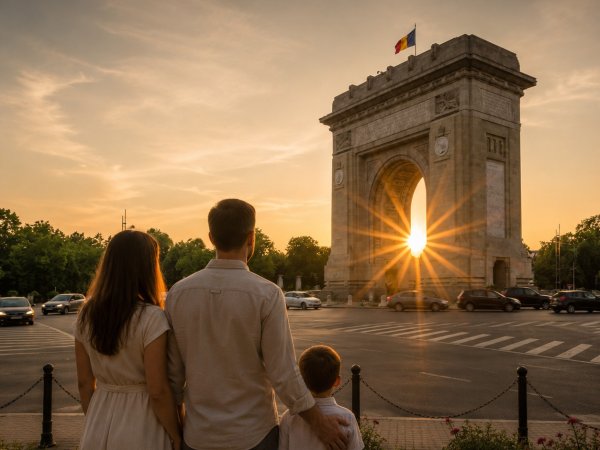
The Arch of Triumph on Șoseaua Kiseleff is the fourth arch built on this spot. The first versions, far more modest, were raised in wood and plaster in 1878 to celebrate Romania's proclamation of independence. The one we see today was built between 1935 and 1936 to the designs of architect Petre Antonescu and inaugurated in 1936. It stands 27 meters tall and is decorated with bas-reliefs by Romanian sculptors of the era, including Ion Jalea and Cornel Medrea.
The arch was conceived as a monument to Romania's participation in the First World War and marks the tradition of military parades along Calea Victoriei. Unlike the famous Arc de Triomphe in Paris, this one sits on a boulevard that was entirely reorganized around it.
What to tell your child: That this arch was built to commemorate a war in which Romania lost hundreds of thousands of soldiers, but in which it also fulfilled a centuries-old dream: to unite all the lands where Romanians lived.
At the end of the day, the historical dates they remember matter very little. What matters is that they saw something real, touched something old, and asked a question — one you either knew the answer to or realized you needed to look up yourself.