How the Streets of Bucharest Were Paved in the 19th Century: Floating Roads Made of Planks and Beams
- Articles
- 18 MAY 26
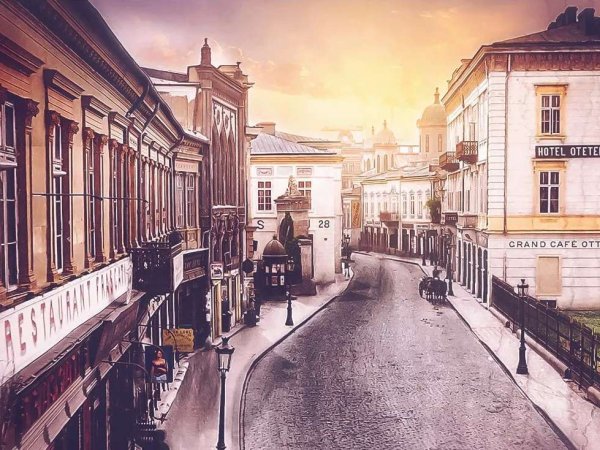
In the first half of the 19th century, Bucharest was far from the image of a modern capital. The city struggled with muddy roads, unstable streets, and a poor infrastructure that directly influenced the daily life of its inhabitants. In the absence of a solid paving system, the streets were often called “bridges,” because they were built from wooden beams placed over the soft ground of the city. This urban reality was not only a practical problem but also a source of comic, frustrating, and sometimes even dangerous situations. From overturned carts to pedestrians covered in mud, the Bucharest of that era offered a contrasting image between its aspirations as a capital and its almost rural reality.
Bucharest in 1822 and the shock of a ruler facing the roads
Around the year 1822, the ruler Grigore Ghica IV is said to have been deeply impressed—or rather shocked—by the state of the capital’s roads. Chronicles of the time describe a city suffocated by dust in summer and turned into a stretch of mud in winter, where movement was a real challenge.
The streets were not simple roads but improvised structures made of wood, called “bridges,” precisely because of the way they were built. These wooden plank bridges, poorly fixed, easily gave way under rain, snow, or traffic.
Under such conditions, the city became almost impracticable, and daily life was constantly affected by the state of the infrastructure.
The “bridges” of Bucharest and everyday urban chaos
The name “bridges” for Bucharest streets was not metaphorical but quite literal. The streets were covered with wooden planks laid over unstable ground, without solid foundations or drainage systems.
During periods of heavy rain or snowfall, these planks became unstable and slippery. They would lift, shift, or tilt, turning walking into an unpredictable experience. Sometimes, a single wrong step could lift a piece of wood and splash mud onto nearby passersby.
Accounts from the time describe almost theatrical scenes: people covered in mud from head to toe, carts stuck, and pedestrians forced to carefully navigate the wooden improvisations.
Picturesque urban scenes and improvised solutions
Life on these improvised “bridges” also generated picturesque, sometimes amusing situations. To avoid soiling their clothes, especially in the case of women, men would sometimes carry them across difficult sections of the road.
These gestures, although born of necessity, also reflected the social norms of the time, when elegant clothing was extremely important. Long and sophisticated dresses were difficult to protect from Bucharest’s mud.
At the same time, nobles and boyars, although traveling by carriage, were not spared problems either. Wheels would sink, carriages would shake, and the risk of overturning was constant.
The first attempts to modernize the roads
Aware of the difficult situation, the ruler Grigore Ghica decided to intervene in the city’s infrastructure. He ordered the repair of the capital’s most important arteries, then known as “bridges.”
Among them were:
- Podul Mogoșoaiei (today’s Calea Victoriei)
- Podul Târgului din Afară (Calea Moșilor)
- Podul Calicilor (Calea Rahovei)
- Podul Beilicului (Calea Șerban Vodă)
The decision was also supported by the boyars of the Divan, who, although not traveling on foot, still felt the discomfort caused by the poor roads through the instability of their carriages and the difficulty of official travel.
The emergence of modern ideas: road paving with stone
During discussions about rebuilding the roads, two foreign entrepreneurs, Hertel and Freiwald, arrived in Bucharest and proposed an innovative solution for the time: replacing wooden bridges with stone-paved roads.
Their proposal was revolutionary for the era. Instead of unstable planks, they suggested the use of stone, which would provide stability, durability, and much more efficient circulation.
The initiative was received with interest by the ruler, who understood that the city needed a profound structural change. The boyars also supported the project, considering it a necessary solution for modernizing the capital.
An ambitious contract for the modernization of Bucharest
In March 1824, an agreement was reached between the authorities and the entrepreneurs. They committed to paving four major city arteries within a period of 12 years, using stone brought from the mountains of Wallachia.
The project envisioned a road system superior even to that of Brașov, considered a benchmark at the time. The works were to be executed according to modern engineering principles, with rigor and organization.
Moreover, the plan included:
- streets built on a slope for water drainage into the Dâmbovița River
- an underground masonry sewer system
- covered channels with vaults
- drainage openings fitted with iron grates
This project was extremely advanced for the early 19th century and represented a true vision of modern urban infrastructure.
The first works and the enthusiasm of the authorities
On June 28, 1824, the first modernized road sections were presented. The samples were built on Podul Mogoșoaiei, in the area of the Corso café, and on Calea Moșilor.
These demonstration sections impressed the authorities and boyars, who considered the project viable and promising. It was the first time Bucharest saw a real alternative to the chaos of wooden streets.
The ruler approved the start of the works, and the city seemed ready for a major transformation.
A slow and incomplete modernization
However, the subsequent evolution of the project remains unclear. Although intentions were ambitious, implementation was slow and fragmented.
Around 1850, Bucharest still had poorly maintained roads, and Podul Mogoșoaiei was again under construction. The situation had become so difficult that access to important institutions, such as the Great Theatre, was hindered.
There is even an episode in which the then theatre director, Costache Dimitrache, sued the City Hall due to the inconvenience caused by the poor road conditions.
From urban chaos to gradual modernization
Real change began only in the second half of the 19th century, with the reign of Carol I of Romania, after 1866.
During this period, Bucharest entered a broad process of urban modernization. Modern paving was introduced, utility networks were expanded, and main arteries were systematized.
However, the city still retained a visible mix of East and West. Only major boulevards were paved with cobblestone or asphalt, while secondary streets remained covered with packed earth, river stones, or macadam.
Modern Bucharest begins to take shape
The urban modernization process had already begun during the rule of Alexandru Ioan Cuza, but the true transformation of the capital occurred during Carol I’s reign.
The city gradually became more organized, cleaner, and more accessible. The emergence of modern paving radically changed daily life, facilitating transport and reducing urban chaos. Thus, the old wooden “bridges” gradually disappeared, making way for a developing European capital.
The legacy of the streets of the past
Looking back, the 19th-century streets of Bucharest perfectly reflect the transition of a city caught between tradition and modernity. From floating wooden plank roads to modern stone pavements, the evolution of infrastructure tells the story of a capital that learned, step by step, to become European.
Although hard to imagine today, those unstable roads formed the foundation on which modern Bucharest was built.
We also recommend: Bucharest’s Calea Victoriei “breathes” history: the old Mogoșoaia Bridge was paved by Constantin Brâncoveanu with tree trunks