Famous boulevard names: Mărășești, the First World War and the unification of Greater Romania
- Articles
- 23 MAR 26
Mărășești Boulevard is one of those Bucharest arteries that says more than it seems at first glance. For many, its name immediately sends to one of the most important battles of the First World War and, implicitly, to the huge effort that made possible the unification of Greater Romania. For others, it is simply a well-known road in the Capital, crossed daily, caught between traffic, tram lines, crowded intersections and old buildings that still preserve something of the air of the city of old. In reality, Mărășești Boulevard brings together all these layers: historical memory, urban transformations, changes of political regime and the deep traces of a Bucharest that rewrote itself several times.
The history of Mărăsești Boulevard
The artery links the main entrance to Carol Park with the Nerva Traian area of today and, even if on the map it has largely kept its route, the city through which it passes has long since ceased to be the same. Between Liberty Square and the passage that bears its name, the boulevard unfolds its history in parallel with the modern history of the Capital.
It was witness to changes of names, to urban expansions, to communist demolitions and to the reorganization of traffic in an area once very different from what we see today. Precisely for this reason, its story cannot be reduced only to a simple topographical description. It is, rather, a lesson about the way in which a road can become a carrier of national and urban identity at the same time.
The symbolic importance of the boulevard also comes from its current name. Mărășești is not only a resonant name, but one loaded with meaning. It sends to Romanian heroism from the Great War, to the military resistance that entered public consciousness as one of the great pages of courage of national history. At the same time, its old name, Independence Boulevard, recalled another founding moment, the War of Independence. Therefore, this artery successively carried two essential landmarks for the construction of the modern Romanian state: independence and then the consecration of the national ideal of unity.
From Independence Boulevard to Mărășești Boulevard
In old Bucharest, the artery was known as Independence Boulevard, a name that had a strong patriotic charge. The name came as a tribute paid to the sacrifices of the Romanian soldiers from the War of Independence, often also called the War of Independence. The choice of such a name was not accidental. In the era of the modernization of the city, many streets and boulevards received names meant to fix in public space the great moments of national history. Bucharest was not only the administrative capital of the country, but also a place in which official memory was inscribed on the map.
This explains why the route begins from the Liberty Square area, at the entrance to Carol Park, once called Liberty Park. The entire urban ensemble in this area was, therefore, conceived in the logic of historical and symbolic references. Liberty, independence, then Mărășești became landmarks that designated not only places, but also ideas. They spoke about the struggle for the affirmation of the Romanian state and about the moments in which this state consolidated its identity.
The change of the name into Mărășești Boulevard shifted the emphasis from independence toward the Great War and toward the epic that preceded the unification of Greater Romania. The Battle of Mărășești entered the Romanian imagination as a decisive defensive victory, a symbol of resistance in a dramatic moment for the existence of the Romanian state. In this sense, the new name of the boulevard did not cancel the significance of the old name, but continued the same line of heroic memory. If Independence sent to the conquest of independence, Mărășești evoked the sacrifice that stood at the basis of the achievement of the national ideal of unity.
Through these overlapping meanings, the boulevard becomes more than a simple traffic artery. It can be read as a form of urban pedagogy. The inhabitants of the city, even without intending it, meet history every time they speak or read this name. That is why Mărășești Boulevard occupies a special place in the symbolic geography of Bucharest.
An old route in a city constantly changed
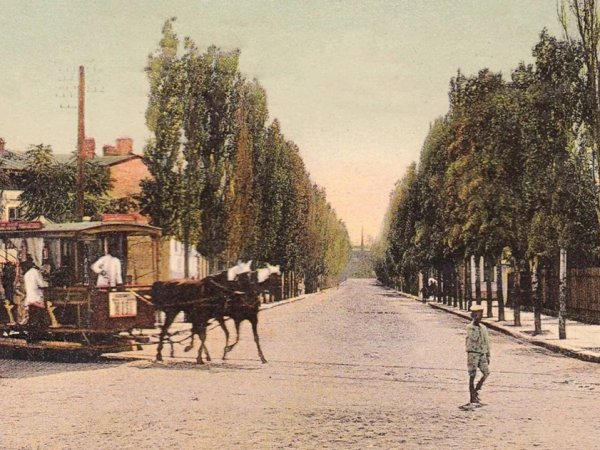
Although the name of “boulevard” can suggest a wide, monumental artery, with many lanes and generously unfolded traffic, the reality at Mărășești is different. We are dealing with an old street, which managed to escape partially from the brutal transformations of the communist era and which largely kept its traditional form. It has one lane on each direction of traffic, and in the middle there are tram rails. This configuration brings it closer rather to the structure of old Bucharest than to the model of the wide arteries designed in the second half of the 20th century.
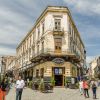
This particularity gives it a special charm. Mărășești Boulevard does not impress through monumentality, but through continuity. It preserves, at least fragmentarily, the “fiber” of the Bucharest of old times. The old houses that still border it today, despite all the urban mutilations, are signs of a city that no longer exists except in portions. They recall an urban landscape made up of villas, harmoniously built fronts and streets that had not yet been subjected to the logic of massive demolition.
In this sense, the boulevard can be regarded as a living document. On the one hand, its route remained recognizable. On the other hand, the built environment around it changed radically. This tension between permanence and change is one of the keys through which Bucharest can be understood. The city went through the modernization from the end of the 19th century and the beginning of the 20th century, the wars, the interwar transformations, then the trauma of communist systematization. Mărășești Boulevard bears the traces of all these stages.
More than that, the fact that the route was not completely erased makes it all the more valuable for urban memory. There are arteries and entire neighborhoods disappeared without a trace or redrawn so deeply that the old city can no longer be intuited. In the case of this boulevard, there are still material clues that allow the reconstruction of an older image of the Capital. Precisely for this reason, it remains one of the most interesting arteries for those who want to understand how Bucharest transformed itself.
The tram, the buses and the new logics of circulation
One of the important changes in the life of the boulevard was the introduction of tram rails on its route. This happened relatively late, around 1988, in a context of broad urban reorganization. Then Avram Goldfaden Street was abolished and Octavian Goga Boulevard appeared, which begins from the Mărășești Passage area. The intervention did not target only transport itself, but also a new logic of remodeling the urban fabric, specific to the last years of the communist regime.
Before the appearance of the trams, the boulevard was crossed by buses. The ring line 33 circulated on the entire length of the artery, and lines 34 and 38 crossed only a portion of it. This detail says much about the way in which the area functioned in the transport network of Bucharest. The boulevard was already an important link between neighborhoods and key points of the city, even if it did not have the aspect of an urban magistral in the classic sense of the word.
The introduction of the tram changed not only circulation, but also the image of the place. The rails in the middle of the road accentuated the sensation of an old urban corridor, crossed however by modern infrastructure. At the same time, they were the expression of an end-of-era intervention, when the communist authorities were trying to reconfigure the transport flows through cuts, widenings and new connections between boulevards. As in many other cases in Bucharest, modernization came together with the disappearance of some streets and with the profound alteration of some historical areas.
From this perspective, the history of transport on Mărășești Boulevard is closely linked to the history of the city itself. We are not talking only about means of movement, but about the way in which political power shaped space. A bus or a tram are not simple technical presences. They involve routes, stops, abolitions of streets, new circulation axes and, sometimes, the sacrifice of fragments of the old city. At Mărășești, all these processes can be read very clearly.
Demolitions, passages and the loss of an old landscape
If there is an area in which the transformations were particularly harsh, it is the one near the bridge over the Dâmbovița. There numerous works and demolitions were concentrated that radically changed the appearance of the place. The Bucharest that we see today at this point no longer preserves almost anything from the charm of the landscape of old. In place of an area built organically, with houses and villas appreciated for their beauty, new structures appeared, imposed by the monumental and utilitarian logic of the communist era.
An eloquent example is the place on which today stands the Palace of the Chamber of Commerce and Industry. There once existed several multi-storey villas, admired for their appearance. Their disappearance was not a simple replacement of buildings, but a symptom of an urban vision that treated the old city as an obstacle, not as a resource. In many areas of Bucharest, this mentality led to irreparable losses, and the Mărășești area was not bypassed.
Also here was located, approximately, Mărășești Square, demolished in order to make room for the underpass passage. Today, the passage is a well-known element of road infrastructure, at the point where Mărășești Boulevard and Octavian Goga Boulevard meet. From a functional point of view, it solves a traffic need. From a historical and urbanistic point of view, however, it marks the disappearance of a previous urban configuration, with everything that it meant as memory, rhythm and continuity.
Such interventions radically changed the perception of the boulevard. What had once been an artery naturally integrated into a coherent urban fabric became, in places, a succession of ruptures. The passages, the new boulevards and the massive volumes raised in the area introduced a different scale, often foreign to the old character of the place. Even so, precisely the contrast between the remaining fragments and the imposed transformations makes Mărășești Boulevard so relevant for understanding the recent history of Bucharest.
Mărășești, the First World War and the idea of Greater Romania
The current name of the boulevard gains its true depth when it is placed in relation to the First World War and to the process of unification of Greater Romania. Mărășești is not only a toponym taken over arbitrarily, but a symbol of Romanian resistance in a crucial moment. In collective memory, the Battle of Mărășești was associated with the determination not to give in and with the sacrifice that made possible the survival of the Romanian state in a dramatic conjuncture.
This military resistance had a significance that exceeded strictly the strategic level. It became a moral and identity landmark. In the years that followed, Mărășești was naturally linked to the idea of victory through resistance and to the road that led, in the end, to the achievement of Greater Romania. Thus, when an important artery of the Capital receives such a name, the gesture has the value of public consecration. The city itself takes over into its structure a defining moment of national history.
At the same time, this name completes very well the old name of the boulevard. If Independence spoke about independence, Mărășești speaks about the defense and consolidation of the nation in a new historical context. The two moments do not exclude each other, but continue each other. They describe two decisive steps in the road of modern Romania: the conquest of sovereignty and the fulfillment of the national ideal. That is why Mărășești Boulevard can also be read as a symbolic bridge between two great chapters of Romanian history.
For Bucharest, such boulevard names were never simple administrative conventions. They functioned as landmarks of public memory. In the absence of this symbolic layer, the city would be only a succession of coordinates. With it, however, the Capital also becomes a map of national history. Mărășești Boulevard illustrates perfectly this idea: an old road, affected by demolitions and modernizations, but which continues to carry in its name the echo of an essential moment for Romania’s destiny.
A boulevard that preserves the memory of the city
Today, Mărășești Boulevard may seem, at first glance, only an intensely circulated artery, caught between very different areas of the Capital. And yet, for whoever looks at it carefully, it tells a much broader story. It tells the story of an old Bucharest, which had other rhythms, other fronts of houses and other urban landmarks.
It tells the story of a capital that inscribed in its streets the great historical moments. And it tells, perhaps most clearly, the story of a city that lost enormously in the 20th century, but which still preserves, in certain places, fragments of its profound identity.
The fact that this artery survived, at least partially, the massive demolitions makes it all the more important. It no longer has today the unitary image of old, but precisely this fragmentary composition increases its evocative force. Mărășești Boulevard is a place in which memory can be seen in layers: historical names, old routes, remaining houses, new infrastructure and scars of communist systematization.
Ultimately, its value does not lie only in what it is now, but also in what it helps us understand about Bucharest and about Romania. Its name speaks about heroism and about the road toward the unification of the country. Its route speaks about an old city, often transformed brutally. And its current landscape speaks about survival, about continuity and about the need to read the city not only through what it displays on the surface, but also through what it lost.
That is why Mărășești Boulevard remains one of those places that deserve to be looked at not only as points on the map, but as pages of urban and national history. It is a boulevard that bore the name of independence and bears today the name of a great battle from the First World War. Between these two landmarks stretches, in fact, the whole story of a Romania that was built through sacrifice, memory and the desire for unity.
We also recommend: Famous boulevard names: Dimitrie Cantemir, illustrious scholar, bohemian intellectual, voivode of Moldavia