How Hanul Zlătari Disappeared from the Capital, the Favorite Residence of Bucharest Bankers, After More Than a Century Since Its Construction
- Articles
- 18 MAY 26
In old Bucharest, inns represented much more than simple stopping places for merchants and travelers. They were true urban nuclei, spaces where business deals were concluded, the latest political news was discussed, and relationships were formed that influenced the economic life of the city. Around them developed shops, workshops, and small communities that set the rhythm of the capital. In these crowded courtyards, among barrels, bales of goods, and horses tied at the entrance, Bucharest was building its identity as a commercial city.
Inns that are no longer in Bucharest
A suggestive example is Hanul Gabroveni, where merchants from Moldova and Oltenia, craftsmen, and people interested in commerce, literature, or politics would arrive. Such places functioned as genuine social centers. Even today, in some inner courtyards in the Old Town, one can observe massive wooden doors, walls bearing traces of inscriptions, and old staircases that preserve the echo of an intense life.
Among all the inns that marked the history of Bucharest, few had a reputation as solid as Hanul Zlătari. Built within the grounds of the monastery of the same name and frequented by wealthy merchants, money changers, and bankers, this complex was for more than a century one of the most prosperous commercial centers of the city. Its disappearance, in 1903, meant the loss of an architectural and economic landmark that contributed decisively to the development of the capital.
From the Goldsmiths' Neighborhood to an Inn of Great Prestige
The story of Hanul Zlătari begins in the Bălăceanului neighborhood, in an area inhabited by master goldsmiths and silversmiths, known as "zlătari." The name of the religious and commercial complex that would develop on today's Calea Victoriei also comes from this guild.
Around a church built in the 17th and 18th centuries, Mănăstirea Zlătari was organized, and part of its land and buildings were transformed into an inn. The purpose was clear: the income obtained from rents and trade was intended to support the activity of the monastic establishment.
This practice was common at the time. Numerous monasteries in Wallachia managed inns and shops to ensure the resources necessary for their maintenance. In the case of Zlătari, the model proved extremely efficient, and the inn quickly became one of the most profitable in Bucharest.
A Place Where Merchants, Money Changers, and Bankers Met
Hanul Zlătari was not intended for ordinary travelers. Its clientele consisted mainly of affluent people: important merchants, master goldsmiths, and money changers, that is, currency exchangers and the precursors of modern bankers.
In an era when financial activities were essential to commerce, the inn became a meeting point for those who managed capital and granted loans. Precisely for this reason, the building earned its reputation as the favorite residence of Bucharest bankers until the beginning of the 19th century.
Within its rooms, transactions were discussed, foreign currencies were exchanged, and important business deals were negotiated. The atmosphere was an exclusive one, dominated by discretion and by an interest in profit, which transformed the inn into a landmark of the capital's economic life.
Shops and Diverse Trade in the Heart of the City
Beyond its accommodation function, Hanul Zlătari was also a vast commercial center. On the ground floor and along the courtyard operated numerous shops in which products of the most varied kinds were sold, from precious metals and jewelry to textiles, spices, and household items.
According to historical testimonies, the complex had grown to include nearly 200 rooms and commercial spaces. This turned it into a true city in miniature, where activity never ceased.
Merchants benefited from security, an excellent location, and proximity to Bucharest's most important commercial arteries. Thus, the inn became a point of reference for the economic exchanges that animated the capital.
When Faith and Business Came into Conflict
The financial success of Hanul Zlătari did not, however, eliminate the tensions between monastic life and commercial activities. At the time, it was said that "crosses and prayer beads could not coexist alongside the Devil's eye," an expression referring to money and the temptations of the material world.
This formulation perfectly captures the contrast between the spiritual tranquility of the monastery and the permanent bustle of the inn. While religious services were being held in the church, prices were being negotiated and interest rates were being calculated in the courtyard.
Nevertheless, it was precisely this combination that ensured the prosperity of the establishment. The revenues obtained from trade supported the maintenance of the church and transformed the Zlătari complex into one of the wealthiest in Bucharest.
The Inn That Survived Earthquakes and Fires
Like many old buildings in the capital, Hanul Zlătari was affected by the major earthquakes of 1802 and 1838. The subsequent reconstruction was carried out according to the plans of Xavier Villacrosse, under the guidance of Abbot Calistrat Livis.
The works modernized the entire complex and strengthened the inn's status as a first-rank commercial center. In the following decades, the building preserved its prestige, and its upper floor even housed public institutions, including the Ministry of Public Instruction, in the second half of the 19th century.
These multiple uses show how important the complex was for the administrative and economic life of Bucharest.
1903, the Year When Bucharest Sacrificed a Monument
At the beginning of the 20th century, the capital was undergoing an extensive modernization process. The authorities sought to widen Podul Mogoșoaiei, later renamed Calea Victoriei, in order to adapt the city to new traffic requirements and urban representation.
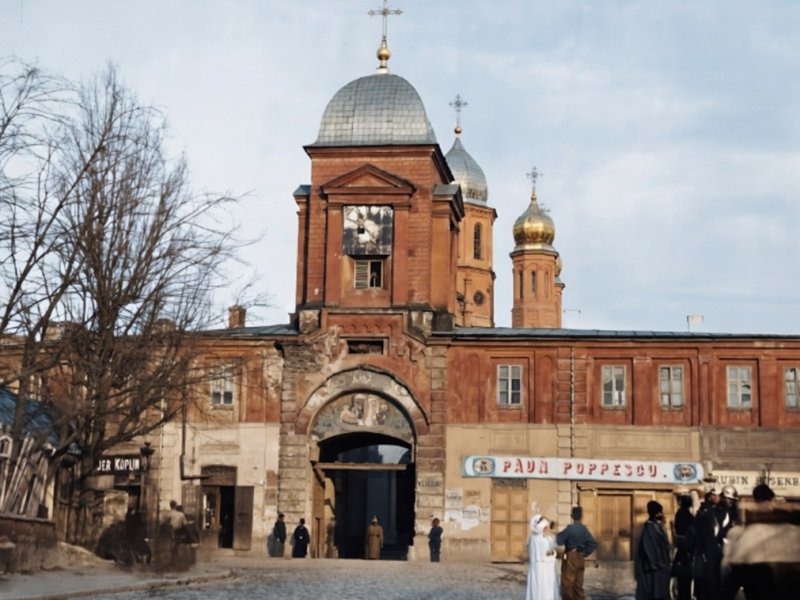
In this context, Hanul Zlătari was considered an obstacle. In 1903, after more than a century of existence in its established form and after a history dating back to the 18th century, the building was demolished, together with the bell tower at the entrance to the complex.
The decision was irreversible. In place of the lively courtyards and shops that had hosted generations of merchants, the city gained space for a modern boulevard, but lost one of the most representative constructions of commercial Bucharest.
What Remained After the Disappearance of the Inn
Today, the only direct witness to this past is Biserica Zlătari, which continues to dominate the area near Muzeul Național de Istorie a României and Palatul CEC.
Although the inn disappeared completely, period photographs and historical documents make it possible to reconstruct the atmosphere of the past. It is known that the complex was an imposing one, with a large courtyard, galleries, guest rooms, and numerous shops.
Its story illustrates the way in which Bucharest modernized, often sacrificing buildings of great historical value in favor of urban development.
A Symbol of the Merchant City
Hanul Zlătari was more than a building. It was an economic center, a preferred residence of money changers and bankers, a place where faith and commerce coexisted for generations.
Built within the grounds of Mănăstirea Zlătari and prosperous thanks to intense trade, the inn contributed to financing religious life and to strengthening Bucharest's reputation as an important commercial center of the region.
The demolition of 1903 erased from the urban landscape one of the capital's most elegant and influential constructions. Nevertheless, its memory continues to live on in documents, photographs, and in the walls of Biserica Zlătari, which preserve the echo of an era in which merchants, goldsmiths, and bankers helped shape modern Bucharest.
We also recommend: The story of “The inn without a name”, the temple of lost souls. Here the poor and the unlucky sought refuge