10 stories from Bucharest you can tell children on a walk
By Eddie Țone
- Articles
- 15 MAY 26
Bucharest hides beneath its layers of concrete and heavy traffic a number of stories worth telling out loud, especially when you are walking through the city with children and they ask you why “that” building looks strange or what the deal is with the name of the street you are on. Because, yes, kids notice things we have learned to elegantly ignore in our daily rush toward the metro.
And when you start asking questions about the Bucharest of old, you realize that this city was far more colorful than it seems today: with inns full of Oriental merchants, streams running through the middle of streets, and old trams that took people out for a ride in the park. So, let’s grab our coats and set off for a walk with the little ones through the Old Town and the surrounding neighborhoods that still preserve memories from the days when Bucharest truly deserved the nickname Little Paris. Here are 10 true stories you can tell children during a walk through Bucharest:
1. Manuc’s Inn and the story of a very clever Armenian
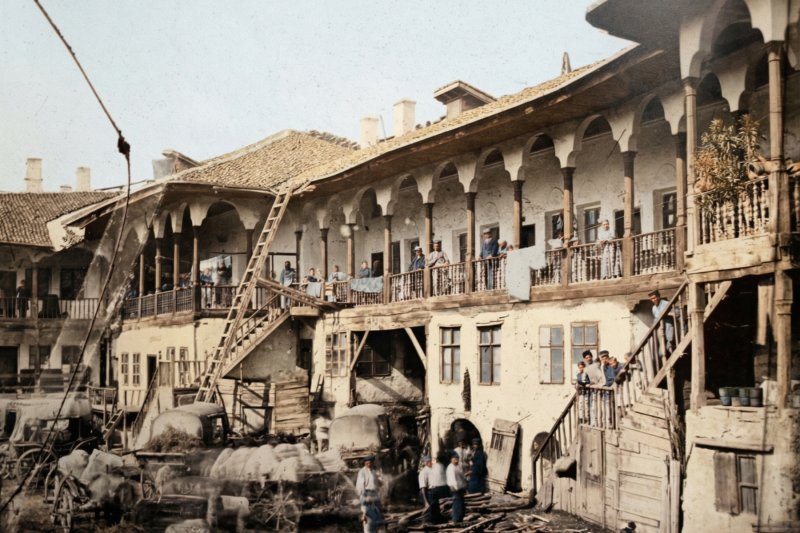
Manuc's Inn, at 1860
Right in the Old Town, just a few steps from the Dâmbovița, stands a massive inn with wooden balconies and an inner courtyard that seems pulled from a film about the Orient. Manuc’s Inn was built in 1808 by an Armenian merchant whose full name was Manuc Bei Mirzaian, a man extremely skilled in business and quite well regarded at the princely court. Armenians had come to the Romanian principalities centuries earlier, bringing with them commercial skill and an impressive network of contacts stretching from Constantinople to Russia.
Manuc Bei was the sort of figure you could have met simultaneously in Bucharest, in Ruschuk — today Ruse, in Bulgaria — and in Constantinople, precisely when you needed him somewhere else. His inn was a serious investment: it had over 100 rooms, rich wine cellars, warehouses for goods, and shops on the ground floor. Merchants from every corner of Eastern Europe stopped here with caravans full of silks, spices, furs, and all sorts of exotic goods. Children can imagine the courtyard full of Armenian, Greek, Jewish, Romanian, and Turkish craftsmen — a miniature Babylon where about ten languages were spoken at once and deals were negotiated over Turkish coffee.
But the strongest story linked to the inn comes from 1812, when the Treaty of Bucharest was signed here, bringing an end to the Russo-Turkish War. Imagine the scene: in the middle of an inn with shops and merchants, ambassadors in glittering uniforms and tense boyars negotiate the fate of Bessarabia.
Manuc Bei, generous as he was when important clients were involved, made the halls of the inn available and mediated the discussions. Peace was signed, Bessarabia passed to Russia, and the inn earned its place in the history books. Manuc himself would die that very year, on his way to Constantinople, leaving behind one of the most beautiful buildings in the Bucharest of that time.
2. Curtea Veche, the place where Vlad the Impaler himself had his palace
When children hear about Vlad the Impaler, the first thing they might think of is Bran Castle, with its mythical vampires. But Vlad’s real palace — at least one of them — was right in Bucharest, at Curtea Veche. The ruins we see today on Strada Franceză, unfortunately caught in an eternal renovation, represent what remains of the princely residence built in the 15th century. Vlad the Impaler established the princely court here sometime around 1459, turning Bucharest from a small commercial town into a political capital.
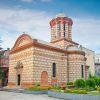
The palace had thick walls, defensive towers, and an inner courtyard where important ceremonies took place. Here Vlad received foreign envoys, here he judged his treacherous boyars, and, if we believe the chronicles, some of them also became acquainted with the famous stakes in the nearby courtyards. The Old Court Church, which still stands today beside the ruins, was built a little later, during the reign of Mircea Ciobanul, in 1559. It is a building with impressive interior paintings and a special charm that comes from the fact that it survived earthquakes, fires, and communist demolitions.
Children should know that Bucharest became a capital precisely because rulers established their court here. Before Vlad, the city was a market town where merchants gathered to trade on the banks of the Dâmbovița. After Vlad built the palace, things changed. Curtea Veche remained the princely residence until the 18th century, when Alexandru Ipsilanti shifted the center of gravity toward Curtea Nouă, on Dealul Spirii, the area where the Palace of Parliament stands today. But the remains of this place remind us that Bucharest was, before anything else, a city of political power, court intrigue, and struggles for the throne.
3. Cișmigiu Garden and the lake that used to be a swamp
Cișmigiu is the park where Bucharest residents come to forget they live in a crowded city. But before the German architect Carl Meyer transformed the area into a public garden in 1847, this was a muddy pond surrounded by orchards and vegetable gardens. The name comes from the cișmigii — the Turkish craftsmen who maintained the city’s cișmele, or public fountains. One of them had an estate right here, on the edge of the pond, so the name was passed on to the place.
The transformation of Cișmigiu into a public park was a matter of prestige for Bucharest, which wanted to resemble the great European capitals. Meyer, a landscape gardener with experience in Vienna, designed the winding alleys, planted hundreds of species of trees, and turned the pond into a romantic lake with rowing boats. In 1883, the garden was expanded by 15,000 square meters and improved, with species of swans and pelicans brought in.
Children love the story of the boats. On Cișmigiu Lake, Bucharest residents have been boating for about 150 years. In winter, when the lake freezes, the skating rink appears, a tradition that continues today. During the Belle Époque, ladies came here in their airy crinolines, gentlemen wore top hats, and at the music kiosk the military band played. The atmosphere was so refined that nobody would have believed that a few decades earlier there had been ponds and frogs there. And one more thing: at the entrance to Cișmigiu from the City Hall side, Romania’s oldest newspaper kiosk still stands.
4. The Royal Palace and the king who wanted order
The Royal Palace, today the main headquarters of the National Museum of Art of Romania, dominates Revolution Square with the solemn air of a former state residence. The current building is the result of a longer history, beginning with the old Golescu house, gradually transformed into a princely and then royal palace. During the reign of Carol I, the palace was expanded according to plans by the French architect Paul Gottereau and the architect Karel Liman, but the monumental form we see today largely belongs to the interwar reconstruction launched after the devastating fire of December 1926.
After the fire, King Ferdinand and Queen Marie asked for the palace to be adapted to the new needs of the Romanian Crown: larger reception halls, official spaces better suited to a state that had become much larger after 1918, and apartments for important guests. Works began in 1927 and went through several stages, under the direction of architects such as Karel Liman, Nicolae Nenciulescu, and Arthur Lorenz. Under Carol II, the palace acquired its modern, severe, and sumptuous image, suited to the political and representative ambitions of the era.
Before this monumental palace, the royal family had used an older residence developed on the same site from the former house of Dinicu Golescu. Carol I, Romania’s first king, preferred a more sober rigor, and his palace had rather the air of an official residence developed over time than that of a grand spectacular setting. Carol II pushed the ensemble toward a much more monumental expression, with neoclassical façades, a courtyard of honor, and halls designed for ceremonies, receptions, and political representation.
Children can learn here that Romania’s kings used this palace for ceremonies, receptions, official meetings, and important moments in state life. After the Second World War and the forced abdication of King Michael in 1947, the building’s destiny changed radically. In 1948, the palace was transferred to the administration of the Ministry of Arts and Information, for the organization of a national art museum. That is how a place built for monarchical power became one of the most important homes of art in Romania.
5. Old trams and the “iron” sound of Bucharest
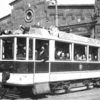
Bucharest entered the age of the horse-drawn tram in 1871–1872, after the City Hall authorized a private company with English and Belgian capital to install iron tracks on the city’s streets. The first routes effectively began operating in 1872 and connected areas such as Bariera Mogoșoaiei, Calea Moșilor, Calea Călărașilor, and Calea Văcărești. For today’s children, the idea of a tram pulled by horses may seem like a strange combination of cart and modern transport, but in 19th-century Bucharest it was a clear sign that the city was trying to keep up with the great European capitals.
The horse-drawn trams were yellow, and the drivers wore uniforms and red caps. They moved slowly, creaked on the rails, and had the slightly comic charm of technological beginnings: modern enough to seem spectacular, slow enough for passengers without tickets to jump off while moving when the inspector appeared. STB even recalls that some passengers took advantage of the low speed of the trams and quickly got off when inspectors boarded.
On December 9, 1894, Bucharest made the leap toward electricity. The first electric tram ran on line 14, between Cotroceni and Obor. It was green, had 8 motor carriages and 8 trailers, and the press of the time described it as “a moving machine, without horses and without fire.” For a city used to hackney carriages, coaches, and trams pulled by animals, the appearance of a vehicle that moved through the power of electricity must have seemed like a small technical miracle, with rails, wires, and a great deal of public curiosity.
Horse-drawn trams nevertheless continued to run for a long time. The last of them disappeared only in 1929, a sign that Bucharest’s modernization did not happen overnight, but through a fairly long coexistence between old and new. In the interwar period, the public transport network developed strongly, and in 1936 the transport company obtained exclusivity over tram and bus transport in Bucharest and in 12 suburban communes.
Today, the history of Bucharest public transport can be discovered at the Museum of the Bucharest Transport Company, where there are photographs, documents, models, tickets, passes, and objects related to the old means of transport, a place children might find fascinating. Among the models that remained in the city’s memory is the V3A, the double-articulated tram introduced into service in 1971, manufactured in the Central ITB Workshops and becoming one of Bucharest’s familiar silhouettes over the last decades.
6. Vanished streams and the city’s secret rivers
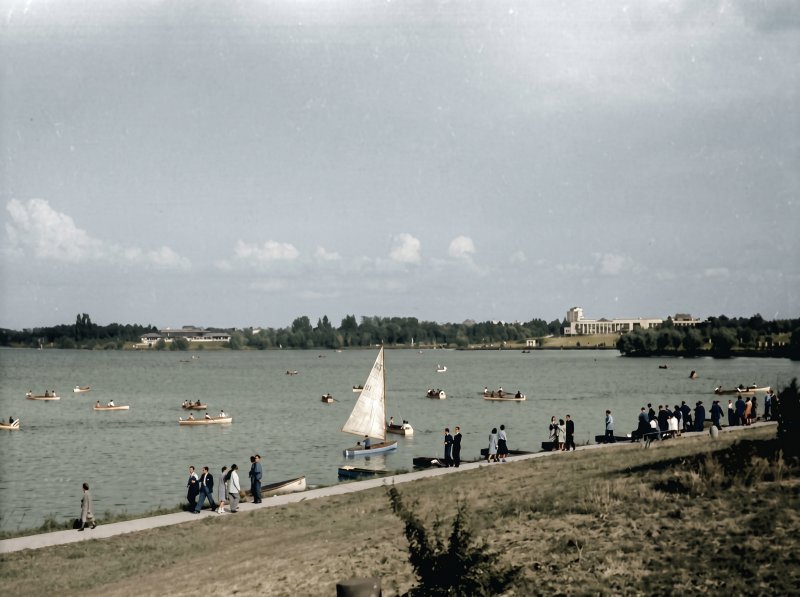
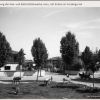
Herăstrău Lake, in 1942.
Bucharest developed on the banks of the Dâmbovița, but its urban history was also influenced by many other waters: the Colentina River, ponds, fishponds, marshes, old branches, and small watercourses that have disappeared today from the visible landscape. Some were regulated, others were transformed into lakes, and marshy areas were drained as the city expanded. For children, the idea is fascinating: beneath the Bucharest of asphalt, boulevards, and apartment blocks there are still traces of a city that was far wetter, muddier, and harder to cross.
Colentina is the most important example. It is not a stream, but a river, and in Bucharest we see it today mainly through the chain of lakes in the north of the city. Starting in the 1930s, the marshy areas along the course of the Colentina were drained and gradually developed into lakes such as Băneasa, Herăstrău, Floreasca, and Tei. Later, the system expanded and was completed with other lakes, forming one of the Capital’s largest urban water structures.
Herăstrău Lake, for instance, is an artificial lake developed on the Colentina River, between Lake Băneasa and Lake Floreasca. The area was drained between 1930 and 1935, at a time when Bucharest was trying to transform the marshes on the city’s edge into spaces for leisure, promenades, and water control. Where there had previously been marshes, heavy summer smells, and land difficult to use, mirrors of water, parks, and landscaped banks appeared.
Văcărești has a different story. The current natural park did not appear from a stream feeding an old delta, but on the site of a large communist hydrotechnical project: the Văcărești Lake Reservoir. The works were abandoned after 1989, and the lake basin, left neglected, was gradually reclaimed by nature. That is how the reeds, ponds, birds, amphibians, and wild vegetation appeared. Today, Văcărești Natural Park is one of the most spectacular areas of urban nature in Europe and a rare example of a place where an unfinished project was transformed, through nature’s patience, into a living ecosystem. A place children absolutely must see.
7. Boyar houses and how the rich lived in the old days
Pre-communist Bucharest preserved numerous aristocratic residences, boyar houses, urban palaces, and elegant villas, especially in central areas and along the great historic avenues. Some had gardens, monumental gates, reception salons, and carefully crafted façades; others preserved the air of a world in which social status could be seen in the size of the hall, in the grand staircase, and in the way the house sat along the street.
Many old buildings disappeared during the communist period, especially in the 1980s, when the systematization of the Capital and the construction of the Civic Center led to the demolition of entire areas of historic Bucharest, including homes, churches, institutions, and houses of architectural value. Some of these buildings survived and can still be seen today, with changed functions: museums, institutional headquarters, restaurants, casinos, or cultural spaces.
Casa Filipescu-Cesianu, at 151 Calea Victoriei, close to Piața Victoriei, is one of the few Belle Époque aristocratic residences preserved in Bucharest. Its current form dates from 1892, when an older building, dated to the period 1846–1850, was remodeled. The house is connected to the Filipescu and Cesianu families and evokes the world of Bucharest’s 19th-century elite, at a time when the architecture and lifestyle of wealthy families were increasingly influenced by Western models. Today, the building houses the Museum of Ages, an exhibition of the Bucharest Municipality Museum about everyday urban life from the 18th century to the present.
Casa Vernescu, located at 133 Calea Victoriei, is another important example of a former elite urban residence. The history of the house goes back to the beginning of the 19th century, with an initial stage connected to Filip Lenș, but the form in which it is known today is linked to the late 19th-century renovation associated with Gheorghe Vernescu, an influential lawyer and politician, and with the architect Ion Mincu. Over time, the house underwent important transformations and became one of the elegant buildings on Calea Victoriei, one of the streets where modern Bucharest displayed most visibly its ambition to be a European city.
In such houses, children can easily understand the difference between the life of the elite and the life of most of the city’s inhabitants. In the residences of wealthy families there could be salons, libraries, Western furniture, gardens, and spaces for receptions, while in many mahalas everyday life was more often marked by dusty or muddy roads, hygiene problems, crowding, and fewer resources. It is precisely this difference that makes boyar houses so interesting: they show a Bucharest that dreamed of European refinement, but which had, only a few streets away, a much harsher reality.
8. The story of Casa Capșa and the famous Joffre cake
Casa Capșa, the historic building at 36 Calea Victoriei, is one of the symbolic institutions of modern Bucharest, connected to the history of confectionery, the literary café, the restaurant, and the luxury hotel. The story begins in 1852, when Anton and Vasile Capșa, two of Constantin Capșa’s 12 children, opened on Podul Mogoșoaiei the confectionery called “La doi frați, Anton și Vasile Capșa” — “At the Two Brothers, Anton and Vasile Capșa.” The first establishment was located in Hanul Damari, opposite Zlătari Church. Later, once Grigore Capșa, trained in Paris, entered the scene decisively, the name Capșa came to mean refinement, French-inspired confectionery, and urban ambition in a Bucharest that was quickly learning to sit at the table with Europe.
The establishment gradually became a meeting place for the social, political, and cultural elite of the Capital. In 1886, Grigore Capșa opened the restaurant and hotel, and in 1891 he inaugurated the salon that would become the famous Café Capșa. Politicians, journalists, members of high society, foreign personalities, writers, and artists passed through here. Discussions begun in Parliament could continue over coffee, and the literary world found here a space well suited to sharp replies, fine observations, and gossip delivered with talent.
Ion Luca Caragiale, Mihai Eminescu, Tudor Arghezi, George Călinescu, and Camil Petrescu are names associated, to different degrees, with the old culture of Bucharest cafés, of which Capșa became one of the emblems. More certain than stories about fixed tables and daily rituals is the fact that, after the First World War, Capșa was regarded as a café of writers and artists. Here, literature could be discussed with passion, politics naturally mingled with conversation, and irony circulated at the speed of a teaspoon striking the edge of a cup.
The Capșa confectionery was renowned for its confectionery and pastry products, from fondant candies and candied fruits to ice cream, cakes, and delicacies inspired by the great European houses. Vasile Capșa had learned the craft from one of the confectioners of the time, Constantin Lefter, and Grigore Capșa perfected himself in Paris, at the famous Maison Boissier. After returning to the country, Grigore played a decisive role in modernizing Romanian confectionery, bringing to Bucharest techniques, tastes, and specialists trained in the refined atmosphere of Parisian confectioneries.
The most famous cake linked to Capșa remains the Joffre, the chocolate dessert created, according to Casa Capșa tradition, in 1920, in honor of the French marshal Joseph Joffre, the hero of the Marne and one of the important figures of the First World War. The cylindrical shape of the cake is usually explained as a reference to the French military cap, and its name has preserved in the confectionery display case a small piece of sweet diplomacy. For children, the story is easy to remember: at Capșa, a cake could bear the name of a marshal, and chocolate became, for a few minutes, European history served on a plate.
9. University Square and its initial image
Today’s University Square is a crowded urban space, crossed by heavy traffic and marked by buildings from different eras: the University Palace, 19th-century statues, interwar buildings, and architectural interventions from the communist period. Before the Second World War, the area had a noticeably different configuration, although several major landmarks, such as the University Palace and the statues in front of it, have remained to this day, with modifications. Here stood one of Bucharest’s great intellectual and cultural hubs, with the University, theaters, cafés frequented by writers and artists, editorial offices, bookshops, and elegant stores.
The University of Bucharest was founded in 1864, during the reign of Alexandru Ioan Cuza, through the decree signed on July 4/16. The main building, the University Palace, with its neoclassical façade facing Regina Elisabeta Boulevard, began as the Palace of the National Academy. The initial core was built between 1857 and 1869, according to the plans of the architect Alexandru Orăscu, and the side wings were added later, between 1912 and 1926, according to the plans of Nicolae Ghika-Budești. The bombings of 1944 severely affected the University Palace, destroying the pediment with the eagle and griffins and important parts of the old body, later rebuilt in stages, including during the communist period.
The statue of Michael the Brave in front of the University is one of Bucharest’s oldest and most important public monuments. Created by the French sculptor Albert-Ernest Carrier-Belleuse, the work was made in 1872 and inaugurated on November 8, 1874. Its presence brings into the square the memory of one of the great historical symbols of the idea of national unity, in a place that would, over time, become associated with education, culture, and the public life of the Capital.
Children can learn that University Square was the site of important historical events. In different periods, civic and political demonstrations took place here, and after 1989 the square became one of Romania’s best-known protest spaces. In 1990, after the Revolution, University Square became the central place of the phenomenon known as the Golaniad: the protests held between April 22 and June 15, 1990, for 53 days, which marked Romania’s difficult transition from communism to democracy.
Although the architecture around it has changed, University Square has remained, in the city’s memory, a space associated with debate, contestation, and intense urban life.
10. Cantacuzino Palace and the story of a genius musician
On Calea Victoriei, at number 141, stands one of the most spectacular palaces of early 20th-century Bucharest. Cantacuzino Palace was built between 1901 and 1903 for Gheorghe Grigore Cantacuzino, nicknamed “the Nabob,” former mayor of the Capital, prime minister of Romania, and leader of the Conservative Party. The architect Ion D. Berindey designed a residence in a Beaux-Arts and French eclectic style, with Neo-Baroque, Neo-Rococo, French Neoclassical, and Art Nouveau elements.
The façade draws the eye through the richness of its sculptural decoration, its floral and geometric motifs, and the princely coat of arms of the Cantacuzino family, placed above the entrance.
The interior was designed for splendor, receptions, and social representation. Important artists of the era were brought in to decorate the palace: the murals bear the signatures of G.D. Mirea, Nicolae Vermont, Costin Petrescu, and Arthur Verona, while the sculptures and carved ornaments are the work of Emil Wilhelm Becker. The interior decoration, with tapestries, chandeliers, lamps, and stained glass, also bears the imprint of Maison Krieger in Paris. The reception halls evoke the model of Parisian noble residences, exactly the kind of architecture through which Bucharest’s elites announced, without much modesty, their entry into the club of European refinement.
The official connection with George Enescu was established after the composer’s death. After the death of Gheorghe Grigore Cantacuzino in 1913, the palace passed to his son, Mihail G. Cantacuzino, and to his wife, Maria, known as Maruca, born Rosetti-Tescanu. After Mihail’s death, Maruca remarried George Enescu, and the Enescu couple lived between 1945 and 1946 in the house behind the palace, originally intended for the building’s administration. After Enescu’s death in 1955, Maruca donated the property to the Romanian state, with the purpose of establishing a museum dedicated to the composer. Since June 19, 1956, the “George Enescu” Museum has operated here.
George Enescu was a composer, violinist, pianist, conductor, and pedagogue, considered the most important Romanian musician. He was deeply connected to France, where he studied, taught, performed, and settled after the Second World War, dying in Paris in 1955. At the same time, he remained connected to Romania through music, through the places where he created, and through the way he brought Romanian creation before international audiences. An important part of his work, especially the two Romanian Rhapsodies, makes use of the spirit and melodies of Romanian inspiration in a Western orchestral language. And Oedipe, his great lyrical opera, completed in 1931, remains one of the major works of Enescu’s creation.
Children can learn that Enescu was internationally recognized as a violinist, pedagogue, and musician of rare stature in the 20th century. Yehudi Menuhin, one of the most famous violinists of the last century, was Enescu’s disciple and expressed many times his gratitude toward the master who influenced his career. Enescu taught in Paris and in other major European and American musical centers, performed on important stages in Europe and the United States, and often returned to Romania during his active life. After the war, however, he left the country and settled in Paris.
The permanent exhibition of the “George Enescu” National Museum presents photographs, manuscripts, musical instruments, personal objects, and documents related to the life and activity of the musician. At present, the headquarters in Cantacuzino Palace is closed for restoration and consolidation works, but the story of the place remains one of the strongest encounters between Bucharest aristocracy and the memory of Romanian music. Here, a palace built for social representation came to preserve the memory of an artist who carried Romania’s name onto the great stages of the world.
Bucharest hides fascinating stories in its streets, beneath old buildings, in the name of a park or a small square. When you walk through the city with children and tell them about inns full of Armenian merchants, about rulers who built palaces, about horse-drawn trams, and about streams hidden beneath the asphalt, the city suddenly becomes livelier, more interesting, and richer. Children learn that history happens right here, in the places we see every day, but which we have learned to look at without truly seeing anymore. And perhaps, if we are lucky, they too will start asking questions, noticing strange details, and discovering other stories that we, hurried adults, missed long ago.
You may also like: Top 10 places in Bucharest where kids can learn through play