Devil's Quarter, Flood Street and the Alley of the Swimming Teacher. Bucharest's Vanished Street Names Tell More About the City Than Any Tourist Guide
- Articles
- 12 MAY 26
Bucharest had, throughout its history, a remarkable habit: naming its streets exactly after what they looked like or what happened on them. No euphemisms, no diplomatic urban planning, no nomenclature committees weighing up sensitivities. If houses burned down on an alley, it was called The Fire. If it smelled bad, it was named accordingly. If thieves and criminals lived there, nobody was going to name it after a national hero.
Many of these names vanished under successive layers of renaming — monarchist, communist, post-revolutionary — or disappeared along with the demolitions that erased entire neighbourhoods from the city's map. What remained are the stories, sometimes more alive than the stones themselves.
Ulița Notagiul — where Bucharest learned to swim
Carol Davila Street, known today as one of the quieter arteries near the Military Hospital, carried an entirely different name until 1885: Ulița Notagiul, the Alley of the Swimming Teacher. The explanation is less poetic than it sounds: the area was home to the first swimming school in Bucharest, and notagiul was the old Romanian word for a swimming instructor — someone who taught you not to drown in the Dâmbovița.
When Dr Carol Davila, the founder of Romanian military medicine, died in 1884, the authorities decided the street deserved a worthier name. Ulița Notagiul became Carol Davila Street, and the swimming school disappeared from memory.
Fire Street and Ruins Alley — the memory of a blaze
In 1847, Bucharest burned. The Great Fire, which broke out on 23 March at the house of a noblewoman named Zoița Drugăneasca, consumed over 1,850 buildings — a third of the city's entire built stock, including what the ruling prince himself described as its most populous and prosperous quarter. The fire started in a central neighbourhood and spread at a speed nobody had anticipated, swallowing up French Alley, German Alley, the Saddlers' Lane, the Cuckoo Market and dozens of other streets.
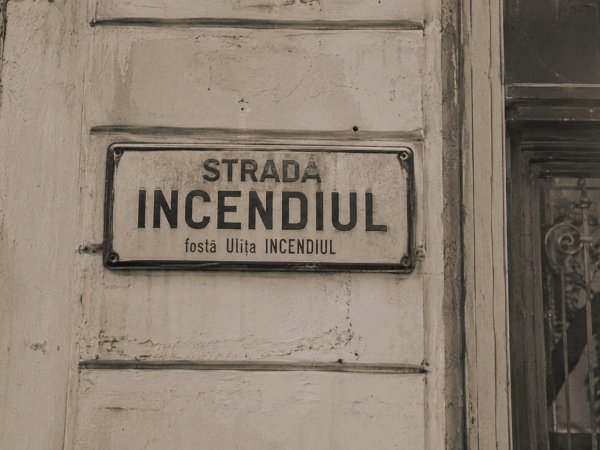
What remained after the fire received, with disarming honesty, the names it deserved. The street now known as Matei Basarab was called Incendiul — The Fire — while nearby there was an Ulița Ruinele, Ruins Alley. Both names pointed directly at what had happened there. A few years later, as the city rebuilt and memories faded, the authorities opted for more reassuring names. Fire Street vanished from the maps, but not from the archives.
The Devil's Quarter — the neighbourhood next to Calea Victoriei that nobody wanted to acknowledge
If a neighbourhood with this name existed in Bucharest today, it would provoke outrage and petitions. In the nineteenth century and early twentieth, it was simply an accurate geographical description.
The Devil's Quarter — Mahalaua Dracului — sat a stone's throw from Calea Victoriei and what is now Piața Victoriei, in the area where Dr Iacob Felix Street meets Banul Manta Street today. It had grown organically over wasteland and orchards, with the construction of the North Railway Station and the development of the surrounding area, quickly becoming a tangle of narrow alleys, dilapidated houses and the kind of people that respectable Bucharest preferred not to see.
The interwar press described it without restraint: narrow, sunken lanes bordered by houses that made you uneasy, with windows patched with scraps of paper in every colour, leprous walls, and a mixture of children, rubbish, dogs, bones, pigs and animal carcasses merging together in clouds of dust.
The quarter was famous for the Yellow Inn, a haven for criminals, and for the brothers known as the Doctoru — two residents who ran a genuine school for thieves, with two specialisations: pickpocketing and bag theft. The painter Ștefan Luchian lived in the quarter between 1907 and 1909 and captured it on canvas — perhaps the only serious visual testimony that survived. The Yellow Inn was demolished in 1985 on Ceaușescu's orders, reportedly because it clashed with the tall apartment blocks being built nearby. The Devil's Quarter survives today only in archives and a handful of paintings.
Adolf Hitler Square — four years of urban shame
The story of the square now named after Charles de Gaulle is a faithful summary of the Romanian twentieth century, told through a single address.
It began as Piața Jianu, became Piața Mihai Eminescu during the interwar period, and during the Second World War — when Romania was allied with Nazi Germany — was renamed Adolf Hitler Square. A public urban tribute to a dictator, expressed in the most visible way possible. After the coup of August 1944, the square quickly reverted to a neutral name, before the communist regime soon offered it yet another eponym: Generalissimus I.V. Stalin, complete with a statue installed at the main entrance to Herăstrău Park. After Stalin's death, the square was briefly called Aviatorilor, and after 1989 it became Piața Charles de Gaulle.
The same place, six names in less than a century. Each change — a collapse of a regime.
The Alley Trodden by Cattle — before refinement arrived
Strada Batiștei, one of the most elegant streets in central Bucharest today, lined with interwar buildings and embassies, carried at its origins a name no estate agent would dare use in a listing: the alley trodden by cattle.
Around 1800, the area was on the city's periphery, with stagnant water, soft ground and a wild, barely passable character. Cattle moved through it and left their mark, literally, in the memory of the place. A few decades later, the Batiștei neighbourhood had already become a landmark of urban refinement, admired by foreign observers. The Frenchman Ulysse de Marsillac noted in 1869 that it was one of the districts that most recalled the cities of the West.
From an alley trodden by cattle to a street comparable with Western Europe — in less than seventy years.
The Hungry Quarter — where poverty became topography
On the site of today's Olimpului Street on Mitropoliei Hill, at the end of the eighteenth century, stretched Mahalaua Flămânda — the Hungry Quarter. The name was not a metaphor: it described directly the economic reality of its inhabitants, most of them poor and destitute people who gathered in this peripheral corner of the city.
And yet the quarter built a community. It raised a church — with donations collected gradually over nearly two decades, completed in 1800 — and created its own social space, organised around the lanes and the small grocery shop at the heart of the neighbourhood. The Hungry Quarter no longer exists in its original form, swallowed by the city's expansion and the demolitions that transformed the hill. What remains is the church, a few nineteenth-century houses and the memory of a place that wore its name with an honesty many might call brutal.
Tirchilești Quarter — the origin of a Bucharest saying
What is now Bulevardul Dacia began as a quarter that in 1802 was called Tirchilești, after a nobleman named Tirchilă who owned the land. The neighbourhood at the edge of the city was considered rough and unmannerly by the rest of Bucharest, which generated an expression that outlasted the quarter by a considerable distance: Parcă ai fi din Tirchilești — "You're acting like you're from Tirchilești" — said of anyone behaving without grace or decorum.
The quarter disappeared, the boulevard replaced it, and the expression remained.
What was lost along with the names
Each renaming was, in its own way, an erasure. Sometimes deliberate — the communist regime systematically eliminated every reference to the monarchy, to Bessarabia, to the West with which no identification was permitted. Sometimes accidental — a fire, a demolition, a modernisation that erased entire neighbourhoods and with them all the strange, vivid, precise names their alleys had carried.
What the old names of Bucharest had in common was that they told the truth. Fire Street told you what it had survived. The Swimming Teacher's Alley announced exactly what you could do there. The Hungry Quarter hid nothing. Bucharest today has 5,340 streets covering 1,820 kilometres, nearly all named after personalities, historical dates or neutral topographies. It has lost the ability to name itself with that same affectionate brutality it once had. Perhaps that is a sign of maturity. Or perhaps it is simply a loss.
Also recommended How Bucharest Streets Got Official Names and Why They Lost Them So Often