Famous Houses in Bucharest: Noblesse Palace, from a landmark of Eclectic architecture in the Belle Époque era to today’s temple of events
- Articles
- 11 MAY 26
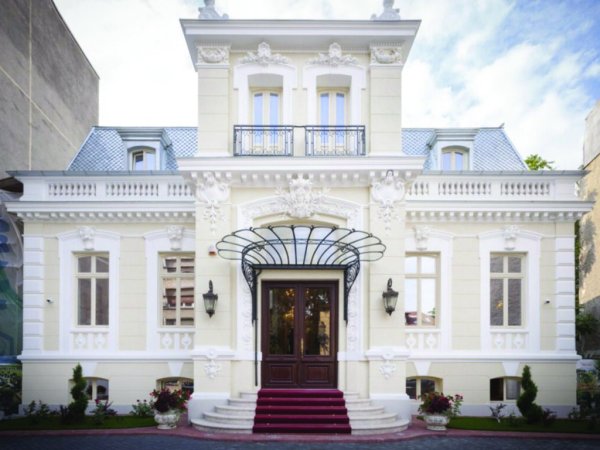
In the heart of Bucharest, where the streets still preserve the echo of an era of refinement and urban ambition, stands one of the most spectacular historical buildings of the Capital: Palatul Noblesse. Built in the 19th century and brought back to life through an extensive contemporary restoration process, the palace is today a remarkable example of architectural heritage reuse. From an aristocratic residence of the Belle Époque era, the building has transformed into a vibrant space dedicated to cultural and high-end social events. Its story is one of continuous transformation: from private residence, to interwar elite salon, then public institution during the communist period, and finally a modern cultural center. Each stage has left traces in the structure and identity of the building, making Noblesse Palace a living witness of Bucharest’s history.
An architectural jewel of the Belle Époque style
Built in 1881, Noblesse Palace is an example of eclectic architecture with strong French influences, characteristic of the Belle Époque period. The building was commissioned by the banker Ioan Pascu, at a time when the Târgul Moșilor area was an important commercial and social hub of the city.
The architectural project was designed by Alexandru Săvulescu, an architect trained at the famous École des Beaux-Arts in Paris. He succeeded in harmoniously combining classical, Renaissance, and Parisian elements, creating an elegant, balanced building representative of the aspirations of Bucharest’s elite at the end of the 19th century.
Through its decorative details, refined proportions, and Western influences, the palace reflects the desire of a society in full modernization, searching for its identity between tradition and European influence.
A residence of elites and a salon of cultural life
In the 20th century, Noblesse Palace became the property of the Berkowitz family, known for its involvement in the financial and cultural life of the Capital. During this period, the building was transformed into a true society salon, frequented by the intellectual elite of the time.
Elegant balls, receptions, and cultural events held here contributed to consolidating the palace’s reputation as a space of refinement and cultural dialogue. The interwar atmosphere brought a new spirit to the building, turning it into a central point of Bucharest’s social life.
In those years, Noblesse Palace was not just a luxurious residence, but a place where ideas, art, and culture met in a sophisticated setting.
The communist period and the loss of architectural identity
With the establishment of the communist regime, the destiny of the palace changed radically. The building was nationalized and converted into an administrative headquarters, later becoming the House of Pioneers and the Children’s Circle of Sector 2.
Although these functions had an educational purpose, they led to significant modifications of the interior space and to the deterioration of original architectural elements. Lack of maintenance and inappropriate interventions severely affected the aesthetic and structural value of the building.
For decades, Noblesse Palace became an example of how historical heritage can be neglected and transformed, losing part of its original identity.
The rebirth of a forgotten monument
The decisive change came in 2012, when Loredana and Silviu Preda, founders of Noblesse Group, decided to save the building and restore its former glory. Restoration began in 2013 and represented a complex project, carried out with attention to detail and deep respect for heritage.
The process involved architects, historians, and specialized craftsmen who worked to faithfully reconstruct the original elements of the palace. Among these are the original German stoves from 1881, the trompe-l’œil painted ceiling, and the solid wood floors, all carefully preserved or restored.
This intervention was not just an aesthetic renovation, but a true reactivation of the memory of the place, restoring its lost identity.
Noblesse Palace today: a cultural and events center
Today, Noblesse Palace has become a multifunctional space dedicated to cultural and corporate events. It hosts conferences, art exhibitions, book launches, workshops, galas, and private parties, all held in an elegant and historic setting.
The building also hosts the headquarters of Noblesse Cultural Association and Noblesse Interiors, strengthening its role as a creative and cultural hub.
The interior spaces are thematically organized, each room having its own identity, while the intimate garden and classical library add extra refinement to the visitor experience. The overall atmosphere blends historical elegance with modern functionality, offering a unique setting for prestigious events.
An example of responsible architectural reuse
Noblesse Palace is not just an event venue, but also an example of best practice in heritage restoration. Its rescue demonstrates how a historical building can be brought back to life through vision, investment, and respect for the past.
In a city in continuous transformation, where many old buildings have been lost, Noblesse Palace stands as a model of cultural responsibility. Its restoration shows that heritage should not only be preserved, but actively integrated into contemporary life.
A living story in the heart of Bucharest
Today, Noblesse Palace is more than an architectural monument. It is a living space that hosts creative communities, cultural events, and social gatherings, continuing its historical tradition as a place of elites and ideas.
Through its elegance, the building manages to harmoniously combine past and present, offering visitors an experience that goes beyond a simple visit to a historic building. It is a journey through time, but also an immersion into contemporary culture.
Thus, Noblesse Palace remains one of the most important historic houses in Bucharest, a symbol of heritage rebirth and proof that architectural beauty can not only be preserved, but also reinvented for future generations.