Famous houses in Bucharest: The Algiu - Toma Stelian House, from the residence where Cuza was allegedly living, to the house renovated by Nicu Ceaușescu and the headquarters of GDS
- Articles
- 07 MAY 26
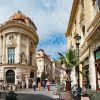
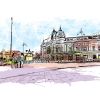
On one of the most elegant and history-filled arteries of the Capital, Calea Victoriei, there is a building that continues to attract the eyes of passersby through its architectural refinement and through the stories surrounding it. The Algiu - Toma Stelian House, located at number 120, represents one of the emblematic constructions of old Bucharest, an edifice that has gone through more than a century and a half of political, social and cultural transformations.Throughout time, the building was associated with important personalities, urban legends and significant moments from the history of the city. From the alleged presence of ruler Alexandru Ioan Cuza, to the renovation ordered by Nicu Ceaușescu and its transformation into the headquarters of the Group for Social Dialogue, the building preserved its status as an architectural and cultural landmark of Bucharest. Today, the Algiu - Toma Stelian House is not only a historical monument, but also a living space, where jazz concerts, cultural debates and artistic events take place, thus continuing the intellectual and social tradition of the place.
An elegant building that appeared in 19th century Bucharest
The Algiu - Toma Stelian House was erected before the year 1850, during a period in which Bucharest was beginning to adopt Western architectural styles and to define its modern urban identity. At that time, the Calea Victoriei area was becoming one of the most important arteries of the city, the place where influential families built elegant residences and impressive palaces.
The form in which the building can be admired today dates from 1875, when the edifice was rebuilt according to the plans of the French architect Paul Gottereau. He was already known for his important contributions to the development of Bucharest architecture and would later design other representative constructions of the Capital.
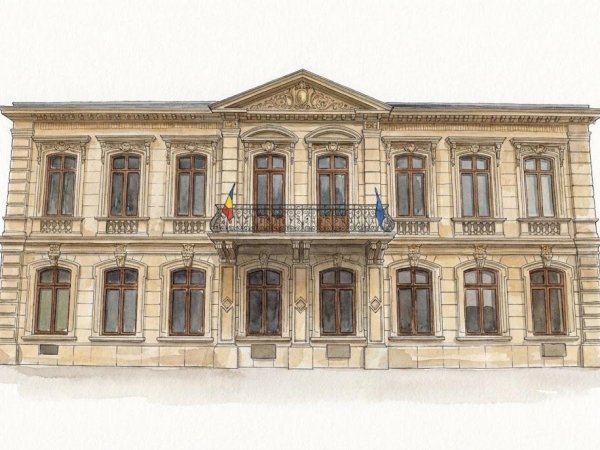
The house was built for Mihai Algiu, and the chosen style was eclectic, with an obvious neoclassical dominance. The main façade, oriented toward Calea Victoriei, impresses through symmetry, elegance and decorative balance. Specialists consider that the edifice clearly bears the mark of Paul Gottereau’s style, there being visible similarities with other constructions designed by him, including the old CEC building.
The administrative director of the Group for Social Dialogue, Tiberiu Czink, explained that the first mentions of the house appear between 1846 and 1852, when the construction was described as a rectangular building located near the Băbeanu Inn. At that moment, the building was not considered one of major importance, but the transformations from 1875 gave it the prestige and appearance that would make it famous.
The neoclassical architecture and the details that resisted time
Even today, in an area where buildings erected in different eras and styles meet, the Algiu - Toma Stelian House manages to stand out. The main façade preserves the original elements conceived by Paul Gottereau and offers an elegant image, typical for aristocratic residences from the second half of the 19th century.
One of the most interesting decorative details is the medallion placed above the façade, in which the letter “A” can be seen, a direct reference to the name of the first owner, Mihai Algiu. Also, the wrought iron balcony completes the refined aspect of the building.
The windows are arranged symmetrically relative to the balcony and are framed by decorative stucco frames. The levels of the construction are separated through a richly ornamented belt course, and the upper part is marked by a strongly emphasized cornice, specific to neoclassical architecture.
The interior also preserves valuable elements. Some rooms still have rich stucco works and spectacular ornaments on the ceilings, made from plaster painted so as to imitate wood. These decorative details offer an image of the refinement and luxury specific to the homes of the Bucharest elite from that period.
The ensemble is made up of two building bodies and a generous courtyard. The main building, oriented toward Calea Victoriei, has five rooms on the ground floor and five on the upper floor. In the secondary part, visible from the courtyard, the servants once lived. This area was modified and extended following the renovations from the 20th century, administrative spaces and offices being added.
Toma Stelian and the transformation of the house into a symbol of the Bucharest elite
In 1895, the house was bought by Toma Stelian, one of the remarkable personalities of Romanian political and cultural life from the end of the 19th century and the beginning of the 20th century.
Toma Stelian lived here until 1914, when he moved into the impressive palace built for him by architect Ion D. Berindei on Kiseleff Road. During the period in which it belonged to Toma Stelian, the house on Calea Victoriei became a space associated with the intellectual and political elite of Bucharest.
The personality of Toma Stelian contributed to consolidating the public image of the building, and his name permanently joined that of the Algiu family. Since then, the building has been known as the Algiu - Toma Stelian House.
The historical and architectural importance of the edifice is also officially recognized. The building appears on the list of historical monuments in Bucharest, having the code B-II-m-B-19865 in the records of the Ministry of Culture.
The legend of Alexandru Ioan Cuza and the romantic stories of the house
Few historical buildings in Bucharest managed to gather around them as many stories and urban legends as the Algiu - Toma Stelian House. The most well-known of these claims that ruler Alexandru Ioan Cuza lived here for a period.
The legend goes even further, stating that Maria Obrenovici, one of the most controversial female figures of the era and the woman said to have been Cuza’s lover, also came to this house.
However, specialists state that there are no documents confirming this information. Moreover, there is also an obvious chronological problem. The current form of the house dates from 1875, while Alexandru Ioan Cuza was forced to abdicate in 1866 and left Romania.
Tiberiu Czink considers that the entire story should rather be viewed as an urban legend, probably born from the fascination of Bucharest inhabitants for historical characters and for the old houses of the city. Even in the absence of clear evidence, these stories contributed to the mysterious aura of the building and transformed it into a point of interest for history enthusiasts.
The renovation ordered by Nicu Ceaușescu
An important chapter in the recent history of the house took place in 1977, when the building went through an extensive renovation and consolidation process, carried out by order of Nicu Ceaușescu.
According to the information provided by the representatives of the Group for Social Dialogue, Nicu Ceaușescu intended to transform the building into a UNESCO youth center. For this reason, the building benefited from serious reconditioning works carried out by the “Carpați” Construction Company.
The interventions carried out then aimed at the functional modernization of the space, without affecting the original architectural structure. The building was carefully reconsolidated, preserving the compartmentalization and the essential decorative elements.
These works had an important role in preserving the edifice, especially since the building does not currently appear on the list of buildings with seismic risk. The thick walls and solid structure contributed to the resistance of the construction throughout the decades.
The renovation from the communist period allowed the saving of an important monument of the Capital during a period in which many historical buildings were demolished or seriously affected by inappropriate architectural interventions.
The headquarters of the Group for Social Dialogue and an important cultural space
After 1990, the Algiu - Toma Stelian House entered a new stage of its existence, becoming the headquarters of the Group for Social Dialogue, one of the most important civic and intellectual organizations in post-communist Romania.
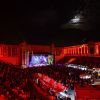
At the same time, the building and its generous courtyard began to host numerous cultural events. The inner garden, with an area of approximately 500 square meters, is known today as the GDS Summer Garden and represents a space appreciated for concerts, debates and cultural meetings.
The International Jazz Festival is periodically organized here, an event that has already become a tradition for lovers of this musical genre. Concerts, symposiums, ceramic fairs and handmade exhibitions also take place in the courtyard.
The entire ensemble has approximately 1,020 square meters, and the building itself occupies around 520 square meters. The space manages to combine the aristocratic atmosphere of old Bucharest with the dynamics of a contemporary cultural center.
A monument that continues to tell the story of Bucharest
The Algiu - Toma Stelian House remains one of the most interesting historical buildings on Calea Victoriei. Its story brings together elements of architecture, political history, urban legend and contemporary cultural life.
From the elegant residence of a wealthy family from the 19th century, to the house associated with the name of Toma Stelian and up to the headquarters of the Group for Social Dialogue, the building crossed all the great eras of modern Bucharest.
In a city in continuous transformation, the Algiu - Toma Stelian House remains a rare example of heritage well preserved and adapted to the new cultural realities. Beyond the legends about Alexandru Ioan Cuza or the memory of the renovation ordered by Nicu Ceaușescu, the true value of the building lies in its capacity to keep alive the memory of an elegant, cosmopolitan Bucharest deeply connected to its history.
We also recommend: Famous houses in Bucharest: Casa Mița Biciclista, gifted by King Ferdinand I to the most famous courtesan of the last century