Famous Houses in Bucharest: Toma Blându's Villa in Amzei and the Story of the Merchant Who Brought the Horse-Drawn Tram to the Capital
- Articles
- 12 MAY 26
Bucharest is a city that reveals its history at every step. Beyond the crowded boulevards and the fast pace of modern life, the Capital still preserves numerous buildings that tell fascinating stories about the people who contributed to its development. Some of these houses impress through their architecture, others through the destinies of their owners, and some manage to combine both dimensions in a spectacular way. In the Amzei area, at the intersection of Biserica Amzei Street and Mendeleev Street, stands one of the most interesting historic buildings in the city: Toma Blându House. The monument, built around 1890, immediately attracts attention through its architectural details and through the unmistakable presence of the six caryatids that stand guard from the first floor. Behind this construction lies the story of a merchant well known during the Belle Époque, the man who remained in the memory of Bucharest residents as the one who brought the horse-drawn tramcar to the Capital.
A Building That Immediately Captures Your Attention
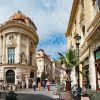
If you set out from Roman Square and walk down Biserica Amzei Street, it is almost impossible not to notice this spectacular house. Its elegant façade and rich ornaments make it stand out even in an area known for its architectural charm.
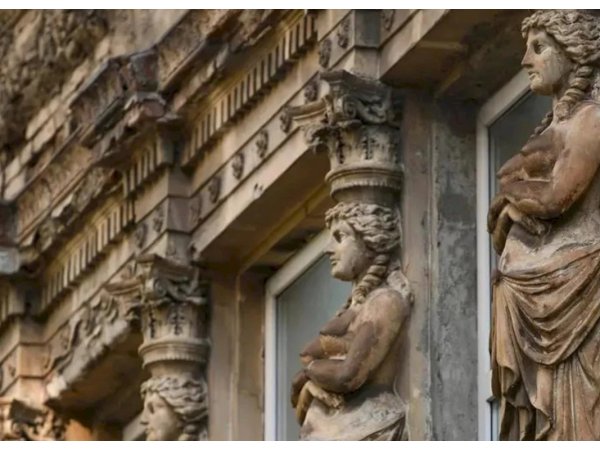
Your gaze is drawn especially to the six caryatids placed on the first floor, next to the windows. These sculpted female figures seem to symbolically support the entire structure and give the building a solemn and refined note. For many passersby, encountering these figures is surprising and transforms a simple walk through the city into a memorable experience.
Toma Blându House is one of those buildings that manage to halt everyday haste for a few moments. In a Bucharest that is constantly changing, the building remains a discreet but extremely valuable landmark of an era of elegance and prosperity.
A Spectacular Blend of Architectural Styles
The building impresses through the way it combines different architectural influences. The façade includes numerous neoclassical accents, such as medallions with faces inspired by Greek Antiquity, pediments, capitals, and columns. All these elements are integrated into a harmonious composition specific to the eclecticism of the late nineteenth century.
What makes the house truly special, however, is the presence of the Ottoman bay window, an architectural element rarely encountered in Bucharest today. The combination of Western ornaments and Eastern influences perfectly reflects the complex identity of the city, located at the crossroads of several cultures.
The Romanian Association for Culture, Education, and Normality (ARCEN) has repeatedly highlighted the uniqueness of this construction. According to the organization, Toma Blându House is one of the few buildings in the Capital that still preserves an authentic bay window, an element that recalls the old Bucharest marketplace.
Who Toma Blându Was
The name of Toma Blându was well known in Bucharest at the end of the nineteenth century and the beginning of the twentieth century. A prosperous merchant and ingenious entrepreneur, he dealt in the sale of broughams, coupés, and carriages, essential means of transport in an era when the city was expanding rapidly.
Blându did not remain in history only as a businessman, but also as an innovator. In his desire to bring modern transport solutions to the Capital, he imported from Belgium several tramcars, luxurious vehicles with benches upholstered in red velvet and drawn by horses.
These means of transport did not run on rails, like classic trams, but directly on the cobblestones. For that era, the tramcars represented a spectacular novelty and a modern alternative for the city's residents.
How Toma Blându's Tramcars Appeared
In 1891, the Prefecture of the Capital and Bucharest City Hall decided to introduce these vehicles on the route between Saint Anton Square, later Saint George Square, and the North Railway Station. The route crossed some of the most important areas of the city: Lipscani, Calea Victoriei, and Calea Griviței.
Although only four of the ten carriages actually belonged to Toma Blându, all of them became known in the collective imagination as "Toma Blându's tramcars." The merchant's name became so strongly identified with this means of transport that the expression remained in use long after their disappearance.
The tramcars operated in Bucharest for thirteen years, becoming a familiar presence for the Capital's residents. For some, they represented the symbol of modernization; for others, a permanent source of noise and discomfort.
A Means of Transport That Entered Bucharest Folklore
The steel wheels of the tramcars produced a shrill sound as they rolled over the cobblestones. For many Bucharest residents, this noise was difficult to endure, and their removal from service was welcomed with satisfaction.
Writer and journalist George Ranetti described the tramcar, in his ironic style, as a "yellow tin ichthyosaur," an image that perfectly captures the massive and somewhat bizarre appearance of these vehicles.
In everyday language, expressions inspired by this means of transport also appeared. "We are going like Toma Blându's tramcar" was said when something was moving very slowly, and "it squeaks like Toma Blându's tramcar" described any noisy mechanism. These expressions remained popular until the interwar period.
The Legacy of Toma Blându
At the time of his death in 1916, Toma Blându was already a well-known figure in Bucharest. A journalist of the time described the old tramcar as a true institution of the city of bygone days, a sign of the impact this initiative had had on urban life.
Although the tramcars disappeared, the merchant's name continued to be associated with the entrepreneurial spirit and the desire to modernize the Capital. His house in Amzei remained the most visible testimony to the success and prestige he enjoyed.
Today, the building represents not only a historic monument, but also a symbol of an era in which Bucharest was rapidly transforming into a European metropolis.
Toma Blându House and the Amzei District 2030 Project
At present, Toma Blându House is part of the Amzei District 2030 perimeter, ARCEN's initiative dedicated to the regeneration of one of the most valuable historic areas of the Capital. The project aims to protect heritage and to bring back to public attention the buildings and stories that define the identity of the city.
The Amzei area is one of the most interesting in Bucharest, bringing together elegant houses, charming streets, and historic monuments that evoke the atmosphere of the Belle Époque. In this context, Toma Blându's villa occupies a special place, being one of the most expressive buildings in the neighborhood.
Through its activity, ARCEN contributes to the rediscovery of these places and to understanding their role in the history of Bucharest.
A Monument That Tells the Story of a Disappeared Bucharest
Toma Blându House is more than a spectacular building. It represents a window into an elegant, cosmopolitan Bucharest full of bold initiatives. Its ornaments, caryatids, and bay window preserve the memory of an era in which architecture and entrepreneurial spirit went hand in hand.
The story of the merchant who brought the horse-drawn tramcars to the Capital completes the charm of this house. Toma Blându was one of those people who contributed discreetly, but decisively, to transforming the city into a modern center.
Today, anyone who passes along Biserica Amzei Street and raises their eyes toward the six caryatids can discover not only a remarkable building, but also an essential part of the history of Bucharest.
We also recommend: Famous Houses in Bucharest: Noblesse Palace, from a landmark of Eclectic architecture in the Belle Époque era to today’s temple of events