12 interesting things you may not have known about Cișmigiu Park
By Eddie Țone
- Articles
- 09 MAY 26
You pass by its wrought-iron fence every day, perhaps even cutting through its alleys on your way to university or the office, yet you probably ignore the fact that beneath your feet lies the former “lake of Dura the Merchant.” In the 18th century, the place where today you try to dodge pigeons was an unhealthy swamp, a malaria hotbed that Bucharesters avoided with perfectly justified caution.
If you have ever wondered why Cișmigiu Park has such a specific melancholy, it is worth knowing that it was born from a radical transformation: from fetid mud to the Viennese elegance we now admire on Instagram. Let’s see how many of these 12 interesting things about Cișmigiu Park you already knew:
1. Cișmigiu is a park born from a swamp
In 1779, Alexandru Ipsilanti decided that Bucharest needed drinking water, not merely historic mud. He ordered the construction of two public fountains, and the chief supervisor of these works bore the title of “Mare Cișmigiu” — Great Cișmigiu. This position, which today would probably sound like a middle-management role in a utilities company, belonged to the boyar Dumitru Siulgi-Basa, essentially the man in charge of Bucharest’s fountains. He built himself a house near the swamp in question, and people began calling the area, quite simply, “la Cișmegiu.” In practice, you are walking through a park named after a former administrator of water networks.
The actual transformation began much later, under the supervision of the Russian general Pavel Kiseleff. He hired the German landscape architect Wilhelm Mayer, former director of the Imperial Gardens in Vienna. Mayer came to Wallachia and looked at Dura’s swamp with the optimism of a man who knows he has the state budget behind him. Together with his assistant, Franz Harer, he designed what was to become the capital’s first true public garden.
It was not easy work, because the land refused to cooperate. The archives of Bucharest City Hall mention that thousands of cartloads of soil had to be brought from other areas in order to level the ground.
Interestingly, Meyer died of typhoid fever at the age of 38, which meant that the landscaping works were continued by the German landscape architect Friedrich Rebhuhn.
The result was officially inaugurated in 1854, although the garden had opened in 1847, after years of drainage works and the planting of exotic species brought directly from European nurseries. In 1883, the Capital City Hall bought a plot of land from the former garden of the Crețulescu family, increasing the park’s surface by 15,000 square meters and populating it with swans and pelicans. A year earlier, in 1882, Cișmigiu had been lit by electricity.
2. In Cișmigiu there are trees that have survived history
If you lift your eyes from your phone while crossing the park, you will notice that the vegetation is far from entirely native. Mayer brought over 30,000 trees and shrubs from the Romanian mountains, as well as rare species from Vienna. You have the chance to see centuries-old plane trees and specimens of Ginkgo biloba that seem to completely ignore the pollution at the Regina Elisabeta intersection. These trees are not there by accident. They were part of a rigorous landscape plan, designed to provide dense shade and a microclimate that makes you forget you are in the middle of a concrete city.
A detail many people overlook is the presence of the bald cypress, Taxodium distichum, native to the southeastern United States, a species that feels very much at home in the still-damp soil of the former swamp. You can recognize it by the aerial roots that emerge from the ground like small stalagmites, offering a living botany lesson free of charge, somewhere between a takeaway coffee and a reading session on a bench.
In the interwar period, Cișmigiu was considered a small botanical garden. There were special greenhouses where plants were grown and then moved indoors during winter to survive Bucharest’s frost. Although today the management of green spaces sometimes feels like a losing battle against bureaucracy, the basic structure of the park remains the one designed by Mayer, proving that a well-made plan can survive political regimes and earthquakes.
3. The Writers’ Rotunda “reconciled” Bucharest’s cultural life
In 1943, in the middle of the war, someone had the inspired idea of creating a space dedicated to Romanian literature. This is how the Writers’ Rotunda appeared — initially called the Roman Round — an ensemble of 12 busts honoring the most important literary figures, from Eminescu to Caragiale. If you sit on a bench there, you are practically being watched by the stone gazes of those who laid the foundations of the modern Romanian language, in an oddly quiet place where the busts seem to debate, in silence, the current state of education.
It is interesting to observe that the selection of writers has always reflected the political context of the period. Some busts were regarded with suspicion by the communist regime, while others were added to validate certain cultural directions. Even so, the Rotunda remained a cardinal point for anyone who wants to feel “old Bucharest.” According to art historians, these monuments are both tributes and landmarks of a sculptural style that tried to bring European rigor to the eastern part of the continent.
You cannot pass by them without feeling a slight irony: the writers who once dueled in sharp remarks in the cafés of Calea Victoriei are now forced to stand next to one another, in a perfect circle, for eternity. Perhaps this is the park’s way of making peace between monumental literary egos.
4. La Cetate — monastery or stage set?
If you have explored the more secluded areas, you have surely come across the place called La Cetate, somewhere near the intersection of Schitu Măgureanu and Știrbei Vodă streets. It looks like a medieval ruin forgotten by time, but the truth is far more prosaic and, at the same time, more interesting. It seems to be the ruins of a monastery built in 1756 by the logothete Văcărescu, with sources saying that a secret tunnel once started from the monastery, connecting the Crețulescu Palace to the bank of the Dâmbovița.
And yet, other sources say that in the 19th century it was highly fashionable for parks to include such architectural elements suggesting a glorious and mysterious past, and that La Cetate is, in practice, a stone theatre set. Mayer understood that the Bucharest public needed a bit of spectacle and a place where they could feel as if they had stepped into tales of knights. Over the years, the ruin served as a backdrop for thousands of period photographs and later as a playground for generations of children who conquered the “fortress” with wooden swords.
5. Cișmigiu Lake was the place where you absolutely had to “be seen” in winter or summer
In winter, Cișmigiu has been the epicenter of Bucharest entertainment for more than a century. The skating rink on the lake is not a modern invention; the tradition of skating here dates back to the second half of the 19th century. During the interwar period, it was the place where you had to be seen if you belonged to “good society.” Girls wore elegant skates and fur-trimmed clothes, while gentlemen tried to impress with confident movements on the ice.
In summer, the boat is the mandatory accessory. Taking a boat ride on Cișmigiu Lake is probably one of the city’s longest-lived romantic clichés, but one that works every time. The lake is not very deep — roughly 1 to 1.5 meters — but its bottom hides thick layers of silt and, probably, many objects lost by visitors over the decades.
According to data from the Bucharest Lakes, Parks and Leisure Administration, ALPAB, the lake is artificially fed and requires constant maintenance in order to prevent it from returning to its original swamp state. A continuous battle of technology against nature trying to reclaim its territory. As long as the pumps are working, you can enjoy the reflection of the weeping willows in the water.
6. The Sissi Stefanidi Fountain tells the story of a tragedy
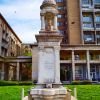
Near one of the park entrances, you will find a monument that radiates a particular sadness: the Sissi Stefanidi Fountain. It depicts a grieving mother pouring water from a pitcher. The statue was erected by the Stefanidi family in memory of their daughter, Sissi, who died at a young age, and it represents one of those places where the park ceases to be a space for leisure and becomes an altar of private memory.
The sculpture is the work of Ion C. Dimitriu-Bârlad and is remarkable for the delicacy of its details. If you look carefully at the expression on the statue’s face, you will understand why it is considered one of the most moving works in the park. The constantly flowing water symbolizes life moving forward, despite the losses endured.
Over time, the fountain became a meeting point for Bucharesters, many of whom do not know the tragic story behind it.
7. The Great Bridge — the Curved Bridge — was the most visited place in Cișmigiu
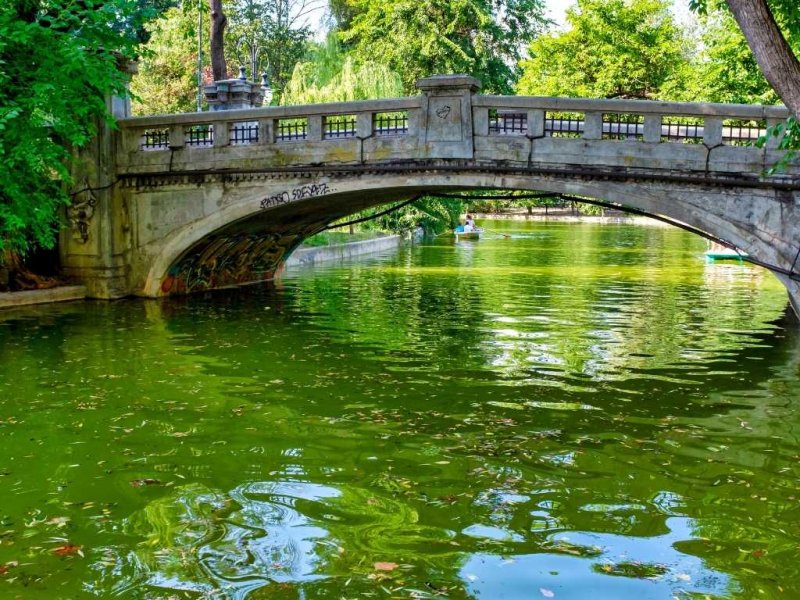
The Great Bridge in Cișmigiu, the one crossing the lake, is an interesting piece of engineering for the period in which it was built. Made of reinforced concrete, it imitates the arched shape of bridges in famous parks in London or Paris. Its curve is aesthetic and functional at the same time, allowing boats to pass underneath without difficulty.
The park’s historian notes that this bridge was one of the first of its kind in Bucharest. It quickly became a favorite spot, offering the best panorama over the entire lake and the Monte Carlo restaurant. If you want to understand the structure of the park, you have to stop in the middle of the bridge.
From here, you can see how the alleys radiate from key points, creating an organized labyrinth. Every visual perspective was calculated by Mayer to offer the eye a surprise at every bend in the path. The Great Bridge was restored in 2023.
8. The Monte Carlo restaurant was bombed in 1944
The building of the Monte Carlo restaurant, located on the small island in the lake, has had a turbulent history. Designed by the architect Ion Mincu in 1926, it was initially a much more elaborate construction in the Neo-Romanian style. Unfortunately, the original version was destroyed during the bombings of 1944. What you see today is a reconstruction that attempts to preserve the original spirit, but has lost some of the refined details from the early 20th century.
In its glory days, Monte Carlo was the place where the city’s most lavish balls were held. Politicians, artists and businesspeople gathered here to discuss the fate of the country between two sophisticated courses, making it a symbol of luxury accessible only to the elite, a place where etiquette mattered more than the menu.
The fact that it was rebuilt shows the symbolic importance of this spot in Bucharest’s emotional geography. Cișmigiu without Monte Carlo would be like a sentence without a predicate. Recently, the restaurant was taken over by the City Grill group, which is considering reopening it under a new concept.
9. Cișmigiu contains a large Japanese Garden
In the 1970s, an exotic corner appeared in Cișmigiu: the Japanese Garden. It was created with the support of the Embassy of Japan and follows the basic principles of this style: minimalism, balance and the presence of natural elements — water, stone, plants. Although small, this area offers a strong contrast with the rest of the park, which is dominated by the European landscape style.
The Japanese cherry trees that blossom in spring turn this corner into a magnet for photographers and tourists. It is interesting how such a culturally different space managed to integrate into a garden that originally aspired to be a replica of Vienna. In 2026, Bucharest City Hall announced the planting of another 24 cherry trees, bringing their total number to 85, which makes this corner of the park one of the largest Japanese gardens in Europe.
10. “Cișmigiu & Comp.” was the defining novel of many adolescents
You cannot talk about this park without mentioning that it gave its name to one of the most beloved books of Romanian adolescence. In the interwar period, the students of Gheorghe Lazăr High School — the garden’s next-door neighbor — turned the park’s alleys into their unofficial “office” for skipping classes and socializing. The title of the book “Cișmigiu & Comp.”, written by Grigore Băjenaru, became a state of mind, the “corporation” of those who preferred to learn about life on the benches by the lake rather than listen to lectures in dusty amphitheaters.
According to memoirs from the period, the park had a strict hierarchy established by the students. Certain alleys were reserved exclusively for seniors, while freshmen had to make do with peripheral areas, under the watchful eyes of pedagogues who often patrolled the park trying to “recover” the runaways. This symbiosis between school and garden turned Cișmigiu into Romania’s first cultural “hub” for young people, a space where freedom was measured by the number of laps around the lake completed before the bell rang.
11. Bucharest’s first newspaper kiosk is still in Cișmigiu
At the entrance from Regina Elisabeta Boulevard stands the first newspaper kiosk installed in Bucharest, believed to be as old as the park itself. The kiosk is in the same place where it was originally installed but, unfortunately, it has not been restored and is now in a state of decay.
12. The chess players’ corner is a famous place, and Cișmigiu’s benches have a rich history
No description of Cișmigiu would be complete without mentioning the “chess players’ corner.” Here, regardless of the weather, you will find middle-aged and elderly men bent over chessboards, playing backgammon or rummy, engaged in matches of rarely seen intensity — a fascinating social spectacle, with unwritten rules and spectators who offer unsolicited advice.
This corner represents the essence of the park’s community. It is the place where friendships lasting decades are made and unmade, where everything is discussed, from politics to — especially — football. For many of these people, Cișmigiu is their extended living room, the place where they feel useful and connected to the world, a form of resistance in the face of aggressive digitalization. It is a lesson in patience that the park offers you free of charge, right next to the main alley.
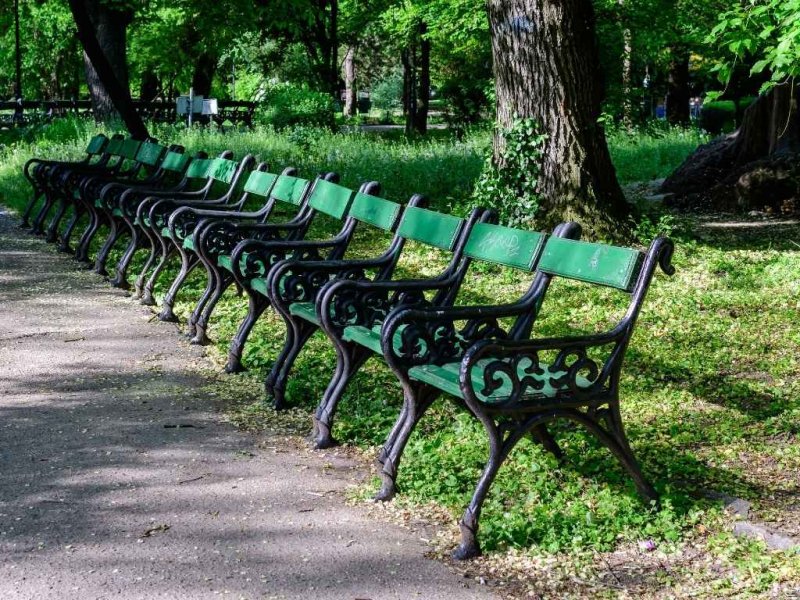
If you want to understand what imported refinement meant in interwar Bucharest, you need to know the story of the cast-iron benches that, until recently, gave a touch of Parisian nobility to the alleys near the old Monte Carlo restaurant. These were collector’s pieces cast in France, at the famous Fonderie Barbezat & Cie in Val d’Osne, an art foundry that, in the 19th century, set aesthetic standards in Europe’s great metropolises.
Their history on Romanian soil began spectacularly: they were specially ordered for the University of Bucharest, a detail revealed by the presence of the old coat of arms of the city, with the face of Saint Demetrius, cast directly into the metal structure. In 1930, they were moved from in front of the University to Cișmigiu, where they survived almost a century of political regimes and bad weather. The fact that they bore the inscription “Val d’Osne Barbezat” placed them in the same league as the urban furniture of major Western capitals, making them living testimonies of a Bucharest that did not compromise when it came to its public image.
In 2025, 96 benches and 126 chairs were restored and returned to Cișmigiu Park, placed — following meticulous documentation — in their original locations.
The future of a historic garden
Today, Cișmigiu Park finds itself at a delicate moment in its existence. The struggle between the conservation of historical heritage and the modern needs of infrastructure is visible at every step. Cracked paving slabs, the need to maintain old trees and the management of the bird population are constant challenges for City Hall and civic organizations such as the Cișmigiu Civic Initiative Group.
Every time you pass by Cișmigiu Park, remember that it was an ambitious project begun 200 years ago by a “Great Cișmigiu,” refined by German landscape architects and kept alive by generations of people who understood that a city without gardens is a city without a soul.