Awnings, the Jewels of the Houses of Little Paris. The Most Beautiful Buildings with Awnings in Bucharest
- Articles
- 12 MAY 26
Bucharest hides countless architectural details that define its personality and recall its elegant past. Beyond imposing façades, monumental columns, and rich ornamentation, there are seemingly discreet elements that contributed decisively to the charm of the city once nicknamed Little Paris. Among these, awnings occupy a special place. Made of wrought iron, glass, and, in the beginning, textile materials, these decorative canopies were designed to protect building entrances, but they quickly became true works of art. Whether they adorn sumptuous palaces, aristocratic villas, or more modest houses, awnings continue to tell the story of a Bucharest deeply influenced by French style. Some are spectacular and richly ornamented, others delicate and almost diaphanous, inspired by the flowing curves of Art Nouveau. In every case, they give buildings a touch of refinement and attract the eye of even the most hurried passerby.
What Awnings Are and Why They Became Symbols of Urban Elegance
An awning is a canopy placed above the entrance of a building, supported by metal brackets and usually covered with glass. Initially, its role was strictly practical: it protected the door and visitors from rain, snow, or strong sunlight. Over time, however, the awning went beyond its utilitarian function and became a decorative element with strong aesthetic value.
In Bucharest, awnings appeared in the second half of the nineteenth century, along with Romanian society's orientation toward the West. After breaking away from Ottoman influence, the elites adopted French fashion, architecture, and lifestyle. The trends launched in Paris quickly reached the Romanian Principalities, and awnings became one of the most visible expressions of this fascination with Parisian elegance.
They were not reserved exclusively for aristocratic palaces. Awnings were also installed on more modest residences, a sign that the desire for refinement belonged not only to the great boyar families, but also to the rising bourgeoisie.
The French Influence and the Role of Great Architects
The decorative canopies that adorn Bucharest's old houses come directly from the French architectural tradition. Paris had, at that time, an extraordinary power of influence, and its urban model was enthusiastically adopted in the Capital of Romania.
Among the architects who contributed decisively to the spread of awnings were Ion D. Berindey and Paul Gottereau, two essential names in the history of Romanian architecture. Their projects introduced to Bucharest a sophisticated language inspired by the Beaux-Arts, Art Nouveau, and later Art Deco styles.
Even when their authors are unknown, it is evident that these structures were conceived with care and craftsmanship. Many models were later taken up by ironwork workshops and replicated, becoming part of a true urban architectural folklore.
How Awnings Evolved Over Time
The first awnings were supported by metal pillars and covered with textile fabrics that were removed during the cold season. These structures resembled the elegant kiosks found in European parks, created on a reduced scale.
Later, the textile materials were replaced with sheet metal and then with glass, the solution that ultimately prevailed and gave these elements transparency and visual lightness. In recent restorations, some of the original glass panes have been replaced with polycarbonate, a more durable but less authentic material from an aesthetic point of view.
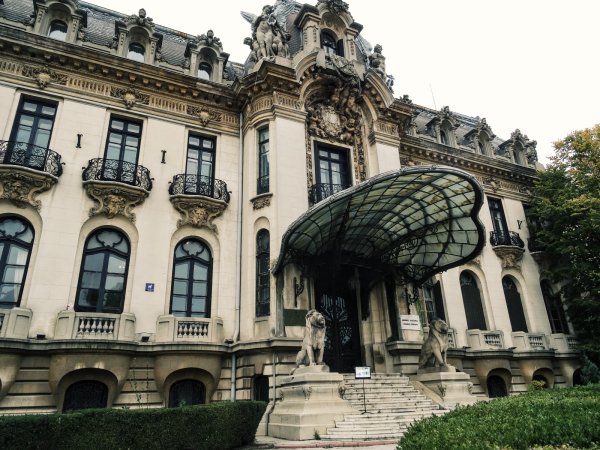
In terms of shape, the first awnings were simple and rectangular, with one or more sloping planes. Over time, they became increasingly elaborate, some acquiring volume and spectacular proportions. The most impressive example is the awning of Cantacuzino Palace, considered one of the most spectacular in Bucharest.
An Architectural Jewel Between Exterior and Interior
The awning represents a transitional space between the street and the house, between the public world and the intimate universe of the home. Suspended between exterior and interior, it functions as a gesture of welcome addressed to guests.
From a symbolic point of view, the awning prolonged the moment of arrival and departure, offering host and guest a few extra moments of conversation. If drawn schematically, a door crowned by an awning would resemble a human silhouette with arms wide open.
It is precisely this symbolic dimension that explains why awnings were placed in the most visible locations. They represented a form of prestige and a statement of taste, like a jewel that completes the attire of a building.
The Most Spectacular Awnings in Bucharest
Among the most impressive examples is the awning of Suțu Palace, today the Bucharest Municipality Museum. This elegant structure is believed to have been designed by architect Paul Gottereau, one of the most important creators of Bucharest at the end of the nineteenth century.
Equally impressive is the awning of Cantacuzino Palace on Calea Victoriei, now the headquarters of the George Enescu National Museum. With ample forms and an elaborate structure, it is considered one of the most spectacular achievements of this kind in the Capital.
Another remarkable example is the awning of Krețulescu Palace on Știrbei Vodă Street, which harmoniously complements the elegant architecture of the building.
Houses and Palaces That Preserve the Charm of Little Paris
Bucharest still preserves numerous other valuable examples. Among them are the houses on Frumoasă Street no. 19, Știrbei Vodă no. 24, Marin Serghiescu no. 10A, Paleologu no. 12, Londra no. 33, and the buildings at Piața Amzei no. 4-6.
Distinctive awnings can also be admired at the Filipescu-Brâncoveanu House, now the national headquarters of the National Liberal Party, as well as at the Nanu-Muscel House in Victory Square.
Some buildings have a single awning, others two or three, and the record is held by a building that preserves no fewer than five such decorative canopies. This detail shows how important this element was in defining the image of a residence.
The Origin of the Term "Awning"
The origin of the Romanian term "marchiză" remains partly shrouded in mystery. The word designates not only the decorative canopy, but also a certain type of armchair and a diamond cut, all associated with an aristocratic universe.
One hypothesis suggests that the first such canopy adorned the residence of a marchioness, and the name was later transferred to the architectural element. Another theory refers to military and naval life, where the term designated a kind of small fore-tent that protected entrances or command posts.
Regardless of its exact origin, the word evokes refinement, elegance, and social status, precisely the values these structures expressed visually.
Awnings, a Fragile and Precious Heritage
Although they are elements of minor architecture, awnings have exceptional heritage value. They complete façades, enhance the aesthetic value of buildings, and provide clues about the tastes and aspirations of the era in which they were created.
Many of them disappeared because of deterioration or inappropriate renovations. Those that have survived today represent true urban jewels and deserve to be protected with the same care given to major monuments.
In Bucharest, these canopies of iron and glass continue to tell the story of a city that looked to Paris and sought to transform Western elegance into an essential part of its own identity. Awnings are not simple decorative details, but discreet signatures of an era in which beauty was considered a necessity of everyday life.
We also recommend: Assan House, the palace in the heart of the Capital where the first Romanian to travel around the world lived