The Bucureștioara stream: where does the vanished tributary of the Dâmbovița flow today?
By Eddie Țone
- Articles
- 14 MAY 26
Present-day Bucharest, this fascinating mixture of concrete, glass and the permanent desire to get somewhere on time, hides beneath its layers of asphalt a liquid history that few people can still perceive today.
If we look carefully at the city map, beyond the buildings crowding together to catch a shred of sunlight, we discover a network of watercourses that once dictated the rhythm of urban life. The most important of these aquatic spirits, the one that carried the affectionate name of the settlement itself, remains the Bucureștioara stream.
This small hydrographic artery was, several centuries ago, one of the reasons our ancestors chose to build their homes on these lands, offering sources of fish and water in an age when nature was still the absolute master of the landscape. Today, the Bucureștioara has become a mere echo in the capital’s sewer system, a memory buried deep beneath the steps of passers-by in the central area. Even so, its route remains imprinted in the memory of old documents and in the curious configuration of certain streets.
The liquid genesis of a princely name
The name of this stream, Bucureștioara, carries within it a tenderness that reveals the close relationship between the inhabitants and the watercourse. The first documentary mention of the stream dates from 1608, at a time when the city was beginning to shape its identity as a commercial and political center. In those days, water was considered a blessing, and the Bucureștioara offered exactly what was needed for harmonious development. It was a tributary of the Dâmbovița which, although small compared with the main river, possessed an overflowing personality.
Historians suggest that this small running water played an essential role in naming the city. It is far more plausible that the settlement took its name from the water beside which it developed than from the legend of a shepherd named Bucur, however romantic that fireside story may sound.
The Bucureștioara was the vital artery of the first mahallas, providing food and a natural path through the rich vegetation of the plain. The people of those times saw the streambed as a divine gift, fishing in its waters and using it for their daily household needs. Over time, this relationship changed, as the city grew and its needs became far more complex and, unfortunately, far dirtier.
Bulindroi’s pond and its equestrian depths
The source of this legendary stream lay in a place we now know as Grădina Icoanei. In past centuries, this space was occupied by an impressive body of water known as Balta Icoanei or, more picturesquely, Lake Bulindroi. The name came from a local estate owner, a certain Bulindroi, who owned those marshy lands. Chroniclers of the time estimated the surface area of this lake at around 20,000 square meters, a colossal size for the current center of Bucharest.
This body of water was fed by its own springs and was so deep that local legends mentioned the risk of even a rider drowning in it, horse and all. It was a wild place, full of reeds and aquatic life, offering a strong contrast to the calm of today’s park.
The image of a huge lake located between today’s Jean Louis Calderon Street and Magheru Boulevard seems taken from a parallel reality, but this was the source of the Bucureștioara. The water started from this natural basin and began its journey toward the southeast, crossing the mahallas and gathering along the way all the stories of the city. The transformation of this pond into a public garden took place late, in 1873, when the city hall decided to drain it in order to eliminate the source of infection it had become in the meantime.
A matter of olfactory onomastics
As Bucharest began to grow more crowded, the inhabitants’ affection for their little stream gave way to a much more pragmatic and, in the end, destructive attitude. The course of the Bucureștioara gradually became what we might call the city’s first collecting sewer. For this reason, the delicate name Bucureștioara was replaced in popular speech by far more suggestive and less elegant names, such as Căcaina or Căcata. These epithets reflected the sad reality of a watercourse that had lost its purity in favor of sanitary utility.
All the craftsmen in the neighboring areas considered the stream the ideal place to get rid of the remains of their production. Butchers, tanners, soap makers and fishmongers threw their waste directly into the water, turning the course of the Bucureștioara into a pestilential mixture of organic refuse. What had once been a source of life had become a breeding ground of miasmas, a black line crossing the city, which everyone tried to avoid, although everyone contributed to its degradation.
The urban archipelago behind Colțea Hospital
After leaving the area of Grădina Icoanei, the Bucureștioara crossed the Scaunelor and Săpunarilor mahallas. Its route was winding, dictated by the irregular relief of the area. Once it reached the back of today’s Colțea Hospital, the stream widened again, forming another body of water known as Balta de la Carvasara or Lake Șuțu. The name “carvasara” came from the presence of the customs office in that area, underlining the commercial importance of the place.
The property of the Șuțu family stood in the immediate vicinity, and the presence of this lake added a special charm to their residence, even if the smell of the water left much to be desired on hot summer days. At this point, the Bucureștioara was in the heart of the market town, witnessing noisy transactions and everyday bustle. The standing water behind the hospital was a major geographical landmark for Bucharesters of the 18th century, being the place where the stream was preparing to branch into two distinct arms, as if trying to embrace as much of the capital’s territory as possible before flowing into the Dâmbovița.
The branches of a capricious course through the mahallas
Toward the city center, the Bucureștioara decided to split into two courses, as if attempting to cover as large an area as possible. The western branch ventured through Târgul Cucului, passing south of Saint George’s Church. It descended through the Bărăția area, passed near the walls of the Old Princely Court and found its end in the Dâmbovița, somewhere near the old Bazaca Street. This street has since disappeared from the city map, having been located near the place where the meat hall in Piața Unirii stands today.
The second branch, the eastern one, had a much longer and more complex route. It cut across Podul Târgului de Afară, today’s Calea Moșilor, and continued along Radu Calomfirescu Street. From there, it crossed Podul Vergului, known today as Calea Călărași, and went toward the area of Labirint Street. Gion, one of the great historians of Bucharest, provides additional details, mentioning that this branch turned along Corbului Street and flowed into the Dâmbovița in the Popescului mahalla, upstream from the Jicnița Domnească.
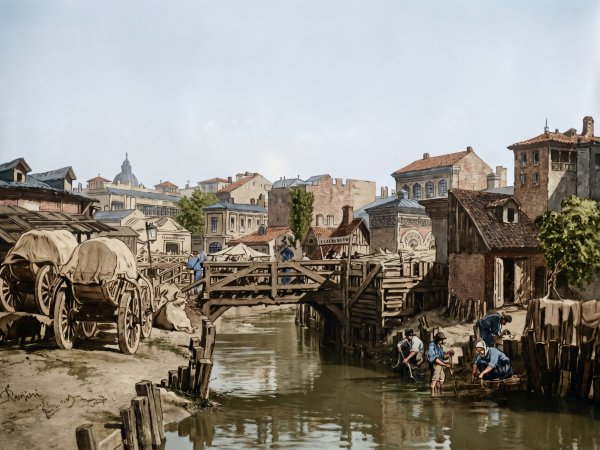
This water network formed an urban landscape dominated by small bridges and improvised footbridges, giving Bucharest the appearance of a lacustrine city, although one marked by filth and heavy smells.
The war between land and water in property deeds
The instability of the streambed caused constant problems for the inhabitants of the central mahallas. Because rubbish was repeatedly thrown into it, the bed silted up and the water changed course as it pleased, especially during periods of heavy rain. This wandering of the waters often led to flooded courtyards and, more seriously for the mercantile spirit of the age, to changes in property boundaries. In the commercial center, where land was extremely expensive, every palm of ground lost to the stream generated heated legal disputes.
The archives preserve numerous pieces of evidence from lawsuits between neighbors who argued over the way the Bucureștioara “stole” from their gardens. Some property owners tried to gain land by filling in the streambed, an action that punished the mahalla during the first serious rain.
In July 1814, the inhabitants of the Scaunelor Vechi mahalla sent Ioan Gheorghe Caragea a desperate complaint. They asked for the canal to be cleared, because rainwater was flooding their houses and endangering their health. Those on Radu Calomfirescu Street reported that their lane had become navigable in an undesirable way, turning into a foul-smelling pond that made passage impossible and endangered the lives of the common people.
Municipal efforts and gradual disappearance
Caragea Vodă understood the gravity of the situation and ordered sewerage and cleaning works to be carried out, but the slow pace of the administration and political events left the project unfinished. Only the section from the Icoanei mahalla to Podul Târgului de Afară received minimal attention. The city continued to struggle with the stream’s whims until the middle of the 19th century, when Bucharest’s destiny changed radically.
The Great Fire of 1847 represented a turning point. The massive destruction of the central areas gave the authorities the opportunity to restructure the city according to modern principles. New streets were laid out, and houses were rebuilt according to a different spatial logic. In the 1853 plan drawn up by Major Borroczyn, the Bucureștioara already appears as a ghost of what it had once been. In place of the old watercourse, the map indicates marshy lands and isolated fragments of sewerage, a sign that the stream had been partially buried or dried up by urban expansion.
Dâmbovicioara and the suffering siblings of the aquatic network
The Bucureștioara represented only one part of the capital’s hydrographic complexity. Another important stream, called Dâmbovicioara, completed the landscape on the right bank of the Dâmbovița. It rose on the eastern slope of Dealul Spirii and crossed the Sfinții Apostoli and Antim mahallas. Its route included crossing Podul Calicilor, today’s Calea Rahovei, and flowing into the Dâmbovița in the area of today’s Piața Unirii.
Like its more famous sister, the Dâmbovicioara suffered because of urban negligence. Documents from 1830 mention complaints from the inhabitants of the Dudescu and Sfântul Ilie mahallas, who found themselves drowned by waters that had nowhere left to drain because of the accumulated filth. There were discussions about whether the Dâmbovicioara was a real tributary or merely an old branch of the Dâmbovița that went around an island located in front of the Princely Court.
Regardless of its geographical status, its fate was identical to that of the Bucureștioara: it was buried under layers of earth and pavement, becoming part of the sewer system of a city that aspired to be a “little Vienna” or a “little Paris,” far from the marshy smells of the past.
The invisible legacy beneath the pavement
If we walk today through Grădina Icoanei and feel an unexpected coolness on summer days, this is probably due to the thermal memory of the former Bulindroi pond. The Bucureștioara continues to flow, but it does so invisibly, through the modern pipes beneath the central boulevards. The city managed to discipline its waters, but the price was the loss of an element of identity that had given it its name.
What remains are dusty documents and the curiosity of urban explorers trying to locate the old mouths of the stream. Bucharest was built on a generous meadow, full of springs and small streams, and the spirit of the Bucureștioara still haunts the foundations of the old houses in the Scaunelor mahalla. We therefore have a story about transformation and about the passage from admiration for nature to its complete disregard in the name of urban progress.
Although the stream is absent from the eyes of passers-by, it remains the foundation on which the capital rose, reminding us that beneath any modern metropolis there always pulses the heart of a watercourse that refused to be forgotten entirely.
You may also like: The Batiștei neighborhood: from the path trampled by cattle and the puddles of the Bucureștioara to today’s grand residences