Famous houses in Bucharest: Cazzavillan Palace, the architectural jewel with Venetian ornaments in the heart of the Capital
- Articles
- 08 MAY 26
Bucharest hides numerous spectacular buildings, many of them forgotten by time and almost invisible to those hurrying through the city streets. Beyond the crowded boulevards and modern buildings, the Capital still preserves fragments of its former elegance, from the period when it was nicknamed “Little Paris.” Some of these constructions continue to impress through their beauty, even though today they have reached an advanced state of degradation. Among the most fascinating examples is Cazzavillan Palace, one of the most mysterious and spectacular historical buildings in Bucharest. Hidden on Luigi Cazzavillan Street, just a few minutes from Calea Victoriei, the palace seems detached from another era. The façade decorated with Venetian elements, the elegant arcades, and the sculpted details transform the building into an almost unreal appearance in today’s urban landscape. Today, the palace is abandoned and affected by the passage of time. The broken windows, fallen plaster, and traces of degradation strongly contrast with the architectural refinement that can still be observed. Even so, the building continues to attract the attention of those passionate about the history of Bucharest and the charm of early 20th-century architecture.
A hidden palace in the center of Bucharest
Cazzavillan Palace is located on Luigi Cazzavillan Street, in a central area of the Capital, very close to Calea Victoriei and the old aristocratic center of the city. Although it is situated in an intensely trafficked part of Bucharest, the building remains almost unknown to many inhabitants of the city.
Today, the palace is surrounded by apartment blocks, parked cars, and ordinary buildings, and the contrast between the elegance of the construction and the surrounding urban landscape is obvious. Precisely this contrast gives it a mysterious air. At first glance, the building appears completely abandoned, but a few seconds are enough to notice the beauty of the architectural details that still resist.
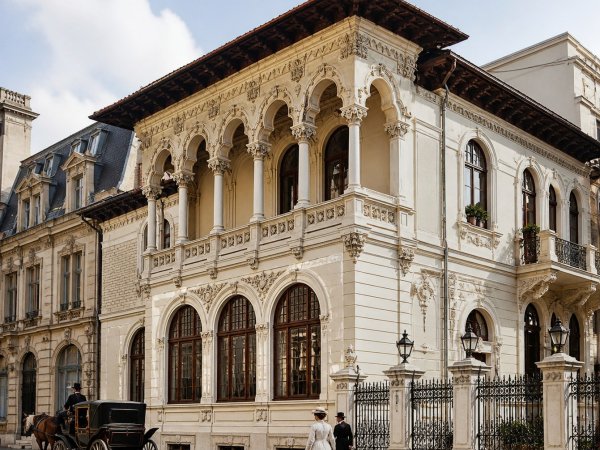
The façade immediately recalls Venetian palaces. The slender arcades, elegant columns, and rich ornamentation give the impression of a construction directly inspired by Italian architecture. Precisely for this reason, many Bucharest residents have begun calling it the Capital’s “Venetian palace.”
In a city where numerous historical buildings have been demolished or radically modified, Cazzavillan Palace remains one of the few constructions that still preserve the sophisticated atmosphere of Belle Époque Bucharest.
The story of Luigi Cazzavillan and the beginnings of the palace
The history of the building is closely connected to Luigi Cazzavillan, an important personality for the Romanian press at the end of the 19th century and the beginning of the 20th century. Originally from Italy, Cazzavillan arrived in Romania in 1877, during the War of Independence, as a war reporter.
Romania then needed correspondents and journalists to transmit information about the conflict, and the Italian decided to remain in Bucharest after the end of the war. Over time, he became one of the most influential figures in the Romanian press.
Luigi Cazzavillan is best known for founding the newspaper “Universul,” one of the most important and influential publications in Romania during that era. The newspaper had enormous success and contributed to the modernization of the Romanian press, during a period in which Bucharest was beginning to adopt Western models in culture and society.
The success of the publication gave Cazzavillan an important status in the public life of the Capital. In this context also appeared the idea of building a palace that would reflect the prestige and ambitions of the time.
The building was erected between 1901 and 1911, during a period in which Bucharest was going through a broad process of urban and architectural modernization. The Capital was then building its image as an elegant and cosmopolitan city, and the new buildings were designed to impress.
A spectacular mixture of architectural styles
Cazzavillan Palace is considered one of the most interesting eclectic constructions in Bucharest. The building combines classical, Gothic, Venetian, and Art Nouveau influences, in a spectacular style rarely encountered in the architecture of the Capital.
The ground floor of the building was dominated by large semicircular windows and elaborate sculpted details. The decorative elements offered elegance and monumentality to the construction, and the carefully made ornamentation demonstrated the concern for refinement specific to the beginning of the 20th century.
The upper floors are those that made the palace famous. Here appear the Venetian influences that differentiate the building from many other historical constructions in Bucharest. The slender arcades and decorative columns create the impression of a small Italian palace hidden in the center of the Capital.
During the Belle Époque period, architects in Bucharest were strongly influenced by European trends. The city borrowed elements from French, Italian, and Viennese architecture, and the result was a sophisticated and eclectic urban landscape.
Cazzavillan Palace perfectly reflects this period. The construction does not strictly follow a single architectural style, but combines several influences in a harmonious way. Precisely this mixture gives it personality and transforms it into one of the most spectacular historical buildings in Bucharest.
The hidden luxury inside the palace
Although today the interior of the building is almost completely degraded, in the past Cazzavillan Palace was considered one of the most elegant private constructions in the Capital.
It is said that inside there were luxurious salons decorated with refined furniture, stained glass windows, and impressive ornamental elements. The monumental staircases and spacious rooms were designed to impress visitors and to reflect the owner’s social status.
At the beginning of the 20th century, the Bucharest elites invested massively in spectacular constructions. The palaces and villas built then had the role of demonstrating financial success and closeness to the Western lifestyle.
During that period, Bucharest was rapidly transforming into a modern capital. The aristocracy, the bourgeoisie, and the new influential people of the city were building residences inspired by the great European capitals.
Cazzavillan Palace was part of this sophisticated and elegant world. It was not just a simple building, but a symbol of modernization and of Bucharest’s ambition to become a city comparable to Paris, Vienna, or Venice.
The degradation after the 1977 earthquake
The fate of the palace changed radically in the second half of the 20th century. One of the greatest blows to the building was the 1977 earthquake, which seriously affected numerous historical constructions in Bucharest.
Cazzavillan Palace suffered important damage then. Part of the roof was affected, and many original details were lost forever. After the earthquake, the building did not benefit from major restorations, and the degradation constantly continued.
Years of neglect, infiltrations, and lack of maintenance accelerated the deterioration of the construction. In addition, vandalism and abandonment contributed to the destruction of valuable architectural elements.
Today, the building is in a fragile state. The broken windows, deteriorated walls, and obvious traces of degradation give it a dramatic appearance. Many of those passing through the area have the impression that the palace is very close to collapsing.
Even so, the architectural beauty of the construction has not completely disappeared. Even ruined, the building continues to impress through its details and through the atmosphere it transmits.
A symbol of the elegant Bucharest of the past
Cazzavillan Palace is more than an abandoned building. It represents an important part of the history of Bucharest and of the image of the city at the beginning of the 20th century.
During the Belle Époque period, the Capital was going through one of the most spectacular stages of its development. The city was modernizing rapidly, and architecture was becoming an instrument through which Bucharest tried to compete with the great European capitals.
The palaces, hotels, and elegant buildings constructed then reflected the optimism and desire for modernization of Romanian society. During that period, the press, culture, and social life were developing rapidly, and Bucharest was becoming an extremely active urban center.
Cazzavillan Palace recalls that disappeared world. A world in which important newspapers operated in monumental buildings, in which architecture was created to impress, and in which urban elegance mattered enormously.
Even though today the building is in an advanced state of degradation, it continues to be one of the most fascinating hidden monuments of the Capital.
Why Cazzavillan Palace still fascinates
There are numerous abandoned historical buildings in Bucharest, but few manage to transmit the same atmosphere as Cazzavillan Palace. Perhaps precisely the contrast between the beauty of the past and the degradation of the present makes it so impressive.
Many enthusiasts of urban photography, architecture, or history come to admire the building and capture the details that resisted time. The Venetian arcades, columns, and decorative sculptures offer spectacular images even in the current state.
The palace has also become a symbol of the way Bucharest gradually loses part of its historical heritage. Numerous valuable buildings have been abandoned or demolished in recent decades, and many of them risk disappearing completely.
At the same time, there is also hope that such monuments could one day be restored. In many European capitals, historical buildings in a similar state have been brought back to life and transformed into cultural spaces, hotels, or artistic centers.
Cazzavillan Palace has the potential to once again become one of the architectural jewels of Bucharest. Until then, however, it remains suspended between beauty and ruin, between the spectacular past and the fragile present of a city that is still trying to protect its architectural memory.
We also recommend: The Universul Palace, the ambitious project of journalist Luigi Cazzavillan and the history of Romania’s first high-circulation newspaper