How Modern Sewage Appeared in Bucharest and the Epidemics That Accelerated the Works
By Eddie Țone
- Articles
- 05 MAR 26
You hurry along the uneven sidewalks of the capital, gracefully sidestepping a puddle left behind by a torrential rain and stepping firmly onto a heavy metal cover decorated with raised lettering. That cast-iron disc is your only visual interface with an engineering masterpiece hidden beneath the asphalt, a vast network of brick and concrete tunnels that swallows the daily consequences of our civilization.
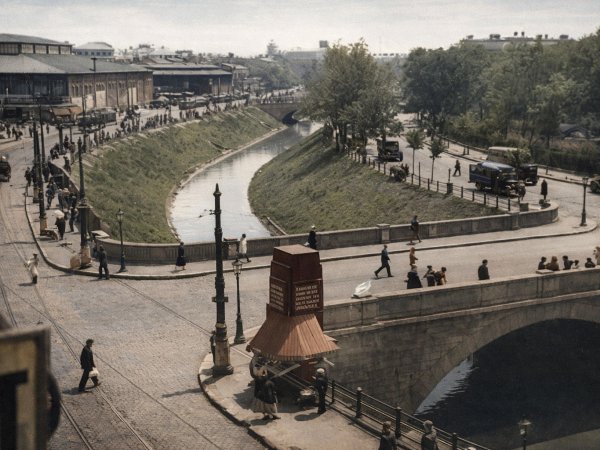
You glance toward the concrete channel of the Dâmbovița River, watch ducks navigating between ephemeral islands of plastic bottles, and you might assume that Bucharest’s relationship with public hygiene has always been a story of compromise. Historical reality reveals something far more fascinating, a tale in which progress was extracted with surgical forceps, under the direct threat of bacteria highly motivated to drastically reduce the tax-paying population.
Before the arrival of modern sewerage, Bucharest functioned according to a chillingly simple principle, one based on the immediate and involuntary recycling of its own waste. To understand the enormous technological leap made at the end of the nineteenth century, you must descend into a time when the smell of the city would have struck you with the physical force of a brick wall.
An era when the dominant perfume was unmistakably organic
If you had landed in Bucharest in the 1850s, your first major challenge would have been the simple act of moving from one point to another without losing your shoes, your dignity, or possibly your life. The city breathed through an organic street system composed of a legendary mud, the famous Bucharest sludge, capable of swallowing entire carriages along with their horses.
The municipal solution of the time involved covering the main streets with thick oak trunks. Beneath these wooden platforms developed a vibrant ecosystem, a primordial soup made of household waste, wastewater, and the uninhibited contributions of draft animals.
The Dâmbovița River simultaneously fulfilled two roles that were utterly incompatible from a sanitary perspective, functioning at once as the main source of drinking water and as the settlement’s liquid garbage dump. Along its banks, life boiled in a lethal biological harmony. Butchers carefully washed their tools and threw animal remains directly into the current. A few meters downstream, housewives scrubbed laundry with enthusiasm, while tanners used primitive chemical substances to process hides.
From this very same murky and aromatic water, the famous sacagii drew their merchandise. These picturesque entrepreneurs of urban hydration filled enormous wooden barrels straight from the river, loaded them onto horse-drawn carts, and roamed the streets shouting loudly to announce their presence.
Residents bought the precious liquid, left it for a few hours in a clay vessel to allow the mud and various surprise solids to settle, and then drank it with complete conviction, giving birth to the legendary saying about the sweet water of the Dâmbovița. The immune resilience of nineteenth-century Bucharest residents deserves serious medical study. Biology, however, has its limits, and no amount of local pride can overcome them forever.
Cholera, an extremely persuasive construction supervisor
Local administrations have historically demonstrated a remarkable reluctance to spend colossal budgets on works buried deep underground, lacking visible electoral appeal. To convince city officials to clean up the capital, a supreme argument was required, delivered in the form of periodic and devastating visits from the specter of cholera.
The first wake-up call arrived in 1831, during the Russian administration led by General Pavel Kiseleff. The cholera epidemic struck the city with a ferocity difficult to describe, transforming the streets into a genuine theater of medical warfare.
Kiseleff reacted with the military rigor the situation demanded, establishing the first sanitary commissions, organizing strict quarantines, and imposing elementary rules for waste management. Despite these early efforts, infrastructure was completely absent, and the measures relied exclusively on human restrictions, without addressing the fundamental problem of contaminated water.
Decades passed, the city grew in both population and European ambitions, while microbes maintained their residence. Typhus epidemics and the return of cholera in 1873 and 1886 acted as shrill alarms in the ears of the political class.
Physicians of the era, influenced by the discoveries of Louis Pasteur and Robert Koch, began placing unbearable pressure on mayors. The voices of pioneers of public hygiene, such as Doctor Iacob Felix, tirelessly emphasized a simple mathematical equation: the mortality rate would continue to rise directly in proportion to population density as long as Bucharest residents continued to drink water from the same source into which they discharged their waste.
The panic generated by cholera achieved the rare performance of unlocking public budgets and transforming sewerage from a Western luxury into a matter of national security.
Sir William Lindley and the first plans on English paper
When Romanian authorities finally decided to approach the problem scientifically, they turned to the greatest expertise available. They invited Sir William Lindley, a British civil engineer with a legendary reputation, the man responsible for designing sewer systems in Hamburg, Frankfurt, and Warsaw.
The Englishman arrived in the capital, analyzed the city’s terrain with his clinical eye, assessed the disastrous flow of the Dâmbovița, and drew up an integrated master plan worthy of Europe’s great metropolises.
Lindley’s project proposed the strict separation of domestic wastewater from rainwater, the use of the natural slope of the land for gravitational flow, and the construction of massive collectors. On paper, everything looked impeccable.
When the estimated cost was presented, the faces of Bucharest’s city officials acquired a pallor similar to the symptoms of the diseases they were attempting to prevent. The expenses were astronomical for a state that had only recently emerged from Ottoman-era feudal structures.
Following a bureaucratic tradition that you may still recognize today, the exceptional plans of the British engineer were praised, carefully archived, and abandoned in a dusty drawer of the City Hall. Yet the rejection of the Lindley project served an important purpose, setting an essential technical standard for the Romanian engineers who would eventually take on this difficult task.
The great rectification of the Dâmbovița and the end of fragrant floods
Before digging tunnels beneath the streets, Romanian engineers had to domesticate the main source of disaster. The Dâmbovița followed a meandering course, full of lazy bends, muddy islets, and stagnant pools. After every serious spring rain, the river overflowed, flooding the lower neighborhoods and returning to citizens, directly into their courtyards and living rooms, everything they had thrown into the water during the winter.
Between 1880 and 1883, under the leadership of brilliant engineers such as Grigore Cerchez and Nicolae Cuțarida, the capital’s first monumental hydraulic project began.
The plan involved deepening the riverbed, widening it, and most importantly constructing collector channels parallel to the river’s course.
These immense conduits had a vital role: to capture the city’s waste and carry it downstream, away from the urban center, leaving the main river relatively clean, at least in theory. The rectification of the Dâmbovița became the backbone on which the entire later sewer network would rest.
The noise of wheelbarrows, pickaxes, and thousands of workers who manually excavated millions of cubic meters of earth marked Bucharest’s definitive passage into modernity.
Elie Radu and the moment Bucharest began digging with purpose
The true revolution of underground infrastructure bears the unmistakable signature of engineer Elie Radu, a visionary with phenomenal work capacity and equal stubbornness.
While Mayor Pache Protopopescu transformed the city’s surface by aligning streets and paving them with cobblestones, Elie Radu and his colleagues argued firmly that any surface improvement would be pointless without a proper sanitary foundation.
Elie Radu understood a fundamental paradigm of sanitary engineering and insisted on the complete abandonment of river water consumption in favor of capturing underground water from Bragadiru and Arcuda.
Once the problem of clean water entering the system was solved, the challenge of removing it followed. Under his technical guidance, at the turn of the nineteenth and twentieth centuries, Bucharest began to be pierced by a spiderweb of exposed brick tunnels.
An ovoid profile was adopted for the underground channels, essentially an inverted egg shape, extremely efficient from a hydrodynamic standpoint. This form ensures a constant flow velocity at the base of the channel, preventing the accumulation of sludge and waste even when the water flow is very low.
Hundreds of master bricklayers manually laid millions of bricks, binding them with a special hydraulic mortar, initially imported and later produced locally.
The craftsmanship of these builders reached a level of perfection difficult to imagine by the standards of today’s rapid construction. The main galleries were tall enough to allow maintenance workers to walk through them during inspections, equipped with tall rubber boots and gas lanterns, true explorers of the city’s darkness.
The underground legacy we walk upon every day
As streets gradually received the sewer network, residents’ lives changed radically. Infected courtyard wells were sealed one by one. The sacagii vanished into the void of history, becoming a simple element of nostalgic folklore.
Infant mortality dropped dramatically, and cholera was reduced to a paragraph in medical textbooks.
The Victorian technology of arched brick construction proved astonishingly resilient in the face of time, earthquakes, and the city’s explosive development.
Today you walk through the streets of the Old Town, sip a specialty coffee on a cozy terrace, and watch the constant flow of tourists. Directly beneath your chair, a few meters underground, the ovoid channels designed by Elie Radu and built through the labor of generations of anonymous workers continue to function flawlessly, silently and efficiently carrying out the same unglamorous tasks they performed a century ago.
The modern sewerage system of Bucharest remains, perhaps, the most honest form of civilization we have ever managed to implement. It represents a triumph of science over bacteria, of engineering reason over organic chaos, and a permanent reminder that humanity’s greatest advances often begin with an urgent need to survive our own filth.
You may also like: Dem. I. Dobrescu, the mayor who transformed the Capital into the Little Paris, has a street named after him in Bucharest