What the neighborhoods of interwar Bucharest looked like and what the social differences between them were
- Articles
- 28 MAY 26
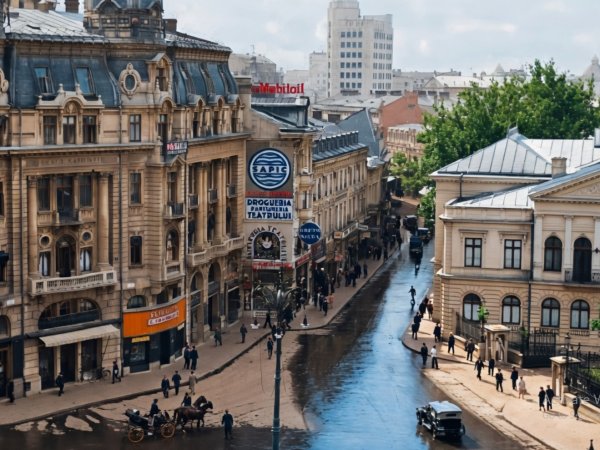
The interwar period represented one of the most spectacular stages in the development of Bucharest. Between the two world wars, the capital of Greater Romania expanded rapidly, the population grew massively, and the city began to acquire the image of a modern European metropolis. At the same time, however, Bucharest was a city of profound contrasts: elegant boulevards coexisted with muddy streets, luxurious villas appeared next to poor slums, and the social differences between residents could be seen directly in the architecture and organization of the neighborhoods. During that period, the neighborhood in which you lived said almost everything about your social status, profession, and standard of living. Interwar Bucharest was not divided only administratively, but also socially and culturally. There were areas reserved for political, intellectual, and military elites, neighborhoods for civil servants and the middle class, but also working-class slums where living conditions were difficult.
Interwar Bucharest – a city in continuous transformation
After the First World War, Bucharest developed rapidly. The emergence of Greater Romania transformed the capital into a much more important political and economic center. The population increased spectacularly, and the city expanded toward the north, west, and east through new land divisions and residential neighborhoods.
Modernization was visible especially in the center and in the new neighborhoods. Boulevards were paved, Art Deco and modernist buildings appeared, modern utilities and more efficient public transport were introduced. At the same time, however, the outskirts remained largely undeveloped, with unpaved streets, lack of sewage systems, and improvised housing.
This contrast defined interwar Bucharest. That is why the city was often described as simultaneously Western and Balkan. Near the center you could encounter elegant palaces and luxurious hotels, and just a few streets away the poor slums began.
The elegant neighborhoods of the Bucharest elite
The most prestigious areas of interwar Bucharest were Dorobanți, Kiseleff, Aviatorilor, and Cotroceni. These neighborhoods were inhabited by politicians, industrialists, major merchants, university professors, doctors, and high-ranking officers.
The houses here were built in architectural styles modern for that era: Neo-Romanian, Art Deco, modernist, or inspired by French architecture. The villas had generous gardens, decorated facades, columns, and luxurious interiors. Many owners hired famous architects such as Ion Mincu, Petre Antonescu, or Horia Creangă.
In these areas there were wide sidewalks, modern public lighting, and better access to transport. The atmosphere resembled that of major Western cities, which is why Bucharest received the nickname “Little Paris.”
Cotroceni – the neighborhood of intellectuals and military officers
Cotroceni was one of the most appreciated neighborhoods of the era. Its development was strongly influenced by the presence of Cotroceni Palace and the military institutions in the area. Doctors, university professors, artists, and high-ranking officers lived here.
The neighborhood was known for its elegant Neo-Romanian villas, quiet streets, and green spaces. Unlike other areas of Bucharest, Cotroceni had a calmer and more intellectual atmosphere. Many writers and cultural figures lived here.
During the interwar period, Cotroceni symbolized the rise of the educated class. It was not only a wealthy neighborhood, but also one associated with cultural and academic prestige.
Dorobanți and Kiseleff – the symbols of luxury
Dorobanți and the Kiseleff area represented true symbols of wealth. Some of the most impressive residences in the capital were built here. The neighborhood was preferred by aristocrats, diplomats, and major businessmen.
The wide boulevards and proximity to Kiseleff Road offered a Western atmosphere. Elegant cafés, exclusive clubs, and receptions organized in luxurious villas transformed the area into a center of Bucharest’s high society life.
The residents of these neighborhoods had access to comfort rarely found in the rest of the city: stable electricity, running water, modern furniture, and personal automobiles. In many cases, domestic staff lived in separate rooms within the property courtyards.
The neighborhoods of the middle class
Between the luxurious areas and the poor slums there was an important category of neighborhoods intended for the middle class. These were populated by civil servants, teachers, engineers, small merchants, and state employees.
During the interwar period, numerous land divisions organized specifically for this social category appeared. The houses were more modest than the villas of the elite, but they were built according to modern and relatively uniform plans.
The streets of these neighborhoods were orderly, and the homes usually had small courtyards and gardens. The state and various institutions began supporting the construction of housing for civil servants and skilled workers.
Vatra Luminoasă and the modern land divisions
Vatra Luminoasă became one of the most interesting examples of interwar urban planning. The neighborhood was built for employees of the Social Insurance Houses and for salaried workers with stable incomes.
The homes were constructed according to standardized models and offered modern conditions for that time. The neighborhood had airy streets and plenty of green space, which differentiated it from the crowded slums.
During the same period, small land divisions also appeared in areas such as Iancului, Foișor, or Sfântul Elefterie. These neighborhoods reflected the development of an urban middle class that desired stability and comfort.
The slums and working-class neighborhoods
At the opposite pole from the elegant areas were the slums of interwar Bucharest. Neighborhoods such as Rahova, Grivița, Ferentari, Dudești, or Colentina were populated mainly by workers, day laborers, and people with very low incomes.
Living conditions were difficult. Many streets were unpaved, and after rain they became almost impassable. Sewage systems were absent in numerous areas, and public lighting was weak or nonexistent. The houses were small, often built from cheap materials such as adobe or wood.
Large families lived in one or two rooms, and toilets were often located in the yard. Water was brought from communal wells. In these neighborhoods, however, there was a strong community life. Neighbors knew one another, and the slum had its own rules and traditions.
Grivița – the neighborhood of railway workers
Grivița was one of the most important working-class neighborhoods of Bucharest. Its development was linked to the North Railway Station and the CFR workshops. The area was populated mostly by railway workers and their families.
The homes were modest, but the neighborhood had a strong identity. Grivița also became famous for working-class activism and the strikes of the 1930s. Life here was completely different from the luxury of Dorobanți or Cotroceni.
Although poverty was obvious, the neighborhood had strong social solidarity. People depended on one another, and the community was very united. Precisely this working-class identity later caused Grivița to be transformed into a symbol of communist propaganda.
The social differences between neighborhoods
In interwar Bucharest, social differences were immediately visible. They were reflected in architecture, infrastructure, lifestyle, and even in the mentality of the residents.
In wealthy neighborhoods, people frequented elegant restaurants, modern cinemas, and social events. Affluent families sent their children to prestigious schools and adopted Western fashion.
In the slums, life was dominated by physical labor and the struggle for survival. Access to education and medical services was much more limited. Children often began working from very young ages, and the standard of living remained precarious.
The address had become a symbol of social status. Living on the central boulevards or in the north of the city meant prestige and influence. Living on the outskirts often meant marginalization and lack of opportunities.
Architecture – the mirror of social differences
The architecture of interwar Bucharest perfectly reflected these inequalities. In wealthy neighborhoods, sophisticated villas and modern apartment buildings with elevators and spacious apartments predominated. In working-class areas, small houses and improvised constructions dominated.
However, the interwar period was also one of the most valuable from an architectural point of view. Art Deco and modernist styles changed the image of the city, and many buildings erected then still exist today.
Numerous neighborhoods still preserve the imprint of that era. Cotroceni, Dorobanți, or the Foișor area continue to be appreciated for their interwar charm and elegant architecture.
The legacy of interwar Bucharest
The social differences in interwar Bucharest influenced the development of the city for many decades. Even today, contrasts can still be observed between the elegant historical areas and the former working-class neighborhoods.
The communist regime radically modified many of these neighborhoods through demolitions and the construction of apartment blocks, but the social and urban structure created during the interwar period did not completely disappear. Some areas preserved their prestige, while others continued to be associated with the working class or with the outskirts.
Interwar Bucharest remains fascinating precisely because of these contrasts. It was a city trying to become Western and modern, but which still preserved enormous social differences. In the same space coexisted aristocratic luxury, bourgeois modernism, and the poverty of the slums.
This combination of elegance and precariousness gave the capital a unique identity, and the traces of that period can still be discovered today in the streets, houses, and neighborhoods of Bucharest.
We also recommend: How the bourgeoisie's life unfolded in Bucharest between the two World Wars