How the bourgeoisie's life unfolded in Bucharest between the two World Wars
- Articles
- 17 APR 26
The interwar period represented one of the most effervescent stages in the history of Bucharest, a city which, in those years, experienced an accelerated development both from an economic point of view and a cultural one. After the end of the First World War and the achievement of the Great Union in 1918, Romania entered a new phase of national consolidation, and the capital became the center of this transformation.
The historical context and the rise of the Bucharest bourgeoisie
The Bucharest bourgeoisie, made up of merchants, industrialists, bankers, senior officials and liberal professionals, was the main engine of this evolution. This social class was characterized by a high level of education, access to financial resources and an evident desire for modernization and Europeanization.
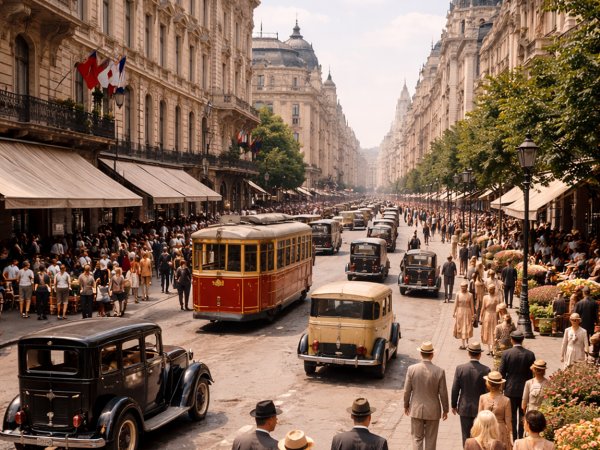
Many of the members of the bourgeoisie had studied abroad, especially in France or Germany, and brought with them cultural influences and Western lifestyles. Bucharest thus began to be nicknamed “Little Paris”, not only because of its architecture, but also because of the lifestyle adopted by the urban elites.
In this context, the bourgeoisie became a symbol of progress and refinement. It dictated fashion, cultural tastes and social standards, and the daily life of its members reflected a combination between Romanian tradition and European modernity. Elegant houses, lavish balls and the concern for education and culture were only some of the defining elements of this class.
The dwelling and the domestic lifestyle
The life of the Bucharest bourgeoisie unfolded in spaces that reflected the social status of the owners. The houses were located in select neighborhoods, such as Dorobanți, Cotroceni or the central area, and were built in various architectural styles: neoclassical, eclectic, art nouveau or art deco. The interiors were decorated with quality furniture, often imported, oriental carpets, paintings and art objects.
The dwelling was not only a private space, but also a place of social representation. The salon, in particular, had an essential role, being intended for receiving guests. Here tea gatherings, musical evenings or intellectual discussions were organized. Etiquette was very important, and the behavior of the hosts and guests had to respect strict rules of politeness and good taste.
The domestic life was supported by household staff. Bourgeois families often had maids, cooks or governesses for the children. This allowed the members of the family to focus on social, cultural or professional activities. At the same time, the children were educated in a rigorous environment, where discipline and good manners were essential.
Food also reflected the social status. The meals were elaborate, inspired by French cuisine, and included several courses. Dinner was often an important moment of the day, in which the family gathered, and sometimes guests were invited. The serving of the meal was a true ritual, with fine tableware and precise rules of etiquette.
Education and cultural formation
Education occupied a central place in the life of the interwar bourgeoisie. Families invested considerably in the training of their children, considering that this is the key to success and to maintaining social status. Children attended prestigious schools, and studies abroad were encouraged, especially for boys, but also for girls in certain cases.
Girls were educated not only in an academic sense, but also in the spirit of art and good manners. They learned music, dance, foreign languages and were prepared for the role of hosts in society. Boys, on the other hand, were oriented toward careers in fields such as law, medicine, engineering or public administration.
Culture was an essential component of daily life. The bourgeoisie attended theaters, operas and concerts. Reading was an appreciated activity, and personal libraries were well equipped. The magazines and newspapers of the time were read daily, and discussions about politics, art or literature were frequent in social circles.
Also, the French language had a privileged status. It was considered the language of culture and refinement, and many members of the bourgeoisie used it in everyday conversations. This cultural orientation toward the West contributed to the formation of a distinct urban identity, different from the rural one.
Social life and entertainment
The social life of the Bucharest bourgeoisie was extremely active and varied. Balls, receptions and dinners were frequent events, where members of the elite met to socialize, exchange ideas and consolidate their relationships. These events were organized with great attention to detail, from decoration to clothing.
Cafés and luxury restaurants were also important meeting places. Here business was discussed, political ideas were debated or social alliances were established. The atmosphere was lively, and elegance was an unwritten rule. Participation in such activities was essential for maintaining status in society.
Entertainment also included modern activities for that time, such as the cinema or car rides. The city’s parks were frequented for promenades, and vacations in mountain or spa resorts had become a common practice. The bourgeoisie thus adopted a dynamic lifestyle, oriented toward relaxation and socialization.
Fashion played an important role in social life. Clothing was an indicator of status and personal taste. Women wore elegant dresses, inspired by Parisian trends, and men adopted well-tailored suits. Public appearance was carefully prepared, and elegance was considered a virtue.
The role of the woman in bourgeois society
The bourgeois woman occupied a complex role in interwar society. Although in many cases she was responsible for managing the household and for the education of the children, she also had an active presence in social and cultural life. Participation in events, organizing gatherings and involvement in charitable activities were important aspects of her role.
At the same time, the interwar period also brought a certain emancipation of women. More and more women had access to higher education and began to work in fields such as education, medicine or the arts. This change reflected Western influences and the social transformations of the era.
The woman was also a symbol of elegance and refinement. Her appearance in society was carefully studied, and her behavior had to respect the strict norms of the time. At the same time, she had an essential role in transmitting cultural and moral values to the next generations.
Transformations and decline toward the end of the interwar period
Toward the end of the 1930s, the life of the Bucharest bourgeoisie began to be affected by political and economic changes. The global economic crisis of 1929 had repercussions in Romania as well, affecting the financial stability of many families. At the same time, internal political tensions and the rise of authoritarian regimes created a climate of uncertainty.
These transformations led to a gradual change in lifestyle. The opulence characteristic of the 1920s began to be replaced by greater prudence. Social events became rarer, and cultural investments were sometimes limited.
With the outbreak of the Second World War, this world of the interwar bourgeoisie began to disintegrate. The subsequent political changes, including the establishment of the communist regime, led to the disappearance of this social class as a dominant force. Properties were nationalized, and the bourgeois lifestyle was replaced by a completely different social model.
Nevertheless, the legacy of the interwar bourgeoisie remains visible even today in the architecture of Bucharest, in cultural traditions and in collective memory. This period continues to be perceived as one of refinement and effervescence, representing an important landmark in the evolution of the city and of Romanian society.
We also recommend: Social contrasts in interwar Bucharest: the luxury of the elites versus life in the outskirts