Social contrasts in interwar Bucharest: the luxury of the elites versus life in the outskirts
- Articles
- 16 APR 26
Interwar Bucharest was a city of strong contrasts, in which Western modernity and local traditions coexisted in a fragile balance. Nicknamed “Little Paris”, the capital of Romania experienced, in the 1920s and 1930s, a period of cultural and urban effervescence, but behind the elegant façade deep social differences were hidden. While the elites enjoyed luxury, refinement, and a cosmopolitan lifestyle, in the outskirts thousands of people lived in modest conditions, marked by deprivation and insecurity. This duality profoundly defined the identity of the city. Bucharest was not only a space of progress and modernization, but also one of inequalities, in which the distance between social classes was visible at every step.
Bucharest “Little Paris” and the façade of modernization
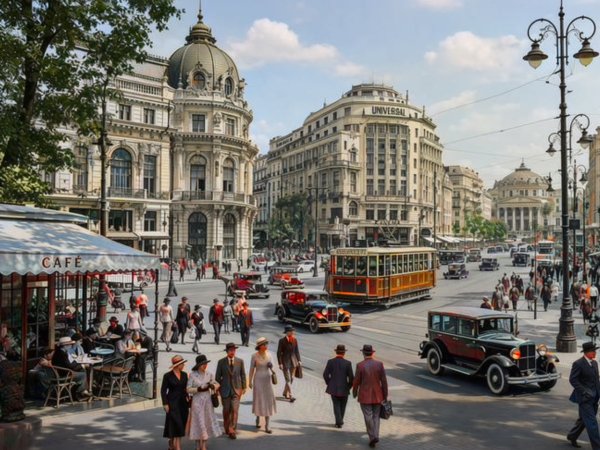
During the interwar period, Bucharest underwent an accelerated transformation. New boulevards, elegant buildings, modern institutions, and sophisticated cafés contributed to the image of a European city. Architecture inspired by the French style, Western fashion, and intense cultural life consolidated the reputation of “Little Paris”.
The city center had become a space of elegance and impeccable appearances. Calea Victoriei, the wide boulevards, and central areas were populated by well-dressed people, luxury automobiles, and shining shop windows. Everything suggested prosperity and modernity.
However, this image did not reflect the entire reality. Beyond the central areas, Bucharest was changing in a completely different way, and the city’s outskirts revealed another face of modernization, much harsher and less visible.
The life of the elites: luxury, culture, and Western influences
The Bucharest elites of the interwar period were made up of major industrialists, politicians, high-ranking officials, intellectuals, and members of the aristocracy. This social category adopted a lifestyle strongly inspired by the West, especially France.
Their homes were true urban palaces, decorated with elegant furniture, works of art, and sophisticated decorations. The interior reflected not only aesthetic taste, but also social status. Parties, receptions, and musical soirées were common events in these circles.
The cultural life of the elites was intense. Theatres, opera houses, and luxury restaurants were constantly frequented. Going to a performance or dining in a refined venue was part of the social routine of the upper class.
Fashion was another indicator of status. Men wore impeccably tailored suits, while women displayed elegant dresses, often inspired by Parisian fashion. Public image was essential, and social appearances were carefully prepared.
The brilliance of the urban center
The center of Bucharest was the space where modernity was most visible. Elegant hotels, refined restaurants, cinemas, and luxury shops defined the urban atmosphere. Here influential people met, business was discussed, and the city’s social life took shape.
Calea Victoriei became the symbol of this world. Shining shop windows, heavy traffic, and well-dressed crowds created the image of a modern capital. Cafés were places of socialization, debate, and intellectual meetings.
However, this brilliance concealed a much more complex reality. Just a few streets away from these elegant areas, life unfolded at a completely different rhythm.
The outskirts of Bucharest: the invisible world of the city
In the outskirts of interwar Bucharest, living conditions were completely different. Here were located the slums, working-class districts, and underdeveloped areas, where workers, small craftsmen, and low-income families lived.
The houses were often small, built from fragile materials, without adequate infrastructure. The streets were unpaved, and access to running water or sewage systems was limited. In many areas, hygiene conditions were poor.
Daily life was marked by hard work and limited resources. People worked in factories, workshops, or poorly paid services. Income was insufficient for a comfortable life, and economic difficulties were constant.
Nevertheless, the communities in the outskirts had strong cohesion. Solidarity among neighbors was essential for survival. Mutual help and community support partially compensated for material shortages.
Work and survival in the working classes
For most residents of peripheral areas, work was an absolute necessity. The factory, workshop, or marketplace represented the main sources of income. The work schedule was often long and exhausting, and working conditions were difficult.
Low wages did not allow for savings or a high standard of living. Families had to carefully manage their resources, and every expense was calculated with caution. In many cases, multiple family members were forced to work to ensure daily survival.
Education was a luxury for many children in these environments. Although schooling was theoretically accessible, economic reality pushed many to enter the workforce early.
Visible differences between center and outskirts
The contrast between the center and the outskirts of Bucharest was evident visually, socially, and economically. While the center was dominated by elegance, order, and modernity, the outskirts were marked by improvisation, deprivation, and modest conditions.
Even clothing reflected these differences. In the center, elegant clothes were a symbol of status, while in the outskirts clothing was simple and functional.
Urban transport also highlighted this separation. Trams and public transport were used by all classes, but routes and travel frequency emphasized the differences between city areas.
The economic role of social inequalities
The social inequalities in interwar Bucharest were not only a social phenomenon but also an economic one. The elite concentrated resources and influence, while the working classes supported the city’s development through labor.
Industry, commerce, and services depended heavily on the workforce coming from the outskirts. Thus, the city functioned on a fragile balance between elite consumption and mass labor.
Economic crises of the period further deepened these differences, affecting especially the vulnerable population.
Culture and social perception
Although there was a clear separation between classes, interwar culture attempted to build bridges between these worlds. Literature, the press, and theatre often reflected the social contrast and brought attention to the realities of the outskirts.
At the same time, the elites often viewed the outskirts as an “invisible” space, even though they directly depended on it. This perceived distance contributed to the persistence of inequalities.
The legacy of a city of contrasts
Interwar Bucharest remains a classic example of a city situated between two worlds. On one hand, modernity, elegance, and Western influences; on the other, the harsh realities of life in the outskirts.
This duality defined not only the social structure of the city, but also its cultural identity. The contrast between luxury and poverty created a complex urban space, full of dynamism and tension.
Looking back, interwar Bucharest cannot be understood without considering both of its faces. The “Little Paris” city was, at the same time, also a city of deep inequalities, and this reality remains essential for understanding its history.
We also recommend: Fashion in interwar Bucharest: how gentlemen and ladies of the Capital dressed a century ago