Fashion in interwar Bucharest: how gentlemen and ladies of the Capital dressed a century ago
- Articles
- 16 APR 26
The interwar period represented one of the most effervescent stages in the history of Bucharest, a moment when the city fully earned its nickname of “Little Paris.” Elegance, refinement, and Western influences deeply shaped the lifestyle of Bucharest’s inhabitants, and fashion became one of the most visible expressions of this transformation. The streets of the Capital were animated by sophisticated outfits, inspired by the great European fashion centers, but adapted to local tastes. Clothing was not just a necessity, but a symbol of social status, good taste, and belonging to a certain class. Both gentlemen and ladies paid special attention to how they presented themselves in public, and appearing in society had become a true art.
Masculine elegance: the suits of the gentlemen of Bucharest
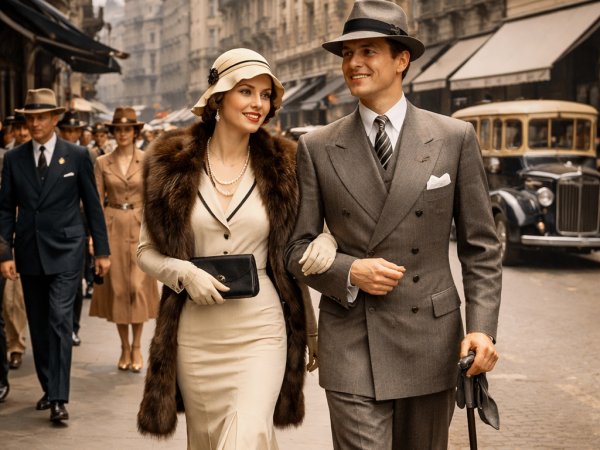
Men in interwar Bucharest stood out through a sober yet refined clothing style. The suit was the central piece of the male wardrobe, being worn both in everyday life and at important events. It was, as a rule, impeccably tailored, made from quality materials such as fine wool or imported fabrics.
The classic suit consisted of a jacket, vest, and trousers, often matched in the same material. The predominant colors were dark—black, gray, navy blue—however, for the warm season lighter shades were also worn, such as beige or cream. The cut was carefully made, highlighting the silhouette, and the details made the difference: elegant buttons, discreet pockets, and well-defined lines.
Accessories had an essential role. The hat was almost indispensable, whether it was a fedora or a bowler hat. The tie or bow tie completed the outfit, and the pocket watch or wristwatch was a sign of social status. Shoes, always well polished, reflected attention to detail.
In high circles, gentlemen frequently resorted to renowned tailors, and some suits were ordered directly from Paris or London. Masculine fashion was less changeable than feminine fashion, but strictly followed the rules of elegance.
Feminine grace: dresses, accessories and Western influences
Women in interwar Bucharest were true ambassadors of elegance. Feminine fashion underwent important transformations during this period, reflecting social and cultural changes. Dresses became looser, shorter, and more adapted to a modern lifestyle.
In the 1920s, the influence of the “flapper” style was evident. Dresses had a dropped waist, were decorated with fringes or beads, and allowed greater freedom of movement. In the 1930s, the silhouette was redefined, the emphasis shifting to elegance and femininity, with longer dresses and cuts that followed the line of the body.
The materials were varied and of high quality: silk, satin, velvet, or lace. Colors and prints reflected Western trends, and the influence of Paris was evident. Ladies from high society ordered their outfits from abroad or had them made by local tailors inspired by French fashion magazines.
Accessories completed the outfits with refinement. Elegant hats, fine gloves, small handbags, and jewelry were indispensable elements. Makeup and hairstyle had also become an integral part of the image, contributing to the creation of a sophisticated style.
Fashion as a symbol of social status
In interwar Bucharest, clothes clearly reflected social position. The elites could afford sophisticated outfits, made from expensive materials and according to the latest trends. Appearances in society were carefully prepared, and elegance was a form of social affirmation.
The middle class aspired to this model, adopting elements from Western fashion, but adapting them to financial possibilities. Shops in the city center offered a variety of products, and local tailors played an important role in spreading trends.
On the other hand, in poorer neighborhoods, fashion was dictated by necessity. Clothes were worn for longer periods, repaired, and reused. Clothing differences were evident and contributed to shaping the social contrasts of the city.
The places where fashion was set
Interwar Bucharest had numerous places where fashion was displayed and admired. Calea Victoriei was the main artery of elegance, where shop windows attracted the gaze of passersby. Here were located the most renowned fashion houses, luxury shops, and tailoring workshops.
Cafés, restaurants, and theaters were spaces where Bucharest’s inhabitants showcased their outfits. Participation in social events required careful preparation, and an impeccable appearance was essential.
At the same time, fashion magazines and the press of the time played an important role in popularizing trends. They presented the latest novelties from Paris and inspired the local public.
External influences and local adaptations
Fashion in interwar Bucharest was strongly influenced by the West, especially by Paris. Styles, cuts, and materials were often adopted and adapted to the local context. This combination between external influences and local traditions gave birth to a distinct style.
Romanian designers and tailors managed to create original outfits that reflected the personality of the wearers. Fashion was not just a copy of Western trends, but a reinterpretation adapted to the tastes of Bucharest’s inhabitants.
The legacy of interwar fashion
Interwar fashion left a strong mark on the identity of Bucharest. The elegance and refinement of that period continue to inspire even today. Although times have changed, the spirit of “Little Paris” remains present in the collective memory.
The outfits of gentlemen and ladies of that era were not only expressions of style, but also of a society in full transformation. They reflected aspirations, values, and the desire for modernity.
Looking back, fashion in interwar Bucharest can be considered a form of art, an expression of elegance and urban identity. It is a period that continues to fascinate and offer inspiration, proving that authentic style never goes out of fashion.
We also recommend: The economic crisis of 1929 and its impact on the inhabitants of Bucharest