The most important personalities who visited Bucharest. From the history textbook to the reality of our times
By Raluca Ogaru
- Articles
- 31 MAY 26
Bucharest has been, over time, more than Romania’s administrative capital. It has been a stage for imperial protocol, a place of diplomatic encounters during the Cold War, a space for major post-communist speeches, a city of papal visits and, after 1989, an important point on the map of international concerts. Emperors, American presidents, Soviet leaders, popes, kings, major artists and personalities who influenced the political, religious or cultural history of the world have all passed through Bucharest.
Some visits remained in archives and historical studies. Others stayed in public memory through images: official motorcades on the capital’s boulevards, speeches in University Square or Revolution Square, religious services in Izvor Park, concerts in stadiums or central parks. Taken together, these episodes also tell the story of Bucharest’s transformation: from a royal capital seeking European recognition, to a communist city, then to the capital of a Romania oriented toward NATO, the European Union and major international cultural circuits.
Franz Joseph I and royal Bucharest in 1896
One of the most important imperial visits in modern Romanian history was that of Emperor Franz Joseph I of Austria-Hungary. The visit took place in September 1896, in an important diplomatic context, after the inauguration of the Iron Gates canal, an event attended by King Carol I, Emperor Franz Joseph and King Alexander I of Serbia. For Romania at the end of the 19th century, the moment had a clear significance: confirming the status of the young kingdom in relation to the great powers of Central Europe.
The visit is analysed in a study published in the journal of the National Museum of Romanian History, which deals extensively with the diplomatic and ceremonial dimensions of the event. The study on Emperor Franz Joseph’s visit to Romania mentions that the trip took place in September 1896 and included ceremonies, dinners, military parades and exchanges of decorations.
For Bucharest, the emperor’s visit meant the city’s entry into a European protocol register. Romania’s capital was not yet the crowded metropolis of today, but it was undergoing rapid modernization, and the meeting between Carol I and Franz Joseph I gave the city important political visibility. Bucharest’s image at the time was that of a royal capital trying to define its place between the Balkans, Central Europe and the major diplomatic centres of the era.
Charles de Gaulle, communist Bucharest and the diplomacy of 1968
In May 1968, General Charles de Gaulle, the President of France, visited Romania. He was one of the most influential political leaders of the 20th century, associated with the French Resistance, the reconstruction of France after the Second World War and the idea of a Europe in which nation states retained a strong role. His visit to Bucharest took place at a tense moment, both for Western Europe, marked by protests in France, and for the Eastern Bloc.
For the regime in Bucharest, de Gaulle’s visit had important symbolic value. Communist Romania was trying to project the image of a foreign policy more independent from Moscow, and the presence of the French president in the capital was used as an argument of diplomatic prestige. An analysis published in the Central and Eastern European Online Library on Charles de Gaulle’s visit to Romania in May 1968 notes the complex context of the trip and the fact that it took place at a complicated political moment.
Bucharest in 1968 was a city controlled by the communist regime, but capable of becoming, for a few days, the setting of an important diplomatic relationship. De Gaulle’s visit did not change the everyday life of Bucharest residents, but it remained one of the major Western appearances in Romania during the communist period.
Richard Nixon, the first visit of an American president to socialist Romania
In August 1969, Bucharest received a historic visit: Richard Nixon, President of the United States, came to Romania. It was the first visit by an American president to a socialist state, and the moment was heavily used by the Ceaușescu regime to underline Romania’s distinctive position within the Eastern Bloc.
Documents published by the Office of the Historian of the U.S. Department of State show that Nixon visited Romania between August 1 and 3, 1969, and include the memorandum of conversations held in Bucharest. The information appears in the American diplomatic volume Foreign Relations of the United States, 1969-1976, Eastern Europe. The American Presidency Project also preserves the text of Nixon’s remarks upon arrival in Bucharest.
For the capital, Nixon’s visit was one of the most spectacular displays of protocol by the communist regime. Beyond propaganda, the moment shows Bucharest’s importance as a space of symbolic negotiation during the Cold War. Romania was still part of the socialist camp, but the American president’s visit sent a message of political differentiation that the regime exploited intensely.
Mikhail Gorbachev and the distance between reform and isolation
In 1987, Mikhail Gorbachev, the leader of the Soviet Union, came to Romania. The visit took place at a time when Eastern Europe was beginning to change, and the Soviet Union was promoting the reforms known as perestroika and glasnost. Nicolae Ceaușescu’s Romania, however, was moving in the opposite direction: isolation, austerity, political control and rejection of reforms.
A report on Mikhail Gorbachev’s visit to Romania, published in the Central European University Press volume “Masterpieces of History”, describes the difficult atmosphere of the meeting and the obvious differences between the Soviet leader and Nicolae Ceaușescu. From this perspective, Gorbachev’s visit to Bucharest can now be read as a sign of the rupture between Romania and the direction in which the rest of the Eastern Bloc was moving.
For Bucharest, the episode has a special significance. The official city was prepared for the Soviet leader’s visit, but behind the protocol stood a tired and isolated society. Only two years after this visit, in December 1989, the capital would become the stage of the collapse of Romania’s communist regime.
Pope John Paul II and the first major ecumenical moment
In May 1999, Bucharest was at the centre of a historic visit: Pope John Paul II came to Romania, the first visit by a pope to a majority-Orthodox country. The event had a powerful religious, diplomatic and symbolic dimension, at a time when Romania was trying to consolidate its European path and rebuild its relationship with the Western world.
The Vatican preserves the main speeches and moments of the visit. On May 7, 1999, Pope John Paul II addressed the Romanian authorities upon his arrival in Bucharest, and the text is available on the Vatican website, on the page dedicated to the Pope’s address upon arrival in Romania. Two days later, on May 9, 1999, the Pope celebrated Holy Mass in Izvor Park, and the homily can be read on the Vatican website, on the page about the Mass in Izvor Park.
For Bucharest, the visit was a rare moment of international religious visibility. Izvor Park, located next to the Palace of Parliament, became the site of a historic service, and the capital was seen at the time as a place of dialogue between Catholics and Orthodox Christians.
Bill Clinton and University Square in post-1989 Romania
In July 1997, U.S. President Bill Clinton came to Bucharest at a sensitive moment for Romania. The country had not been included in the first wave of NATO enlargement decided at the Madrid summit, and Clinton’s visit was designed as a signal of political support for Romania’s Euro-Atlantic direction.
His speech in University Square remained one of the most important public moments of the 1990s. The American Presidency Project publishes the text of the remarks addressed to the citizens of Bucharest, in which Clinton spoke about the partnership between the United States and Romania. The context of the visit is also explained in anniversary materials about the launch of the Romania-U.S. Strategic Partnership, including the Calea Europeană analysis on Bill Clinton’s visit to Bucharest.
For Bucharest residents, the image of the crowd in University Square became a symbol of post-communist hope. The city was no longer only the former capital of an isolated regime, but a space in which Romania openly affirmed its Western direction.
George W. Bush and Revolution Square after the NATO invitation
In November 2002, U.S. President George W. Bush came to Bucharest shortly after Romania had been invited to join NATO. His speech in Revolution Square was one of the strongest symbolic moments in Romanian-American relations after 1989.
The White House published the American president’s speech, delivered in Revolution Square, under the title President Bush Welcomes Romania to NATO. The White House archive also includes a page dedicated to the Eastern Europe visit, recording George W. Bush’s presence in Revolution Square in Bucharest, alongside President Ion Iliescu.
The choice of Revolution Square was not accidental. The place associated with the fall of the Ceaușescu regime became, in 2002, the stage confirming Romania’s path toward NATO. For Bucharest, George W. Bush’s visit symbolically closed a stage that had begun in December 1989: the definitive break from the Soviet sphere of influence and entry into the Western security architecture.
Pope Francis and the European Bucharest of 2019
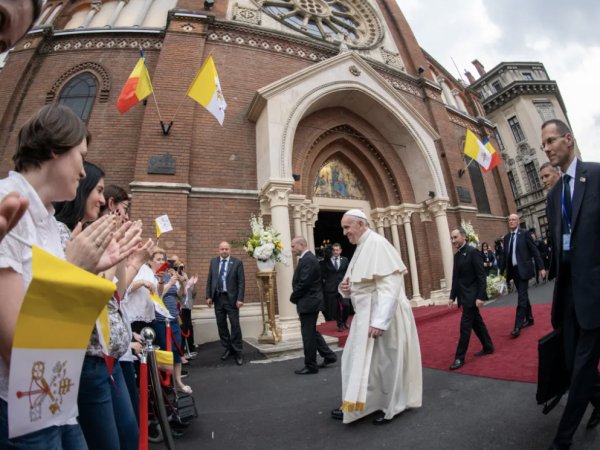
Twenty years after Pope John Paul II’s visit, Bucharest received another papal visit. Pope Francis came to Romania between May 31 and June 2, 2019, and the first part of the visit took place in the capital. The motto of the journey was “Let’s walk together”, and the message emphasized dialogue, unity and closeness between communities.
Vatican News reported on Pope Francis’s arrival in Bucharest, where he was welcomed by President Klaus Iohannis and representatives of religious communities. In Bucharest, Pope Francis also visited the National Cathedral, and the Holy See Press Office recorded the moment of the “Our Father” prayer on the page about the visit to the new Orthodox Cathedral in Bucharest.
This visit showed a Bucharest different from the one in 1999. Romania was already a member of NATO and the EU, and the capital once again became a space for international religious dialogue. If John Paul II’s visit had the character of a historic first, Pope Francis’s visit confirmed the continuity of a difficult but important dialogue.
King Charles III and his personal connection with Romania
King Charles III has a special relationship with Romania, built long before his accession to the throne. His visits are associated especially with Transylvania, rural heritage and nature conservation, but Bucharest remains the official place through which this relationship is reaffirmed.
In June 2023, King Charles III came to Romania shortly after his coronation. The British Royal Family published the speech delivered in Bucharest, in which the monarch spoke about his connection with Romania and the country’s natural and cultural heritage. The text can be read on the official Royal Family website, on the page with King Charles’s speech in Bucharest. Reuters also recorded the official ceremony at Cotroceni Palace in its material about King Charles’s visit to Romania.
For Bucharest, the visit had a distinct symbolic value. It was not only a regular official visit, but Charles’s first presence in Romania as king. The capital functioned as the official gateway of a personal relationship that goes beyond diplomatic protocol.
Michael Jackson and Bucharest entering global pop culture
After 1989, Bucharest also began to receive major international artists. One of the most important moments was Michael Jackson’s concert on October 1, 1992, held at Lia Manoliu National Stadium, as part of the Dangerous World Tour. The concert later became internationally known through the recording “Live in Bucharest: The Dangerous Tour”.
The Bucharest concert was officially distributed by the Michael Jackson Estate on YouTube, and descriptions associated with the recording mention the October 1, 1992 concert at the National Stadium in Bucharest, in front of a very large audience. In 2019, international media reported that the Michael Jackson Estate had published “Live in Bucharest” on YouTube in the context of the “Leaving Neverland” documentary broadcast, and Pitchfork wrote about the release of the concert on the official Michael Jackson channel.
For Bucharest, the concert had the value of cultural opening. Romania had only recently emerged from communist isolation, and the presence of an artist of Michael Jackson’s scale showed that the city could enter the circuit of major Western shows. It was not classic diplomacy, but it was still a form of connection with the world.
Madonna and the capital on the map of major pop tours
In August 2009, Madonna performed in Bucharest, in Izvor Park, as part of the Sticky & Sweet Tour. For the Romanian public, the event was one of the biggest pop concerts organized in the capital after 1989. Unlike political and religious visits, Madonna’s presence said something different about the city: Bucharest had become an important enough destination for major international tours.
The concert also remained in public memory because of the moment when the artist spoke about discrimination against Roma people. The Guardian reported the episode in its article on Madonna’s concert in Romania, mentioning the public’s reaction after the artist’s message. The Bucharest stop is also mentioned in archives dedicated to the Sticky & Sweet Tour, including MadonnaTribe materials about the concert in Romania.
For Bucharest, Madonna represented another step in normalizing the city as a space for major live events. Izvor Park, previously associated with Pope John Paul II’s visit, also became the stage for an international pop show. The city was thus changing registers: from papal visits and political speeches to mass cultural events.
What these visits show about the city’s transformation
The visits of major personalities can also be read as an unofficial chronology of Bucharest. In 1896, Franz Joseph I found a royal capital in the process of asserting itself. During the communist period, Charles de Gaulle, Richard Nixon and Mikhail Gorbachev arrived in a city used as a stage for political representation, but strictly controlled by the regime.
After 1989, Bucharest became the space where Romania publicly announced its new direction. Bill Clinton and George W. Bush spoke in squares that already carried historical meaning. Pope John Paul II and Pope Francis gave the city an international religious and ecumenical dimension. King Charles III reaffirmed the British monarch’s personal connection with Romania, while Michael Jackson and Madonna brought Bucharest into the circuit of major pop performances.
Not all these visits had the same political weight, but each left a recognizable image. University Square, Revolution Square, Izvor Park, Cotroceni Palace, Otopeni Airport, the National Cathedral and the former Lia Manoliu Stadium became, at different times, places where Bucharest was seen by the world.
A capital seen differently through the eyes of the world
Franz Joseph I saw Bucharest as an emerging royal capital, positioned at the edge of Europe’s great balances of power. Charles de Gaulle and Richard Nixon encountered a communist city that wanted to appear more open than other Eastern Bloc capitals. Mikhail Gorbachev arrived in a frozen Bucharest, only two years before the fall of the Ceaușescu regime.
After 1989, Bucharest presented itself differently. Before Bill Clinton and George W. Bush, the city became the stage of Euro-Atlantic aspirations. Before the popes, it was a place of religious dialogue. Before King Charles, it was the official gateway of a personal relationship with Romania. Before Michael Jackson and Madonna, it was audience, energy, spectacle and a desire to reconnect with the world.
These visits are not only episodes of protocol or entertainment. They show how the capital changed and how Romania wanted to be seen at key moments. Bucharest has often been the setting through which the country communicated its ambitions, vulnerabilities and affiliations.
READ ALSO:
Tourist in Bucharest - The best season to visit Bucharest
What to Visit in Bucharest If You Are Not Visiting the Romanian Capital for the First Time