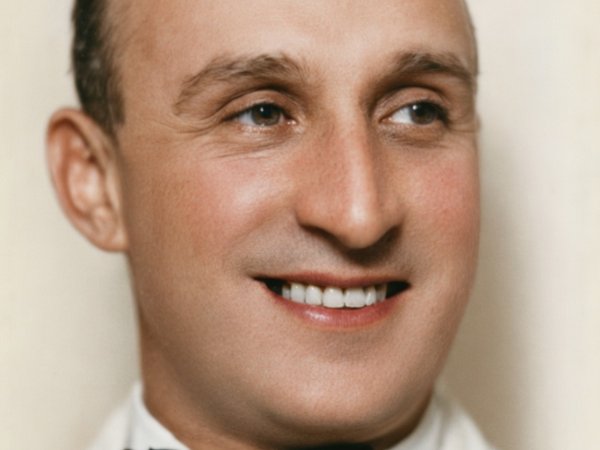
Stars of interwar Bucharest: Composer Gherase Dendrino, one of the founders of the Romanian light music school
- Articles
- 28 MAY 26
Interwar Bucharest was a period of artistic brilliance, cultural effervescence, and performances that transformed the evenings of the Capital into true social events. During that era, revue theaters, summer gardens, and performance halls were the places where the public came to forget their worries and discover the new stars of Romanian music and stage art. Among the great names who contributed decisively to the development of Romanian light music was composer Gherase Dendrino, an artist considered one of the founders of this musical genre in Romania. Talented, elegant, and highly appreciated by his contemporaries, Dendrino was more than a simple composer. He was a pianist, conductor, operetta creator, film music author, and one of the people who defined the artistic atmosphere of old Bucharest. His melodies remained in the public memory for decades, and his artistic activity extended from the interwar period to the years following the Second World War.
Childhood and musical beginnings
Gherase Dendrino was born on September 2, 1901, in Turnu Măgurele, during a period when Romania was beginning to develop its cultural and artistic life at an accelerated pace. From an early age, he showed a special passion for music, and his talent was quickly noticed.
Wishing to build a serious career in the artistic field, he attended the Bucharest Conservatory, one of the most important musical institutions of the time. He had the chance to study with famous and respected professors such as Dumitru Georgescu-Kiriac and Alfonso Castaldi, two personalities who deeply influenced Romanian music.
The years of study offered him not only solid technical training, but also direct contact with the artistic world of the Capital. Bucharest in the 1920s was a cosmopolitan city, full of cafés, theaters, and cinemas, where music had an essential role in social life. For a talented young musician, opportunities began to appear rapidly.
The first steps in artistic Bucharest
After graduating from the Conservatory, Gherase Dendrino began working as a pianist at the Elita cinema in 1928. During that period, cinemas were not only places where the public watched films, but also spaces where live music played a very important role. Silent films were accompanied by orchestras or pianists, and the artists who worked in such places had to possess talent, spontaneity, and the ability to convey emotion through performance.
The experience gained at the Elita cinema helped him enter the important artistic circles of the Capital. Soon, his talent as a composer and conductor began to be noticed, and his professional destiny changed radically at the moment he arrived at the famous Cărăbuș Theater.
The Cărăbuș Theater, led by the great Constantin Tănase, was one of the most popular stages of interwar Bucharest. Modern revue performances full of humor, music, and dance, inspired by the great European stages, were presented there. For any artist of the time, collaborating with Constantin Tănase represented a confirmation of his value.
Collaboration with Constantin Tănase and success at Cărăbuș
At the Cărăbuș Theater, Gherase Dendrino debuted as a conductor and composer. This stage would define his entire artistic career. His compositional talent and ability to create memorable melodies quickly transformed him into one of the most appreciated musicians of Romanian revue theater.
The performances at Cărăbuș enjoyed enormous success among the public. Bucharest residents came in large numbers to watch the shows full of satire, irony, and lively music. In this artistic universe, Gherase Dendrino contributed decisively to the atmosphere of the performances through his elegant and easily memorable compositions.
An important moment in his career was the triumphant tour organized in 1939 together with the Cărăbuș troupe. As conductor, Dendrino accompanied the artists in performances held in Istanbul, Cairo, Beirut, Tel-Aviv, and Jerusalem. The tour represented a great achievement for Romanian theater and proof of the popularity enjoyed by Romanian artists abroad.
For Gherase Dendrino, this experience was extremely important. Contact with the international public and with Oriental and Western musical influences enriched his artistic style and strengthened his reputation as a valuable musician.
The success of musical performances in the 1940s
During the period 1940-1945, Gherase Dendrino became one of the most sought-after composers of theater music. He signed the music for extremely popular performances such as “Patience, Tănase” and “Don’t Give Up, Tănase!”, productions that continued the tradition of satirical shows launched by Constantin Tănase.
During the same period, he collaborated with Ion Vasilescu and Vasile Vasilache in composing melodies for numerous successful musical comedies. Among them were “Express Train 402,” a play written especially for Birlic and Nora Piacentini, as well as performances such as “Firfirică,” “Sir Cockroach,” “Poor Gică,” “Apartment 54,” “At a Good Hour,” “A Sugar Boy,” “The Villa with Illusions,” “Străbunescu & Co,” and “Piccolo.”
These productions were staged at the Savoy Theater, one of the most important revue theaters in Bucharest. The public was attracted not only by the famous actors, but also by the charming music composed by Dendrino and his collaborators.
Another important title in his career is “Gioconda at Savoy,” a performance that remained known in the history of Romanian musical theater due to its enormous success.
Conductor and operetta creator
After the war, Gherase Dendrino continued his artistic activity at an impressive pace. Between 1946 and 1949 he was conductor at the Alhambra Theater, another important stage of Bucharest entertainment.
Beginning in 1950, he became chief conductor of the Bucharest Operetta Theater. This position once again confirmed his artistic prestige and the important place he occupied in Romanian music.
Dendrino did not limit himself only to light music and revue performances. He also composed operettas that had a major impact on the public. Among the best known are “Let Me Sing” and “Lysistrata.”
The operetta “Let Me Sing” is considered one of his most important creations and represents a tribute to the great composer Ciprian Porumbescu. The work enjoyed remarkable success and remained in the repertoire of Romanian theaters for a long time.
The melodies that conquered the public
Throughout his career, Gherase Dendrino composed numerous melodies that became extremely popular and were hummed by entire generations.
Among his best-known creations are “A Mandolin Was Singing,” “What Are You Doing This Evening?”, “Safe Journey,” “We Met in a Waltz,” “Don’t Be Upset If I Cry,” “A Gondolier Sang a Melody,” and “Maybe You Sing Too…”
These melodies stood out through elegance, sensitivity, and Western influences specific to the era. Dendrino’s style combined romanticism with the modern rhythms of the time, and his compositions had a special melodiousness that made them easy to remember.
Many of his songs were performed in revue shows, on the radio, or in the elegant restaurants of Bucharest. Gherase Dendrino’s music contributed to defining the bohemian and sophisticated atmosphere of the Capital.
Presence on major international stages
The value of his creations was not limited only to Romania. In 1965, Gherase Dendrino’s melodies reached the famous stage of the Olympia Theater in Paris, on the occasion of the “Grand Music Hall de Bucarest” tour performed by the “Constantin Tănase” Theater.
For Romanian artists of the time, Olympia represented one of the most prestigious European stages. The fact that Dendrino’s music was presented there demonstrates the composer’s high artistic level and the appreciation enjoyed by Romanian theater abroad.
This tour was considered an important moment for promoting Romanian culture abroad and an international recognition of the value of the artists formed during the interwar period.
Film music and appearance in cinematography
Besides his theatrical and compositional activity, Gherase Dendrino was also involved in cinematography. He composed music for the films “The Protar Affair” and “On My Responsibility,” both released in 1956.
His musical experience and artistic sensitivity helped him create soundtracks suitable for the atmosphere of Romanian films of the era.
More than that, Gherase Dendrino also appeared as an actor in the film “A Winter Night’s Dream,” directed by Jean Georgescu in 1946. In this production he played alongside the great actress Maria Filotti, one of the most important personalities of Romanian theater.
This experience once again demonstrates his artistic versatility and his ability to adapt to different forms of performance.
The artistic legacy of Gherase Dendrino
Gherase Dendrino passed away on January 4, 1973, leaving behind an impressive career and an essential contribution to the development of Romanian light music.
His work remains closely linked to the golden age of artistic Bucharest, to revue theaters, and to the elegant atmosphere of the interwar Capital. Through his melodies and performances, Dendrino contributed to the formation of a modern Romanian musical identity.
Today, his name is associated with the beginnings of Romanian light music and with the era of revue performances that made Bucharest famous. Although time has passed, many of his creations continue to be appreciated for their refinement and special charm.
Gherase Dendrino was one of those artists who transformed music into an expression of elegance and urban sensitivity. Through his talent, he managed to become one of the representative figures of 20th-century Romanian culture and one of the authentic stars of interwar Bucharest.
We also recommend: The stars of interwar Bucharest: Elvira Godeanu - the child abandoned by her father, Zoe Trahanache, the duchess of Romanian theatre