What childhood looked like in Bucharest during the communist years, between 1960 and 1989
By Eddie Țone
- Articles
- 30 MAY 26
The Bucharest of communist childhood turned small things into true domestic epics. A burst ball, patched with Scotch tape, could keep an entire apartment stairwell busy. A matchbox became a garage. A queue for oranges, toward the end of the eighth decade, could enter a family’s memory as a great battle of history. The Bucharest child grew up among hot asphalt, echoing apartment stairwells, crowded parks, school uniforms, rare cartoons, and an entire pedagogy of the manual called “how to manage as well as possible.”
Between 1960 and 1989, childhood changed visibly, passing through several phases. The 1960s still preserved a certain urban breathing space, with old neighborhoods, courtyards, vacant lots, trams, and neighborhood cinemas. The 1970s brought large apartment-block districts, construction sites, new schools, camps, school celebrations, and a more organized childhood. The 1980s tightened the setting, dimmed the light in homes, brought cold, rationing, a TV schedule thinned down to two hours, and a form of early maturity in which children quickly learned the value of a banana, a Chinese chocolate bar, or a pair of jeans received from relatives.
Bucharest’s communist childhood had its real charm, but that charm often stood next to very concrete constraints. Children laughed, ran, collected gum inserts, traded objects, went to the cinema, fought over a scooter, dreamed of Turbo chewing gum, and tied the red scarf around their necks. Everything happened in a city that was growing, being demolished, becoming uniform, and getting used to speaking in whispers about the big things.
The early years, between kindergarten, the apartment courtyard, and the Falcons of the Homeland
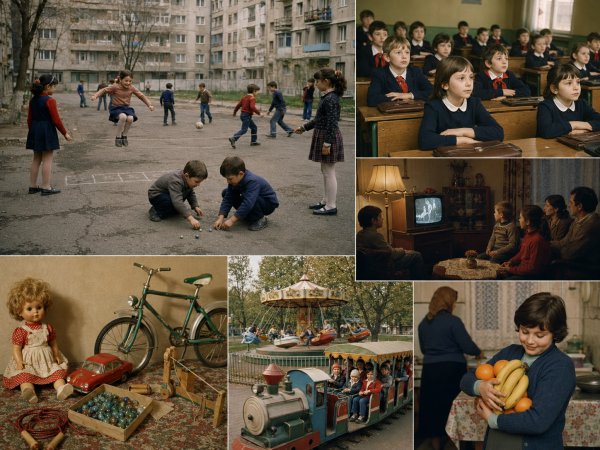
For a small child, communist Bucharest usually began around the apartment block or around the courtyard. In the old neighborhoods, the world still had gates, neighbors sitting at windows, and children making complicated routes among fences, sheds, and trees. In the new districts, the universe was organized around the apartment stairwell, the green space between blocks, and the metal swings, those educational instruments that seemed designed by someone convinced that material resistance mattered more than the delicacy of childhood.
At kindergarten, the child entered a world of fixed schedules. Afternoon nap, mug of tea, food served on thick plates, celebrations, poems, songs, and lining-up exercises. From the second half of the 1970s, preschoolers also entered the world of the Falcons of the Homeland, an organization created in 1976 for children aged 4 to 7. The specific uniform, with orange elements, placed them symbolically in the antechamber of Pioneer life. The child learned early that festivity had precise rules, and that the group photo demanded seriousness, even when shoelaces came undone and bangs stood in every direction.
Toys for small children were few, and precisely for that reason they became characters with long biographies. Arădeanca dolls were among the best-known Romanian toys of the period. They had eyes that closed, combable hair, stiff dresses, and a solemn expression, as if they had just been called to a meeting. For boys, tin or plastic toy cars, trucks, little tractors, cap guns, toy soldiers, Indians and cowboys, and building cubes represented serious wealth. A toy received on June 1, from Father Frost, or on the child’s birthday was kept, repaired, lent with caution, and claimed back with impressive legal energy.
Outside the home, games required minimal scenery and maximum imagination. Hopscotch, elastic, blind man’s buff, ducks and hunters, country-country we want soldiers, lapte gros, and hide-and-seek worked perfectly in the space between two apartment blocks. Bucharest’s neighborhoods became sports fields, theater stages, race tracks, and people’s courts. A curb was enough for entire championships. A piece of chalk found in a schoolbag could draw a world.
Primary school, the uniform, and entry into the world of the Pioneers
In primary school, childhood received a schoolbag, a registration number, a desk, a class register, and a generous dose of solemnity. The communist school cared deeply about form. The uniform, collar, badge, tied-back hair, trimmed nails, covered notebook, clean cover, and orderly handwriting were part of daily education. The teacher had an authority that descended over the classroom with the precision of a wooden ruler placed on the desk.
In second grade, pupils became Pioneers. The moment came with a ceremony, an oath, the red scarf with the tricolor, and the official entrance into a universe in which childhood was placed in the service of the state. On paper, the Pioneer was supposed to study well, be hardworking, polite, orderly, and devoted to the homeland. In practice, the child quickly understood that a wrinkled scarf could trigger comments, and that the plastic ring through which the scarf passed had an importance disproportionate to its size.
Textbooks were standardized, lessons carried official formulations, and compositions about the homeland, the party, factories, harvests, and the leader appeared with a frequency that was healthy for the system and tiring for the pupil. At the same time, school remained the place where many children discovered reading, mathematics, drawing, choir, sports, and their first solid friendships. Classes were often large, and desks preserved underneath them a small museum of notes, hardened chewing gum, and fountain-pen caps.
For children in Bucharest, school also had its own geography. The road to school could pass by the grocery shop, tobacco shop, confectionery, cinema, market, or construction site. In the 1970s and 1980s, many new districts grew with schools placed between apartment blocks, and the schoolyard became a football pitch, gathering place, space for line-ups, and arena of small social hierarchies. Whoever had a good ball, a Chinese pencil case, scented gum, or foreign felt-tip pens quickly entered a discreet aristocracy.
Toys, collections, and the small economy of exchange
The children of communist Bucharest were masters of collecting. They collected chewing-gum inserts, stamps, bottle caps, badges, stickers, matchbox labels, foreign wrappers, photos of actors, postcards, foreign cigarette packs, colored napkins, and anything that passed through their minds and hands. The value of an object depended on rarity, origin, and story. A glossy wrapper from the West could surpass many perfectly functional objects in prestige.
Turbo chewing gum, which appeared toward the end of the 1980s in the memory of many children, became almost mythological through its car inserts. Before it, there were other small treasures, from Chinese chewing gum to Rom chocolate bars, Eugenia biscuits, drops, caramels, puffed corn snacks, and CIP candies. Some were easy to find, others appeared like astronomical phenomena, briefly visible, then gone. See… Cuban candies.
Romanian industrial toys coexisted with improvisation. A cardboard box became a television, a wire became a steering wheel, a spool became a wheel, and a piece of wood could be a ship, pistol, or microphone, depending on the mood of the day. Children built forts out of pillows, paper airplanes, slingshots, bows, swords, telephones made from boxes tied with string, and all sorts of devices that parents confiscated with the air of customs authorities.
There were board games too. “Nu te supăra, frate,” “Piticot,” dominoes, chess, backgammon played around the house, and magnetic games brought family evenings around the table. For many children, chess had a special status because it seemed simultaneously a game, an intellectual discipline, and a method by which an adult could fall asleep respectably in an armchair. Some had even got their hands on Monopoly and tried to reproduce it from cardboard and… memory.
City entertainment — from the cinema to Children’s Town
Under communism, Bucharest had a very strong neighborhood life, and for children the cinema was one of the great outings. Neighborhood cinemas or central ones, from Favorit to Gloria, from Patria to Scala, from Luceafărul to Festival, offered access to Romanian films, Soviet productions, comedies, adventure films, cartoons, and, more rarely, Western movies, which reached the country several years after their international premieres. The queue for tickets, the smell of the hall, the folding seats, and the rustle of candy wrappers turned going to the cinema into a small urban celebration.
Parks played an essential role. Cișmigiu, Herăstrău, Carol, Tineretului, IOR, and the green spaces between apartment blocks offered children places to run, walks, boats, ice cream, cotton candy, and family photographs. Tineretului Park, inaugurated in the 1970s, became an important landmark in the south of the capital. Children’s Town, built in the 1980s in the Tineretului Park area, quickly entered Bucharest mythology, with a little train, carousels, Ferris wheel, bumper cars, and amusement rides that seemed spectacular in a world with few options.
The Palace of the Pioneers was another major landmark. Established in Cotroceni in 1950 and operating in various other locations until 1985, when the one in Tineretului was inaugurated and still exists today, it offered clubs and activities for children, from music and dance to sports, sciences, model airplanes, art, and other educational interests. For the gifted or ambitious child, such clubs could open real paths. For the child brought there by parents with great hopes, they could become yet another crowded agenda, alongside homework, uniform, and comments about handwriting.
Television had a special power precisely because of its rarity. Nell Cobar’s “Mihaela,” with Azorel alongside her, remained one of the bright figures of Romanian animation. “Teleenciclopedia,” launched in 1965, kept children and parents in front of the screen with a combination of nature, history, science, and voices that became famous — could we ever forget “Moțu” Pittiș, Sanda Țăranu, or Carmen Movileanu? There were also series such as Dallas, Kojak, and Colombo, there were westerns, and there were other drops of the West that, little by little, evaporated.
In the 1980s, when the TV schedule was drastically reduced to only two hours of odes per day, the appearance of a decent program became an event. At the same time, antennas appeared on apartment blocks, and Bulgarian television became a friend to children as well. They acquired a form of patience that today would seem like an extreme sport.
Adolescence, high school, and rites of passage
After the age of 14, the child entered the world of the Communist Youth Union, high school, productive practice, the uniform worn with less and less conviction, and small gestures of individuality. Bucharest teenagers listened to music on cassette players or reel-to-reel tape recorders, traded tapes, copied cassettes, caught foreign radio stations, and built their cultural tastes on routes parallel to the official offer. A good cassette circulated like a diplomatic letter. Complete with a list of songs, written as neatly and colorfully as possible.
High school brought more sophisticated friendships, first loves, outings to confectioneries, the cinema, the park, tea houses, or the city center, for a profiterole at Scala or Casata. For teenagers of the 1970s, Bucharest still had many classic urban landmarks. For those of the 1980s, the city was changing brutally through demolitions, construction sites, systematization, and the emergence of the Civic Center. Children and teenagers saw entire streets disappear, families being relocated, familiar places turning into rubble. Urban childhood received harsh lessons about the fragility of the city.
Teenage fashion had precise codes. Jeans, foreign sneakers, jackets, T-shirts with Western prints, sunglasses, perfumes brought from abroad, or a simple bag with a foreign logo functioned as status symbols. In an officially egalitarian world, differences were sometimes visible in very small details. A good pen, a Japanese pencil case, a better-looking pair of sneakers, or a foreign magazine could quickly change one’s social position in the high-school hallway.
The 1980s and childhood in scarcity
The 1980s brought a harsher reality over Bucharest childhood. Food rationing, queues, cold apartments, saved electricity, and the reduced TV schedule entered family life. Children became witnesses to conversations about meat, oil, sugar, gas cylinders, milk, bread, oranges, and bananas. Sometimes they stood in line with parents or grandparents; other times they held the place in the queue, a social institution in itself, with rules, suspicions, and small neighborhood dramas.
In homes, winter required thick sweaters, blankets, electric heaters, warmed water, and a great deal of inventiveness. Homework was done in weak light, and bathing depended on the hot-water schedule. The child learned early the difference between desire and availability. An orange received during the holidays, a banana kept on top of the cupboard until it ripened, a foreign chocolate bar divided into small pieces carried an almost ceremonial weight.
And still, children found spaces of freedom. The apartment stairwell, the vacant lot, the garage roofs, the back of the school or apartment block, the park, the cinema, and the room of a classmate with a cassette player became territories of their own. Children’s lives were organized in fast, analog, and highly efficient networks. A whistle under the window replaced the telephone. A ball slammed against the asphalt announced the start of the match. A Pegas bicycle made its owner look like the holder of a diplomatic vehicle.
A childhood between official discipline and improvised freedom
Childhood in communist Bucharest was a dense mixture of discipline, relative poverty, solidarity, propaganda, play, ingenuity, and moderate happiness. Children grew up with uniforms, red scarves, school celebrations, standardized textbooks, and official speeches. They also grew up with football between apartment blocks, Arădeanca dolls, elastic, hopscotch, confectioneries, cinemas, parks, the little train at Children’s Town, Mihaela, Teleenciclopedia, and friendships tied around small objects.
Bucharest was a space of control, but also of improvisation. The state tried to organize the child, the neighborhood educated the child in its own way, and the family taught the art of everyday survival. In the middle of it all, the child did what children do in any oppressive era. Took the available material, turned it into play, and built a world large enough to fit between two apartment blocks, a school desk, and a TV screen that came on in the evening for far too little time.
You may also like: From Vacant Lots to Playgrounds: Growing Up in Bucharest Over the Past 30 Years