Pawnbroking, a 550-Year Story: How an Act of Charity Became the Shop on the Corner
- Articles
- 14 JUL 26
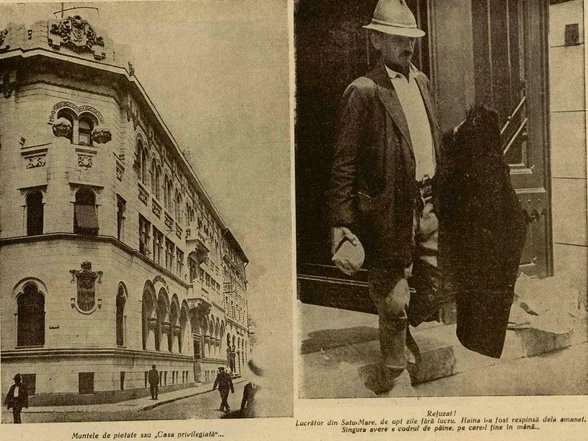
On Sfântul Ionică Street in Bucharest once stood a multi-story building with a sober, imposing façade, the kind of architecture that left no doubt about how seriously the institution inside took itself. A chronicler of the time noted, with a touch of irony, how luxurious the building looked for an institution that claimed to be modest. Inside operated the Mont-de-Piété, officially called the "Privileged House for Pawn Loans." The name sounded like a government office. What happened behind those doors was, in fact, a direct mirror of urban poverty: people arriving with a watch, a piece of jewelry, or a good coat, in exchange for a small sum of money and a receipt many never returned to redeem.
The story doesn't start in Bucharest and not in the twentieth century either.
Perugia, 1462
The model has an Italian, religious origin. In Perugia, in 1462, the Franciscan friar Michele Carcano preached during Lent against the usury practiced by the city's Jewish moneylenders, who operated under agreements with public authorities. The city council voted almost unanimously to revoke those agreements and allocated 3,000 florins to found a "mount" of pawn loans, meant as an alternative with low or no interest. Popular tradition credited the founding to another Franciscan, Barnaba Manassei da Terni, who was actively present in the city during the same period and later helped extend the system to Assisi, Foligno, and Terni. Contemporary historians of the phenomenon, such as Maria Giuseppina Muzzarelli, now treat the founding as a collective effort of the Franciscan Observant movement rather than the work of a single man.
The Latin name, Mons Pietatis, then traveled across Catholic Europe — Monte di Pietà in Italian, Mont-de-Piété in French, Monte de Piedad in Spanish. Interest rates charged were, in theory, kept below the cost of the money lent itself, framed instead as covering the "service" of administration — a theological distinction meant to sidestep the medieval prohibition on usury. In Avignon, such a house opened on January 25, 1589, overseen by the Jesuits, with a very specific target audience: the "ashamed poor," people going through a crisis (illness, unemployment, marrying off a daughter) but too embarrassed to beg for help from neighbors.
Bucharest and an Archival Disagreement
This is where things get less tidy than a popular-history article would like them to be.
One source — the Bucharest City Hall archive, the fund on the Mont-de-Piété held at the National Archives — places the founding of the Bucharest institution in 1871, as a public institution under municipal authority, funded by public capital and donations. A different chronology, reconstructed from period press and from a biography of one of the people involved, tells a different story: a first project by Finance Minister Nicolae Rosetti-Bălănescu around 1864, left unfinished because of the political instability of the Principalities; a second attempt by Menelas Ghermani, Finance Minister between 1888 and 1895, blocked by the failure of the monometallic reform he was pushing at the same time; and only in 1905 the actual founding, in Bucharest, of a bank called "Mont-de-Piété," under the control of the Albina Bank of Sibiu, with the Transylvanian economist Corneliu Diaconovici as director and a 30-year concession granted by conservative minister Take Ionescu — half the net profit was meant to go to the Red Cross.
The two chronologies don't match, and the sources available online don't allow for a confident reconciliation. It's possible that two distinct institutions carried the same name at different times — one municipal and early, the other a private bank from the early twentieth century. It's also possible one of the two chronologies contains an error that has simply been repeated across articles for years. Without access to the archive itself or to a dedicated monograph, the honest position is to say plainly: the exact founding year isn't certain, only that an institution under this name operated in Bucharest for several decades, in a building on Sfântul Ionică Street.
What we do know is how it worked. An appraiser assessed the value of the item brought in and offered, as a loan, roughly a third of it. The owner received the money and a receipt stating the sum, the interest, and the term — usually one to three months. If they didn't return by the deadline, a grace period followed, then the item went to auction; from the sale proceeds, the institution recovered its loan, and the remainder, in theory, went back to the owner.
The Neighbors Across the Street
Right on the same street as the Mont-de-Piété, on the opposite sidewalk, other businesses operated under names like "exchange houses" or "loan houses." They had no official right to lend against pledged goods, so they got around the law a different way: they bought up the receipts issued by the Mont-de-Piété from people desperate for cash, knowing the pledged item's real value was several times higher than the sum written on the receipt, then offered a fraction of that difference. The pattern repeated constantly — the exchange house's window kept filling up with new pieces, resold with no obligation to return the difference to the actual owner. A charitable institution doesn't eliminate usury around it. It just moves it across the street.
A War and a Lost Treasury
World War I hit the banking institution run by Diaconovici directly. He had sided with the political line favoring Romania's involvement alongside the Central Powers, a position that permanently marked his public career — after the war he was accused of pro-German sympathies and forced to withdraw from public life. The bank's assets vanished along with the state treasury, sent to Moscow in the winter of 1916, when the capital was occupied by German troops, and never recovered from Soviet Russia.
What happened to the pawnbroking function itself during the interwar years and then under communism is harder to reconstruct from public sources. We know for certain that the regime installed after 1948 nationalized, through a single law passed in one day, all the banks, industrial enterprises, and insurance institutions in the country — the National Bank had already come under state control two years earlier. It's reasonable to assume that any Mont-de-Piété-type banking institution was swept up in that wave, but no document has turned up that explicitly confirms, with a date and legal basis, the specific dissolution of pawnbroking activity. That remains a gap the published history leaves unresolved.
Commerce, Without the Charitable Core
Pawnbroking only reappears publicly after 1989, but in a form entirely different from the original. It's no longer a public institution or a bank with a social mission and profits donated to a charity — it's a private business, regulated since the mid-2000s as a non-bank financial institution (NBFI), supervised by the National Bank and the Consumer Protection Authority. Interest rates are no longer set by a public authority on behalf of the "ashamed poor"; each firm sets its own, according to the market. Practically the only thing that survived from the Perugia model is the mechanism — item brought in, appraisal, loan, term, redemption or sale — not the reason it existed in the first place.
The market has grown steadily in recent years, driven by high bank interest rates and inflation, reaching an estimated 1.8 billion lei. Starting January 1, 2026, the minimum capital thresholds for firms wanting to open a pawnshop changed under Law 239/2025, and licensing now goes through a stricter process than a decade ago. The stately building on Sfântul Ionică Street disappeared from the city's landscape long ago. What's left is the counter behind bulletproof glass, the security camera, and, underneath the entire industry, the same old need for fast money, no questions asked.
Photo: Ilustrațiunea română, 1929.