Famous houses in Bucharest: The Radu Arion House and the story of the diplomat who defied the communists
- Articles
- 09 JUL 26
Bucharest hides numerous buildings steeped in history, and many of them tell stories that go far beyond the architectural beauty of their façades. Behind the gates of the old aristocratic residences, important decisions were made, destinies were shaped, and lesser-known pages of Romania's history were written. One of these buildings is the Radu Arion House, located near Amzei Church, a historical monument that combines the elegance of late 19th-century architecture with the remarkable destiny of a family of aristocrats and diplomats. Although today it is difficult to notice because of the apartment blocks built in its immediate vicinity, the house continues to impress through its proportions, refinement, and decorative details. However, its true value lies not only in its architecture but also in its connection with one of the bravest Romanian diplomats of the 20th century. Radu Scarlat Arion chose exile instead of compromise and defied the establishment of the communist regime by preserving an important part of Romania's diplomatic archives, becoming one of the voices of the Romanian exile in the West.
An elegant house hidden in the heart of Bucharest
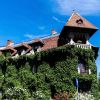
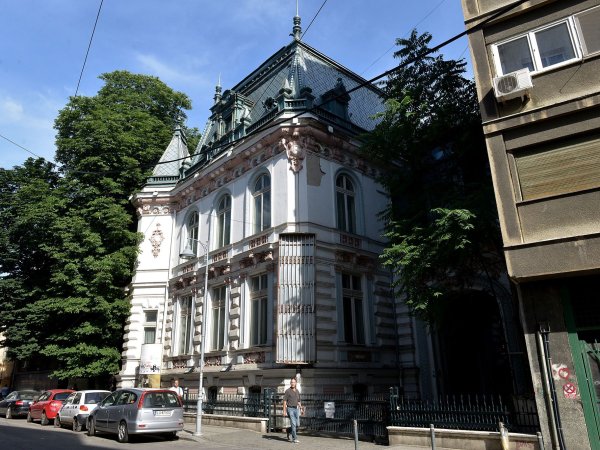
The Arion House was built in 1894, during a period when Bucharest was experiencing one of its most spectacular stages of urban development. The project was designed by architect Filip Xenopol, one of the respected professionals of the time. His signature can still be seen today on the building's façade, in the form of the initials "FX," carved discreetly on the petal of an ornamental cartouche located at one corner of the building.
The property was built in a Neo-Gothic style complemented by Neoclassical influences, a combination that gives it a distinctive elegance. The façade stands out through the harmony of its proportions, its pastel shades, and the richness of its ornaments. The windows are framed by pilasters topped with capitals inspired by the Corinthian style, reinterpreted in a simplified manner, while the decorative elements placed beneath them complete the building's sophisticated appearance.
Although it is now flanked by two apartment blocks built later, the house has retained its grandeur. The contrast between its architecture and the modern buildings surrounding it makes it a surprising sight for anyone discovering the area. Once you notice its elegant lines and decorative details, it becomes obvious that it was designed for a family of high social standing.
The courtyard is not particularly large, but it was designed to meet the needs of an aristocratic residence. The wrought-iron gate allowed the carriages carrying politicians, diplomats, and members of Bucharest's high society to enter the property. Above the main archway there is a decorative lamp made of multicoloured glass, characteristic of the architectural style of the early 20th century, a detail that recalls the elegance of old Bucharest.
The legacy of the Arion family
The house became part of the Arion family's estate through marriage. It was the dowry of Caterina Christopoulos, the great-great-granddaughter of the Greek poet Athanasios Christopoulos, when she married Scarlat C. Arion, a member of an old Romanian boyar family.
The Arion family originated from Ialomița County, where they owned estates in Bujoreni. Scarlat C. Arion served as a senator and was one of the important figures of Romania's public life during the interwar period. The residence near Amzei Church reflected the family's social status and became the home of an intellectual and political elite.
The couple had three children: two sons and one daughter. Each of the sons would follow a remarkable professional path. Vasile Arion, born in 1902, chose architecture and built a career in the field. His younger brother, Radu Scarlat Arion, born in 1904, entered the diplomatic service and would become one of the best-known representatives of the Romanian exile.
A graduate of the Faculty of Law at the Sorbonne, Radu Arion benefited from a solid academic education and a Western cultural background that would influence his entire diplomatic career. His career seemed to be following a natural course until the end of the Second World War, when the political changes in Romania radically altered his destiny.
The gesture that turned him into a symbol of the Romanian exile
The year 1946 represented the decisive moment in Radu Arion's life. In the context of the establishment of the communist regime and the radical transformation of Romania's foreign policy, the diplomats stationed abroad were ordered to return to the country.
Radu Arion, however, refused to return to a Romania under Soviet influence. His choice meant the loss of his diplomatic career, the impossibility of seeing his homeland again for many decades, and the beginning of a life in exile.
Before handing over the Romanian Embassy in Greece to the representatives of the new regime, the diplomat made a decision with profound historical implications. He hid and preserved an important part of the embassy's archives, believing that those documents should not fall into the hands of the communist authorities.
The archives were transported to his family's home in Greece and preserved there for decades. Only after the fall of the communist regime did his son, Constantin Arion, bring those documents back to Romania, thus contributing to the recovery of an important part of the country's diplomatic memory.
The diplomat's son, Scarlat Arion, would later recall that impressive episode. He recounted that the Swiss ambassador, who represented communist Romania's interests in Athens, asked his father for the embassy's keys. Radu Arion handed them over without hesitation, but before doing so he had moved the entire diplomatic archive to his own home, where it remained preserved for many years.
This gesture became one of the symbols of Romanian diplomatic resistance in the face of the political regime change and demonstrates Radu Arion's determination to defend his convictions.
A life dedicated to the fight against communism
Exile did not mean Radu Arion's withdrawal from public life. On the contrary, he continued his activity and became one of the leading voices of Romanians living in exile in the West.
In Greece, he became involved in the press serving the Romanian community and collaborated with the newspaper The Voice of Freedom, founded in 1954 by Greek journalists originating from Romania. The newspaper's purpose was to inform public opinion about the realities of communist Romania and the absence of fundamental freedoms.
At the same time, Radu Arion devoted much of his energy to supporting Romanian refugees. He founded the Romania Welfare organization, through which he organised substantial humanitarian aid for those living in exile.
The organization's activity was impressive. Through its efforts, approximately 163,000 kilograms of food were distributed to Romanian refugees, making a significant contribution to supporting communities affected by exile and material hardship.
At the same time, the diplomat participated in international conferences and meetings organised by the Assembly of Captive European Nations in Paris and London. In his speeches and articles, he firmly condemned Soviet domination over Eastern Europe and sought to draw the Western world's attention to the dramatic situation in the countries under communist control.
For Radu Arion, the problem was not merely the violation of individual rights but the systematic destruction of entire civilizations and national traditions. In his public interventions, he described the communist regimes as one of the greatest forms of oppression known in modern history, emphasising the terror imposed upon hundreds of millions of people in Eastern Europe.
Through his journalistic, diplomatic, and humanitarian activities, Radu Arion became one of the most active representatives of the Romanian exile, helping to keep the cause of a free Romania alive in the West.
The memory of a house that remained the symbol of the family
Although he spent much of his life outside Romania, Radu Arion never forgot the house of his childhood. The story of the residence near Amzei Church was passed down to the following generations, becoming a symbol of the family's roots.
His son, Scarlat Arion, recalled that his father frequently spoke to him about this residence. For the family, the house represented the place where his parents had married and the residence of his grandfather, Scarlat Arion, a Romanian senator.
He also fondly remembered that his grandfather had long refused to have a telephone installed, preferring traditional means of communication, a detail illustrating the mentality of a generation standing at the crossroads between the old and the modern worlds.
These memories transform the building into a place of profound emotional significance, beyond its historical and architectural value.
The destiny of the building after the communist period
Like many other historic residences in Bucharest, the Arion House experienced a complicated history after the establishment of the communist regime and during the years following 1989.
During the 1990s and the early 2000s, the building was given various commercial uses. For approximately ten years, until 2004, it housed the Astoria Casino. Later, several offices and a restaurant operated from the premises.
Today, the gates remain closed, and the house seems to belong to another era. Although it no longer hosts public activities, it continues to attract the attention of architecture and history enthusiasts, being included on Bucharest's list of historical monuments.
Its discreet presence, hidden between modern apartment blocks, recalls the dramatic transformations the Romanian capital has undergone over the past century and the many valuable buildings that have survived the city's accelerated urban development.
A moment of profound symbolic significance took place on 21 October 2017, when the remains of Radu Scarlat Arion and his family members were repatriated from Greece. During a religious ceremony held at Bellu Cemetery, the family returned home, in a sense, after decades of exile.
The repatriation represented more than the fulfilment of a family wish. It symbolised the recovery of the memory of a man who chose to sacrifice his career and personal comfort in order to remain faithful to his principles.
Today, the Radu Arion House remains one of Bucharest's most fascinating historic residences. Its architectural beauty is intertwined with the story of a family of boyars, of a diplomat educated at Europe's great universities, and of a man who refused to accept the new order imposed on Romania after the Second World War.
Beyond its elegant walls lies a lesson in dignity, courage, and commitment to democratic values, and every detail of this house reminds us that Bucharest's history is made not only of spectacular buildings but also of the destinies of the people who once lived within them.
We also recommend: Famous houses in Bucharest: The Ceaușescu House, from the Spring Palace to the memorial museum of the former dictator