Architects who shaped Bucharest: Filip Xenopol, designer of the Capital's modernisation at the end of the 19th century
- Articles
- 09 JUL 26
At the end of the 19th century, Bucharest was going through one of the most important periods of urban transformation in its history. The city was expanding rapidly, the administration was trying to align it with the great European capitals, and a new generation of architects trained in the West was beginning to radically change the appearance of its streets, squares and public buildings. Among these professionals stood out Filip Xenopol, a Romanian architect educated in Germany, who made a decisive contribution to the modernisation of the Capital through administrative, commercial and residential projects that combined technical rigour with aesthetic elegance. Although his name is less well known to the general public than those of other great architects of the period, the legacy left by Filip Xenopol can be discovered in numerous buildings that defined Bucharest at the turn of the 19th and 20th centuries. His work reflects the process of Europeanisation of Romanian architecture and the emergence of a modern vision of urban space.
An architect from an elite intellectual family
Filip Xenopol was born into a family with an impressive cultural and intellectual tradition. His father, Dimitrie Xenopol, belonged to an educated and influential environment, while his siblings would become important personalities of modern Romania. He was the brother of the diplomat Nicolae D. Xenopol, the writer Adela D. Xenopol, and the great historian Alexandru D. Xenopol, one of the founders of modern Romanian historiography.
This family background encouraged the formation of a generation concerned with the modernisation of Romanian society and its rapprochement with Western values. In Filip Xenopol's case, this orientation was reflected in his choice of a career in architecture and in the studies he completed in Germany, one of the most important training centres for European architects of the time.
German education and the influence of Central European architecture
The architectural studies he pursued in Germany provided Filip Xenopol with a solid education based on technical discipline, structural rigour and compositional balance. At the end of the 19th century, German schools of architecture promoted a combination of academic tradition and the new eclectic trends, and these influences are clearly reflected in his work.
The architect assimilated the principles of Central European architecture and adapted them to the Romanian context, which was undergoing an accelerated process of modernisation. His works are distinguished by balanced compositions, subtle decorative details, and special attention paid to proportion and volume. Unlike the excessively ornate architecture that was becoming increasingly popular in certain circles, Xenopol preferred sober and coherent elegance.
Some of the buildings he designed reveal influences of Late Romanticism and Western commercial architecture, reinterpreted for the urban environment of Bucharest. This ability to adapt enabled his projects to integrate harmoniously into a city situated between its Oriental tradition and its European aspirations.
Bucharest in full modernisation
The period during which Filip Xenopol worked coincided with Bucharest's transformation into a modern capital city. Following Romania's independence and the country's economic development, the authorities invested heavily in infrastructure, administrative buildings, public institutions and commercial spaces.
Architects trained in the West played an essential role in this process. They introduced new building typologies, new construction solutions and an architectural language inspired by the great European cities. Filip Xenopol belongs to this first generation of modern architects who laid the foundations of Bucharest's urban image at the end of the 19th century.
The National Bank Passage – a symbol of commercial modernity
One of his most important works is the National Bank Passage, completed in 1890. At that time, commercial arcades represented an expression of Western urban modernity, inspired by the great covered galleries of Paris, Brussels and Milan.
Through this project, Xenopol contributed to the development of a new type of commercial space in Bucharest, intended for pedestrian circulation and modern economic activities. The passage became a landmark of the city centre and an example of the way architecture could support the transformation of urban life.
The Bucharest houses designed by Filip Xenopol
An important part of his activity was dedicated to residential architecture. Between 1892 and 1895, Filip Xenopol designed numerous houses for wealthy families in Bucharest.
Among them are the "C. Năcescu" House on Sfântul Spiridon Street, the "I. Bogdan" House on Știrbei Vodă Street, the "Max Azel" House on Academiei Street, and the "Nasta" House at 33 Armenească Street. The latter is described as an urban residence with restrained decoration and classical proportions, characteristics that define the architect's style.
He also designed the "Dr. Chiriac" House on Sfântul Ionică Street and the "W. Staadecker" House on Smârdan Street. These residences illustrate his concern for modern comfort, functional spaces and the understated elegance of their façades.
Public buildings and representative institutions
Filip Xenopol's work was not limited to private residences. He also designed administrative and educational buildings, contributing to the development of the city's public infrastructure.
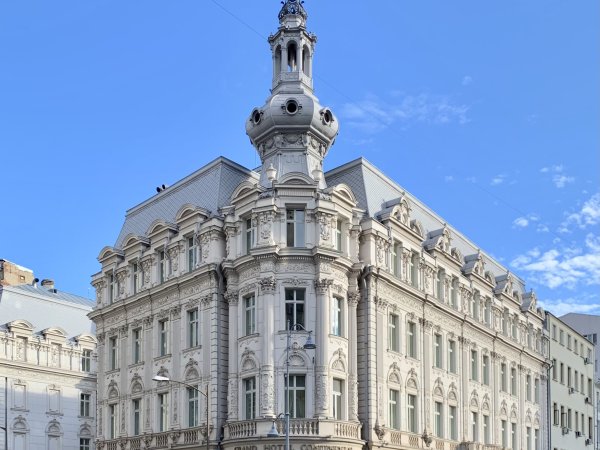
Among his most important projects are the Central Bath on Enei Street, completed in 1895, the Agricultural Club, the School of Trades on Polizu Street, and the famous Continental Hotel in Bucharest. These projects demonstrate the architect's versatility and his ability to approach very different functional programmes.
The Administrative Palace in Râmnicu Vâlcea
Outside the Capital, his most important work is the Administrative Palace in Râmnicu Vâlcea, built in 1895. The building is described as a monumental structure representative of the public architecture of the period.
Through its dimensions, composition and architectural expression, the palace reflects the ambitions of the Romanian administration at the end of the 19th century and its desire to create public institutions comparable to those of the great European cities.
Other important projects
The list of works designed by Filip Xenopol also includes the Boldescu Hospital in Ploiești, a project that demonstrates his involvement in healthcare architecture, a field that was rapidly developing at the time.
The architect also received the Third Prize in the international competition for the design of the administrative headquarters of the Romanian Railways (C.F.R.). This distinction confirms the professional prestige he enjoyed and the fact that he was considered one of the leading architects of his generation.
Filip Xenopol's architectural style
Filip Xenopol's work is characterised by balance, stylistic coherence, and refinement. He did not seek spectacular effects or excessive ornamentation but preferred elegant and well-proportioned solutions.
Eclectic and Neoclassical influences are evident in many of his projects, while Late Romantic accents also appear from time to time. The façades are orderly, the volumes are clearly defined, and decoration is used sparingly to emphasise the building's structure rather than dominate it.
This approach contributed to creating a more coherent urban image that was closer to the Western architectural standards of the period.
His contribution to the Europeanisation of Bucharest
The importance of Filip Xenopol goes beyond the individual value of the buildings he designed. Through his work, he contributed to the Europeanisation of Romanian architecture, introducing modern design methods and an architectural language inspired by the great cultural centres of the continent.
The administrative, commercial and residential buildings created by him helped define the image of Bucharest during a period when the city was building its identity as a modern capital. The functionality, elegance and technical rigour promoted by Xenopol influenced the evolution of Romanian urban architecture.
The legacy of a discreet but essential architect
Today, Filip Xenopol's name is less prominent in public discourse than those of other great architects of Bucharest, yet his contribution remains fundamental to understanding the modernisation of the Romanian capital.
He belonged to the generation that transformed Bucharest from a city marked by Oriental influences into a European capital capable of competing through its architecture and urban planning with the great cities of the time. Through his projects, Xenopol brought rigour, elegance and stylistic coherence to an era undergoing profound change.
The buildings he designed are today not only architectural monuments but also testimonies to a decisive moment in the city's history. They remind us of the period when Bucharest was searching for its European model, and architects such as Filip Xenopol had the courage and the expertise to build it.
We also recommend: