Who Was Alexandru Papiu Ilarian and Why Does He Have a Street Named After Him in Bucharest
- Articles
- 13 JUL 26
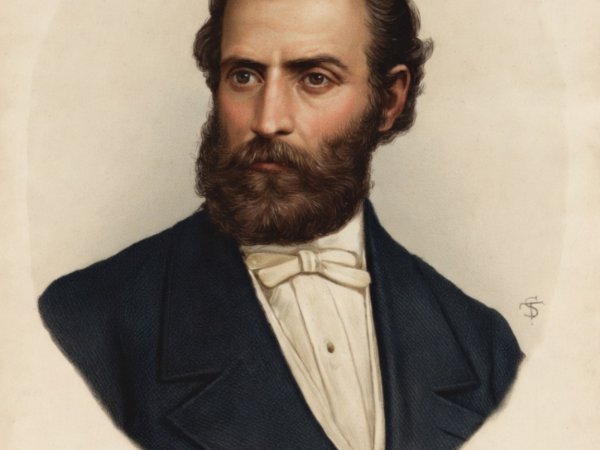
Romania's history is marked by numerous personalities who fought for the affirmation of the national identity and for the modernization of the Romanian state. Among them is Alexandru Papiu Ilarian, one of the most important scholars and politicians of the 19th century. An outstanding jurist, historian, philologist, university professor, and Transylvanian revolutionary of 1848, he dedicated his entire life to defending the rights of Romanians, especially those living in Transylvania. Although his name is less well known today than those of other great personalities of the era, his contribution to the development of Romanian culture and to the consolidation of the institutions of the modern Romanian state is undeniable. His work extended across the political, legal, educational, and scientific fields, and the legacy he left behind continues to be appreciated today. As a sign of respect for his lifelong activity, Alexandru Papiu Ilarian's name was given to a street in the Dristor neighborhood, in Bucharest's Sector 3. It is a tribute to an intellectual who made a decisive contribution to the promotion of national ideals during a period of profound historical transformation.
The early years and the formation of a great intellectual
Alexandru Papiu Ilarian was born on September 27, 1827, in the village of Bezded, in present-day Sălaj County. He came from a Romanian Greek Catholic family, his father being the priest Ioan Pop. Besides Alexandru, the family also had three daughters: Carolina, Ana, and Neli.
In 1832, his father decided to return to his native village, Budiul de Câmpie, located in Mureș County, a locality that today bears the name Papiu Ilarian. It was there that he spent his childhood and attended primary school, showing from an early age an exceptional inclination toward learning.
Education would play an essential role in shaping his future. After completing primary school, in the autumn of 1838 he enrolled at the Catholic Gymnasium in Târgu Mureș, an institution that at the time operated in the building now known as the House with Arches, where the "Unirea" High School functions today.
The years he spent there laid the foundation of his intellectual training. His eagerness to learn and his dedication distinguished him, even as a teenager, as one of the most promising young Romanians of his generation.
His studies and the adoption of the name Ilarian
In 1843, Alexandru Papiu continued his studies in Blaj, one of the most important Romanian cultural centers in Transylvania. There, he was taught by Simion Bărnuțiu, one of the leading ideologists of the Romanian national movement.
Bărnuțiu's influence proved decisive in shaping his political and cultural outlook. The ideas concerning the rights of Romanians and the necessity of affirming the national identity became principles that Alexandru Papiu Ilarian upheld throughout his entire life.
Later, he continued his education at the Piarist High School in Cluj, from which he graduated in 1847 after completing his legal studies. It was there that he adopted the surname "Ilarian," a Latinized name inspired by the translation of the name of one of his ancestors. Choosing such a name was a common practice among Romanian students in Transylvania, who used it to express their connection to Latin culture and to the Roman origins of the Romanian people.
After graduating, he returned to Târgu Mureș, where he became a clerk at the Royal Court. He quickly distinguished himself through his organizational skills and his commitment to the national cause.
His friendship with Avram Iancu and his involvement in the Revolution of 1848
During his time in Târgu Mureș, Alexandru Papiu Ilarian became close to Avram Iancu and to other young Romanian intellectuals concerned with defending national rights.
Together, they became leaders of the "Reading Society," a circle of young Romanian jurists who debated political and cultural issues at a time when Romanians in Transylvania did not enjoy equal rights with the other nationalities of the Habsburg Empire.
When the Revolution of 1848 spread throughout Europe, Alexandru Papiu Ilarian became actively involved in organizing the Romanian revolutionary movement in Transylvania.
He participated in the Great National Assembly of Blaj, held on April 18 and May 3, 1848, an event considered one of the most important moments in the struggle of Transylvanian Romanians for the recognition of their political and national rights.
During July and August of the same year, he served as a propaganda commissioner in Dâmbovița County, with the mission of spreading the ideals of the revolution and mobilizing the population.
Because of his energetic activity and the speeches he delivered at Blaj, his contemporaries gave him the nickname "the Tribune of Blaj." He was elected a member of the National Committee and later became its secretary.
The fate of the revolution, however, soon changed. In the summer of 1849, following the defeat of the revolutionary movement, Alexandru Papiu Ilarian was forced to leave Transylvania and seek refuge in Wallachia.
University studies and recognition as a jurist
After the revolutionary events came to an end, Alexandru Papiu Ilarian resumed his legal studies abroad. He attended the University of Vienna and later the University of Padua, two of the most prestigious higher education institutions of the time. In 1854, he earned his Doctor of Law degree, confirming his exceptional legal education.
It was also during this period that he published one of his most important works, The History of the Romanians of Upper Dacia. The book represented an extensive historical analysis and included numerous references to the Revolution of 1848, as well as to the realities of Transylvania and the Mureș region.
The work stood out through its rigorous documentation and the author's determination to demonstrate the historical continuity and rights of the Romanian people in Transylvania.
Professor, minister, and one of the most respected jurists of his era
His intellectual value was quickly recognized beyond the Carpathian Mountains. Upon the recommendation of the historian August Treboniu Laurian, Prince Grigore Alexandru Ghica of Moldavia invited him to Iași.
Between 1855 and 1858, he held the Chair of Human Law and Criminal Law at the Faculty of Law in Iași, contributing to the education of a new generation of jurists.
He later spent a period in Berlin, where he served as the private tutor of the children of the nobleman Panait Balș.
After returning to the Romanian lands, he held several important positions within the state administration, including Legal Adviser of Moldavia and member of the Board of Schools in Bucharest.
In 1862, he was appointed Prosecutor of the Court of Cassation in Bucharest, one of the highest positions within the Romanian judicial system.
The peak of his political and administrative career came with his appointment as Minister of Justice in the government led by Mihail Kogălniceanu. In this capacity, he took part in one of the most important reforms of the modern Romanian state: the secularization of monastic estates, a measure that contributed to strengthening the state's finances and modernizing the administration.
An impressive scientific activity
In addition to his political and legal career, Alexandru Papiu Ilarian carried out remarkable scientific work. He authored important historical and legal studies, while one of his greatest contributions remains the collection Treasury of Historical Monuments for Romania, a fundamental work for the study of Romanian history.
His intellectual prestige received official recognition in 1868, when he was elected a full member of the Romanian Academy. During the same period, he became actively involved in the development of Romania's cultural and educational life, believing that a nation's progress depends first and foremost on education and young people's access to schooling.
The Transylvania Society and his support for Transylvanian Romanians
One of his greatest achievements was the establishment of the Transylvania Society in Bucharest. Founded in 1867, the organization's primary objective was to support young Romanians from Transylvania, who faced numerous obstacles in gaining access to education because of the policies promoted by the authorities of the Austro-Hungarian Empire.
Alexandru Papiu Ilarian led the society until 1874, becoming directly involved in supporting scholarships and promoting the cultural and national interests of Transylvanian Romanians.
Although he spent much of his career in Bucharest and Iași, he never forgot his Transylvanian roots. He remained a tireless supporter of the Romanians of Transylvania and continued to fight for their rights until the end of his life.
His final years and the legacy he left to Romania
Alexandru Papiu Ilarian passed away in Sibiu on October 23, 1877, at the age of only 50. He was buried in the courtyard of the Church Among the Fir Trees in Sibiu, a place of worship dedicated to Saints Peter and Paul, located at 17 Reconstrucției Street.
Although his life was relatively short, the intellectual and patriotic legacy he left behind is remarkable. His historical works, legal contributions, and involvement in the development of Romanian state institutions continue to be appreciated by historians and researchers.
As a sign of recognition, his memory is preserved in several places across the country. In Blaj, on the alley of the Gloria Monumental Ensemble, there is a bust of Alexandru Papiu Ilarian, commemorating one of the leaders of the 1848 Revolution and one of Transylvania's greatest intellectuals.
Likewise, in Bucharest, a street in the Dristor neighborhood, located in Sector 3, bears his name. This choice is no coincidence. Alexandru Papiu Ilarian made an important contribution to the development of the Capital's legal, political, and cultural life, while his work within the institutions of the Romanian state and as president of the Transylvania Society established him as one of the outstanding figures of the 19th century.
Today, although many Bucharest residents pass daily along the street that bears his name without knowing the story behind it, Alexandru Papiu Ilarian remains one of the men who helped lay the foundations of modern Romania.
Through his courage during the Revolution of 1848, his work in the field of justice, his academic contributions, and his tireless struggle for the rights of the Romanians of Transylvania, he earned an honored place in the nation's history. His name continues to symbolize patriotism, education, and unwavering devotion to the Romanian cause.
We also recommend: Eufrosina Popescu, the first great Romanian artist on the international stage, has a street named after her in Bucharest