The beginnings of feminism in Romania and the role of women in interwar Bucharest society
- Articles
- 02 JUN 26
Romanian feminism did not appear suddenly during the interwar period, but rather represented the result of a complex process of social, cultural, and political modernization that began in the second half of the nineteenth century. In a society dominated by patriarchal norms and a traditional vision of the family, women gradually began to demand access to education, liberal professions, and later, political rights. Bucharest, undergoing continuous transformation and inspired by Western models, became the main center of these emancipation movements. The interwar period represented the moment of greatest affirmation of Romanian feminism. The most important women's organizations, the most active leaders of the movement, and the most intense debates regarding the status of women were concentrated in the capital. At the same time, interwar Bucharest society experienced a profound change in the role of women, who began to be present not only in the domestic sphere, but also in education, culture, administration, and the economy.
The first forms of female emancipation in Romania
The first manifestations of female emancipation appeared in Romania in the second half of the nineteenth century, in a context marked by the modernization of the Romanian state and Western cultural influences. Initially, the organizations created by women had mainly a philanthropic and educational character. They aimed to support girls from poor families, develop female education, and promote charitable activities. Gradually, however, social concerns were complemented by demands for equal rights.
At the end of the nineteenth century and the beginning of the twentieth century, women's access to education expanded considerably. Young women from wealthy families could pursue secondary and even university studies, and some of them continued their education in major European academic centers. This educated generation would become the nucleus of the Romanian feminist movement.
During the same period, publications dedicated to women's issues began to appear, and the women's press became an important instrument for spreading ideas of emancipation. Romanian intellectual women argued that the modernization of society could not be achieved without the active participation of women in public life.
The emergence of the organized feminist movement
At the beginning of the twentieth century, Romanian feminism moved beyond the stage of isolated initiatives and became organized into associations with clear objectives. Among the most important figures of this period was Calypso Botez, a teacher, publicist, and activist for women's rights.
Calypso Botez consistently advocated legal equality between women and men and argued that constitutional provisions regarding the equality of citizens should also apply to women. She published works dedicated to the legal status of women and participated in numerous campaigns for obtaining women's political rights. In 1917, she contributed to the founding of the Association for the Civil and Political Emancipation of Romanian Women, one of the most important feminist organizations of the time.
An important moment was the establishment, in 1921, of the National Council of Romanian Women, an organization that brought together numerous women's associations and became the main representative body of Romanian feminism both nationally and internationally. The Council sought to promote civil rights, access to education, and women's participation in public life.
Alexandrina Cantacuzino and the affirmation of interwar feminism
One of the most influential personalities of Romanian feminism was Alexandrina Cantacuzino. Coming from the Romanian aristocracy and educated in a European spirit, she understood that the emancipation of women required not only access to education, but also their integration into economic and political life.
Alexandrina Cantacuzino became involved in numerous women's organizations and represented Romania within international structures dedicated to women's rights. Her activity contributed to increasing the visibility of Romanian feminism at the European level. She promoted women's vocational education and supported their participation in local administration and civic life.
During the interwar period, under the leadership of personalities such as Alexandrina Cantacuzino and Calypso Botez, Romanian feminism became one of the best organized social movements in Southeastern Europe. Although it did not immediately succeed in obtaining all the demands it formulated, the movement created the foundations for the legislative transformations that would follow.
Interwar Bucharest – the center of female modernization
After the First World War, Bucharest experienced accelerated development. The capital of Greater Romania had become an important administrative, economic, and cultural center, and Western influences were visible in architecture, fashion, education, and lifestyle.
In this modern urban environment, women began to occupy an increasingly important place. If in the nineteenth century their role was associated almost exclusively with family and household duties, during the interwar period many women in Bucharest became teachers, civil servants, journalists, lawyers, artists, or doctors.
The universities and high schools of the capital contributed to the formation of an educated female elite. Young women from bourgeois and middle-class families had access to higher education and actively participated in the intellectual life of the city. The appearance of an increasing number of educated women changed society's perception of their abilities and social role.
It was also in Bucharest that the most important feminist organizations, editorial offices of publications dedicated to women, and cultural institutions in which many intellectual women worked were located. The capital thus became the main laboratory of social transformations concerning the status of women.
Women in the family and the change of mentalities
Although modernization was evident, interwar society still retained many traditional elements. The family continued to be considered the primary responsibility of women, while marriage and motherhood represented widely accepted social ideals.
However, in the urban environment of Bucharest, these conceptions began to change. More and more women sought to combine family life with professional and intellectual development. The press of the time frequently reflected debates regarding the relationship between career and domestic roles, child education, and women's economic independence.
Romanian feminists argued that women's participation in professional life did not represent a threat to the family, but rather a condition for the progress of society as a whole. They promoted the idea of partnership between spouses and maintained that women's education contributed to the formation of better-prepared generations.
The change in mentalities occurred slowly and often encountered resistance. Nevertheless, in major urban centers, including Bucharest, the model of the educated and professionally active woman became increasingly visible.
Women's participation in economic and cultural life
During the interwar period, women in Bucharest began to be present in numerous professional fields. They worked in education, healthcare, administration, journalism, and culture. Although salaries and promotion opportunities were often inferior to those offered to men, the mere presence of women in these sectors represented a major change compared to previous decades.
The cultural life of the capital also benefited from women's contributions. Writers, journalists, actresses, and artists actively participated in the development of Romanian culture. Literary salons, public conferences, and cultural magazines provided spaces for female voices to be heard.
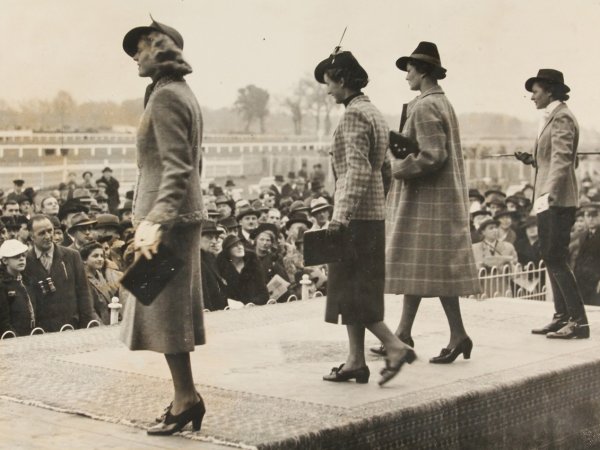
Interwar fashion also reflected social changes. Women adopted modern clothing styles inspired by major European capitals, and their appearance in public spaces symbolized a greater degree of autonomy and personal freedom.
In interwar Bucharest, the modern woman had become a common presence on boulevards, in institutions, in performance halls, and in professional environments, contributing to the image of a capital undergoing a full process of Westernization.
The struggle for political rights
One of the main demands of the feminist movement was obtaining the right to vote. Romanian feminists considered women's participation in political life essential for achieving an authentic democracy.
During the interwar period, numerous campaigns, conferences, and memoranda addressed to the authorities were organized. Activists such as Calypso Botez and Alexandrina Cantacuzino consistently supported the need to recognize women's political rights.
Progress came gradually. Some women were able to participate in certain forms of local administration, and in the 1930s important steps were taken toward the recognition of women's electoral rights. Although women's suffrage was not granted under conditions of full equality during the interwar period, the pressure exerted by feminist organizations prepared the ground for later reforms.
The legacy of interwar feminism
Interwar Romanian feminism represented one of the most important social modernization movements in the country's history. Through the activity of women's organizations and their leaders, essential issues such as access to education, legal equality, political participation, and women's economic independence were brought into public discussion.
In Bucharest, these transformations were most visible. The capital became the space in which women gradually gained access to professions, higher education, and public life. Although interwar society did not completely eliminate gender inequalities, it created the conditions for redefining the role of women and affirming a new female identity.
The legacy of these pioneers of Romanian feminism remains important today. The efforts made by Calypso Botez, Alexandrina Cantacuzino, and many other activists contributed to transforming the status of women in Romania and integrating the principles of equal opportunities into the country's social and political life.
Thus, the history of Romanian feminism is not only the story of a struggle for rights, but also an essential part of the modernization process of Romanian society.
We also recommend: What the neighborhoods of interwar Bucharest looked like and what the social differences between them were