June 1st in Communist Bucharest: The Day Children Somehow Felt More Seen
- Articles
- 01 JUN 26
There is one day that, in the memory of those who grew up in Bucharest during the 1970s and 1980s, carries a special flavor. It was their day. June 1st arrived with a certain electricity in the air, with something unspoken yet deeply felt — that today, as a child, you mattered a little more than usual.
Officially, it was International Children’s Day, adopted from 1950 onward by all countries in the Soviet bloc. Romania was among the first to embrace it. Unofficially, it was the day when parents managed — often with considerable effort — to find a toy or organize an outing to the park. Symbolism and reality rarely walked hand in hand in Ceaușescu’s Romania. On June 1st, at least, they came a little closer.
A School Day Unlike Any Other
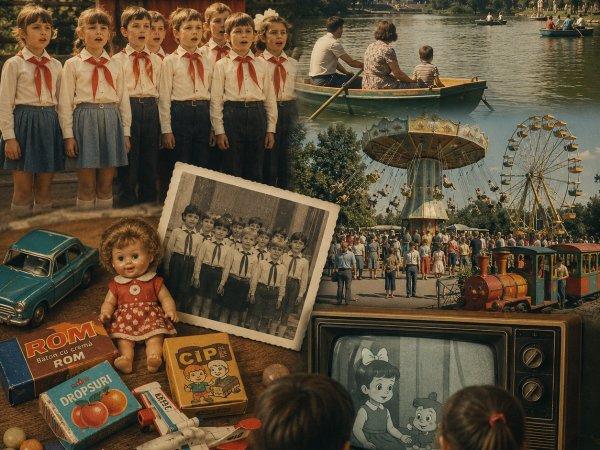
June 1st was not a public holiday. Children still went to school or kindergarten, but ordinary classes disappeared, replaced by celebrations, contests, and ceremonies. Preschoolers arrived dressed in the uniforms of the “Falcons of the Fatherland,” with their distinctive orange details, while the older pioneers wore their pioneer uniforms with almost ceremonial seriousness. The red scarf had to sit perfectly straight; the uniform had to be spotless.
The celebrations inevitably included patriotic poems, songs dedicated to the Party, and speeches about the happy childhood of the “young offspring of the people.” On stage, children recited texts memorized weeks in advance, with clear voices and carefully rehearsed gestures. In the audience, parents applauded and took photographs with great care. Cameras were rare and precious, and a picture from a June 1st celebration could end up in the family album beside wedding and baptism photos.
Then the celebration ended. The uniform came off. Real childhood could begin again.
The Park, Ice Cream, and Rowboats on Herăstrău Lake
Families went out into the city. Cișmigiu, Herăstrău, Tineretului Park, IOR — all of them filled up on June 1st with people who seemed eager to reclaim, in a single day, all the joy postponed throughout the rest of the year. The alleys became crowded. Ice cream lines stretched endlessly. Pink cotton candy appeared on street corners like a seasonal weather phenomenon.
The rowboats on Herăstrău Lake demanded patience. People queued, counted their money carefully, and climbed aboard with excitement. Fathers rowed with calculated effort while pretending to look relaxed. Mothers held tightly onto their children’s sleeves. The children leaned dangerously toward the water. The lake was the same every year, yet every boat ride remained in memory like a small adventure.
At the Children’s Town in Tineretului Park, inaugurated in the 1980s, the little train, the carousel, the Ferris wheel, and the electric cars functioned like fulfilled promises. In a world of shortages and endless postponements, a working carousel felt like a minor miracle. Children stood patiently in line without complaining. They knew it was worth it.
The Gift: A Toy Treasured Like Gold
The June 1st gift was eagerly awaited. Parents did whatever they could. Romanian-made toys — tin cars, Arădeanca dolls with closing eyes, plastic airplanes, toy soldiers — appeared in stores a few days beforehand and disappeared almost immediately. Those who planned ahead bought early. Those who did not found themselves on May 31st staring at nearly empty shelves and improvising.
A toy received on June 1st was carefully preserved, repaired, lent cautiously, and reclaimed with astonishing legal determination. Rom chocolate bars, CIP candies, hard drops, puffed corn snacks, and, toward the end of the decade, Turbo chewing gum with its collectible car stickers completed the sweet landscape of the day. There was selectiveness, there was meaning. Every candy mattered.
Television and Two Precious Hours of Cartoons
Then came the evening television ritual. Cartoons, Mihaela — Nell Cobar’s beloved character alongside Azorel — Lolek and Bolek, Teleenciclopedia: all of them naturally became part of June 1st, like an expected bonus. In the 1980s, when television programming had been reduced to just two hours per day, any cartoon broadcast on Children’s Day became an event. Families gathered around the television with an intensity that only those who lived through it can truly understand today.
The television eventually switched off. The child fell asleep.
And yet something remained behind. Not the toys that eventually broke, nor the candies that disappeared. What remained was the feeling that the adults around you had made an effort — small or large, depending on what they could afford — to make your day different. That in the middle of a city that kept growing, demolishing itself, and learning to speak in whispers, you mattered. That you had been seen.
Perhaps that is the lesson that generation’s childhood leaves for today’s parents: the gesture matters more than the quantity. To be truly present in your child’s day — that is enough.
Happy Children’s Day.