Let Me Show You Bucharest at Night! 10 Beautiful Spots for a Night Walk in the Capital
By Eddie Țone
- Articles
- 22 APR 26
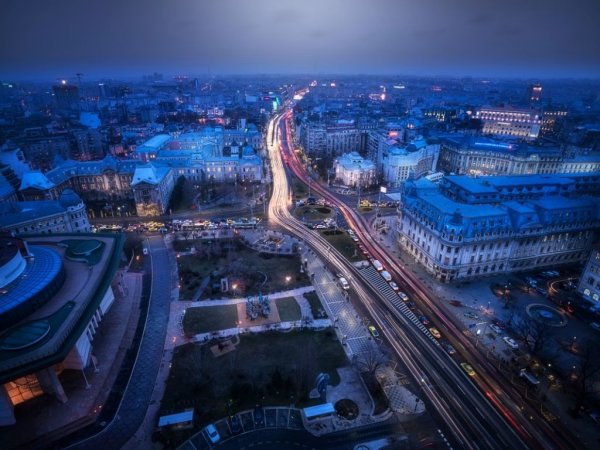
Bucharest metamorphoses once the sun retreats below the horizon, shedding the hectic mask of an Eastern European metropolis in favor of a discreet, almost cinematic elegance. The city breathes a bit more easily under the yellow (or white, as the case may be) light of the streetlamps, offering the nocturnal visitor a much more refined version of everyday reality. A night walk through the Capital is an activity that requires a certain predisposition for fine observation, a slow pace, and a curiosity for architectural details that often vanish in the midday clamor.
From the wide boulevards reminiscent of the Parisian ambitions of the interwar period to the labyrinthine streets where history seems preserved in layers of ivy and old brick, nocturnal Bucharest offers a visual spectacle worthy of any urban explorer's attention. Exploration by moonlight allows for a rediscovery of the genius loci, far from the impatient honking and the dust typical of scorching days, transforming the sidewalks into true stages of historical theater.
Let’s see 10 beautiful places suitable for a night walk in Bucharest:
1. Calea Victoriei and the Aura of a Golden Age
Calea Victoriei represents the vital axis of the city, maintaining its status as the most elegant Bucharest artery through every building that lines it. The route between Victory Square (Piața Victoriei) and the National Military Circle offers a dense sensory experience, where the history of the monarchy meets the modern effervescence of specialty coffee shops. Initially called Podul Mogoșoaiei (Mogoșoaia Bridge), this artery received its current name in 1878 to mark the victory in the War of Independence, rapidly transforming into the favorite stage of high society.
Walking the route at night highlights the mastery of architectural lighting, which accentuates the facade of the CEC Palace, a masterpiece by French architect Paul Gottereau. Completed in 1900, the building features a glass and metal dome that shines spectacularly under floodlights, recalling the times when Bucharest was nicknamed "Little Paris."
A bit further up (heading north), the National Military Circle, designed by architect Dimitrie Maimarolu, dominates the intersection with Regina Elisabeta Boulevard with its imposing Corinthian columns. The attentive observer will notice how the light falls on the marble steps, giving the place a grandeur that seems to ignore the passage of time. Further on, Revolution Square and the Romanian Athenaeum are two other splendid landmarks that can be admired in silence during the night hours. Pedestrians choosing this artery enjoy a cosmopolitan air, with the silhouettes of historical buildings watching over a nightlife full of style and discretion.
2. The Discreet Charm of the Cotroceni Neighborhood
Cotroceni occupies a privileged position in the affective topography of the city, considered by many to be the most beautiful and coherent Bucharest neighborhood. This area has managed to preserve its aristocratic atmosphere, offering the visitor a profound silence, interrupted only by the rustle of leaves in the generous gardens. The streets, named after famous doctors such as Carol Davila or Marinescu, form a labyrinth of interwar villas crafted in Neo-Romanian, Modernist, or Art Deco styles.
A night walk through Cotroceni is like an excursion into a time capsule, where the scent of linden or jasmine lingers long after sunset. The architecture of the neighborhood reflects the refined tastes of the intellectual and political elite from the middle of the last century. Carol Davila, the personality for whom the main street is named, was the doctor who laid the foundations of the Romanian healthcare system, and his symbolic presence seems to ensure the order and elegance of the area even today.
Street lighting in Cotroceni is softer and warmer, favoring long walks where one’s gaze stops on the wrought-iron details of gates or on stained-glass windows glowing discreetly from inside the houses. It is a place of precious silences, where Bucharest reveals its most intimate and least noisy side.
3. IOR Park and the Reflections of Modernity in the Titan Neighborhood
In the eastern part of the city, IOR Park, officially known as Alexandru Ioan Cuza Park, offers a completely different perspective on Bucharest at night. This green space represents the heart of the Titan neighborhood and surprises with its generous dimensions and the quality of its landscaping. The name IOR comes from the Întreprinderea Optică Română (Romanian Optical Enterprise) located nearby, which adds a touch of industrial history to this oasis of relaxation.
At night, the lake in the center of the park becomes a giant mirror reflecting the lights of the surrounding communist-era apartment blocks, creating a modern urban landscape that possesses an unexpected beauty. The running tracks and alleys are constantly illuminated, providing safety and an ideal setting for exercise even at late hours.
The five islands of the lake, including the "Pensioners' Island" or the "Dogs' Island," take on mysterious silhouettes under the moonlight. IOR is where the dynamism of the neighborhood meets the tranquility of the water, offering a relaxing experience far from the rigidity of the historical center. The atmosphere is one of a vibrant community, with residents enjoying an airy and well-maintained space, proving that remarkable aesthetics aren't reserved only for the city center.
4. Grădina Icoanei and Ioanid Park: A Period Setting
Located in the immediate vicinity of Magheru Boulevard, Grădina Icoanei and Ioanid Park form an ensemble of rare elegance, making them the perfect destination for those seeking a cinematic backdrop. Ioanid Park, laid out on the site of a former garden belonging to bookseller George Ioanid, is designed after the model of Parc Monceau in Paris. This small landscaping gem is surrounded by superb villas, many of which are historical monuments of inestimable value.
A night walk through this perimeter reveals a world of fine details, where classic-design streetlamps illuminate cobbled alleys and a small artificial lake. Grădina Icoanei, located just a few steps away, completes this aristocratic landscape. The history of the place is linked to the Icoanei Church and the Bucureștioara stream, which once flowed through this area. Today, the evening stillness transforms these parks into spaces for reflection, where the absence of heavy traffic allows one to hear the murmur of the fountains.
The architecture of the surrounding houses, signed by famous architects such as Ion Mincu or Petre Antonescu, provides a history lesson in Romanian style, visible under a light that softens the imperfections of time and accentuates harmonious forms.
5. The Dâmbovița Quay and European Metropolis Vibrations
The area between Timpuri Noi and the National Library has recently benefited from major transformations, becoming one of the most attractive night promenade zones in Bucharest. The Dâmbovița Quay now offers wide sidewalks, clearly demarcated bike paths, and modern lighting that gives the entire ensemble the look of a major European city. The river water, though tamed within concrete banks, brings a touch of freshness and a distinct visual dynamic through the reflections of streetlights and glass office buildings.
The National Library of Romania, with its monumental facade, serves as a visual landmark, being one of the largest constructions of its kind in the region. On clear evenings, the contrast between the modern buildings at Timpuri Noi and the historical silhouettes in the distance offers a panorama of the capital's urban evolution.
This stretch of the river has become a favorite spot for young people looking for an open space where the breeze is more felt and the horizon isn't completely blocked by building density. The sense of freedom and the wide perspective of the city make this walk a refreshing experience, perfect for ending a busy day.
6. Carol I Park and the Grandeur of Illuminated Monuments
Situated on Filaret Hill, Carol I Park represents one of the most imposing landscaping achievements in Bucharest, inaugurated in 1906 to celebrate 40 years of King Carol I's reign. Designed by French architect Édouard Redont, the park exudes a solemnity that becomes even more pronounced after dark. The focal point of any nocturnal visit is the Mausoleum (Monument to the Heroes of the Nation), an impressively sized structure that dominates the landscape from the hilltop.
Climbing the steps toward the monument offers the visitor a spectacular panorama of central Bucharest, with fountains and wide alleys unfolding symmetrically below. The eternal flame at the Tomb of the Unknown Soldier adds a note of respect and mystery to the entire atmosphere.
Carol I Park also hosts Țepeș Castle, a construction that mimics the Poenari fortress (initially serving as a water tower), and the Roman Arenas, a space dedicated to open-air performances. At night, the alleys flanked by secular trees become corridors of silence, where the "Giants" statues, created by sculptor Dumitru Paciurea, seem to come to life under the play of shadows. It is a place of historical grandeur, where every step reminds one of a nation's ambitions to align with the European cultural standards of the early 20th century.
7. The Armenian Quarter and the Labyrinth of Forgotten Stories
The Armenian Quarter represents one of the most authentic areas of Bucharest, preserving an urban texture that miraculously survived brutal systematization. Streets like Speranței, Plantelor, or Armenească form a labyrinth where every house hides a personal history or an urban legend. This area was the center of the Armenian community, recognized for its merchant spirit and contribution to the city's cultural life.
The centerpiece of this neighborhood is the Armenian Church, a replica of the cathedral at Echmiadzin, which watches over the nocturnal peace of the area. Not far away is the Melik House, the oldest habitable house in Bucharest, dating back to around 1760 and currently housing the Theodor Pallady Museum.
A walk at night through these places offers a sensation of protective isolation from the rest of the city. The diffused light highlights eclectic architectural details, from Moorish elements to traditional Balkan motifs.
8. Herăstrău Park and the Silence of the Lakeshore
Herăstrău Park, officially renamed King Michael I, is the city's largest park and offers a generous walking route that circles the lake for approximately seven kilometers.
At night, the park divides into two contrasting worlds. The area toward Șoseaua Nordului is vibrant, full of bright lights and music coming from the luxury restaurants lining the water's edge. This part of the park attracts a crowd eager for socialization and a perpetual holiday atmosphere.
In contrast, the rest of the park offers long stretches of semi-darkness and total silence, where only the lapping of the water and the rustle of the reeds accompany the walkers' steps. The bridges crossing the lake provide excellent angles for night photography, capturing the city lights reflected in the dark mass of the water.
Herăstrău was landscaped in the 1930s on a marshy area, its transformation being one of the greatest urban planning achievements of the royal period. A night walk here allows for a complete escape from the built environment, offering fresh air and a vast space where thoughts can unfold freely under the starry vault.
9. Constitution Square and the Grandeur of Unirii Boulevard
For those who appreciate monumental scale and wide perspectives, Constitution Square (Piața Constituției) and Unirii Boulevard represent the ideal destination. This architectural ensemble is dominated by the Palace of the Parliament, the second-largest administrative building in the world, which at night takes on a massive and imposing silhouette under the floodlights. Constitution Square often hosts major events, but on ordinary nights, it offers a vast and quiet space, perfect for admiring the details of the facade of the "People's House."
Unirii Boulevard, with its recently modernized fountains, offers a light and water show on summer weekends that attracts numerous visitors. These fountains hold the world record for the longest system of choreographed artisanal fountains in the world, a point of pride for modern engineering.
The walk from Constitution Square to Unirii Square reveals a perspective on the megalomaniac vision of the 1980s, transformed today into a popular promenade area. The grandeur of the space and the rigorous symmetry of the buildings give the place an atmosphere of power and stability, providing a stark contrast to the narrow streets of old Bucharest.
10. The English Passage on Calea Victoriei and the Secrets of Adjacent Streets
Exploring the area between Calea Victoriei and Magheru Boulevard offers surprises at every step, being the place where contemporary urban creativity meets the city's old structures. The English Passage (Note: contextually often associated with the Victoria Passage umbrella installation), famous for its ceiling made of hundreds of colored umbrellas, has become a major attraction, revealing a vibrant visual frame under the spotlights. This small pedestrian street serves as a gateway to an alternative Bucharest, full of street art and small venues with personality.
Adjacent streets, such as Câmpineanu Street or Academiei Street, hide passages and inner courtyards that deserve to be explored at late hours. This area reflects an interesting mix of styles, from elegant interwar buildings to modernist insertions and recent artistic interventions.
Walking through these places allows one to observe how the city constantly reinvents itself, adapting old spaces to the needs and tastes of new generations. The atmosphere is relaxed and full of life, proposing a perfect conclusion for a nocturnal foray through the heart of Bucharest, where every step reveals a new facet of a metropolis that refuses to sleep completely, preferring to dream with its eyes open under the moonlight.
You may also like: How Bucharest Residents Spend Their Nights: Popular Bars, Clubs, and Terraces