How to visit Bucharest without wasting time in traffic. A one-day itinerary by metro, on foot and with well-chosen breaks
By Raluca Ogaru
- Articles
- 29 MAY 26
Bucharest can be a spectacular city for tourists, but it can also become tiring if you try to explore it by car, taxi or ridesharing at the wrong hours. Distances do not always look big on the map, but traffic can turn a short ride into a long pause, especially in the morning, around lunchtime in busy areas or in the late afternoon, when the city slows down on its main boulevards.
The best option for a first day in Bucharest is a simple combination: metro for longer distances, walking in the central areas and well-chosen breaks in places where it is actually worth stopping. This way, you can see some of the city’s most important landmarks without wasting time in traffic and without feeling that you are rushing from one attraction to another.
Why you should avoid the car if you only have one day in Bucharest
For a tourist, Bucharest may initially seem easy to explore by car: wide boulevards, many points of interest in the city centre and ridesharing apps available at any time. In reality, the city centre has many areas where traffic builds up quickly, and the time lost between two attractions can be longer than the time spent at the attraction itself.
Areas such as Piața Victoriei, Piața Romană, Universitate, Piața Unirii, Calea Victoriei, Splaiul Independenței or the boulevards around the Palace of Parliament can become very crowded during the week. If you only have one day, it is not worth building your itinerary around taxis or app-based rides, especially for distances that can be covered much better on foot or by metro.
The metro is, in most cases, the most efficient way to cross the city quickly. For surface transport, STB states on its official fares page that a 90-minute metropolitan journey costs 3 lei, while a metropolitan journey integrated with the metro, valid for 120 minutes, costs 7 lei. For tourists staying longer, there are also 24-hour or 72-hour passes, including integrated options with the metro.
Morning: start from Piața Victoriei
An efficient itinerary can begin in Piața Victoriei, one of the best starting points for a day of sightseeing in Bucharest. It is easy to reach by metro, has good connections and is close to several important landmarks. If you arrive here in the morning, you have the advantage of starting the route on foot, without depending on traffic.
From Piața Victoriei, you can see the area around the Romanian Government building and then walk onto Calea Victoriei, one of the best-known and most pleasant avenues for tourists. On foot, the route becomes much more interesting than from a car, because you can notice the historic buildings, facade details, cafés, small shops and the real rhythm of the city.
If you want a first cultural stop, you can choose the “Grigore Antipa” National Museum of Natural History, located right in the Piața Victoriei area, or you can continue directly toward Calea Victoriei. For a single day, it is better to choose only one or two indoor attractions, rather than trying to enter every museum along the route.
On Calea Victoriei: Bucharest is easiest to discover on foot
Calea Victoriei is one of the best areas for tourists who want to understand Bucharest without following a complicated route. Along this avenue, palaces, historic hotels, museums, elegant buildings, shops, cafés and fragments of the old city all come together. It is a good walking route precisely because every few hundred metres bring something different.
From Piața Victoriei toward the centre, you can pass by Casa Vernescu, the National Museum of Art of Romania, the Romanian Athenaeum, the Royal Palace, Revolution Square and several representative buildings from modern Bucharest’s history. You do not need to treat the route as a rigid checklist of attractions, but rather as an urban walk where short stops are part of the experience.
A good break can be taken in the area around the Romanian Athenaeum or near Revolution Square. Here you will find cafés, restaurants and photo-friendly spots without moving away from the route. If you visit Bucharest during the weekend, check in advance whether part of Calea Victoriei is pedestrian-only, as events such as “Open Streets” can change the atmosphere of the area and make the walk even more pleasant.
Lunchtime: the Old Town, but without rushing
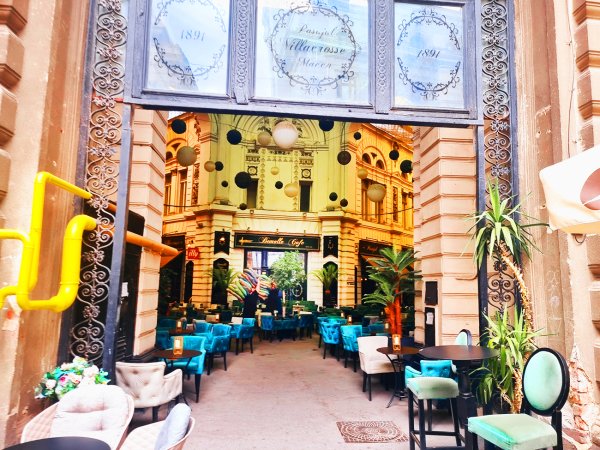
From the area around the Telephone Palace, the National Military Circle or Macca-Vilacrosse Passage, you can easily walk down toward the Old Town. This is one of Bucharest’s best-known tourist areas and, even though it can be crowded, it is worth including in a one-day itinerary. Here you will find pedestrian streets, restaurants, terraces, old churches and buildings that show the city’s contrasts.
In the Old Town, it is worth seeing Stavropoleos Church, Manuc’s Inn, the Old Princely Court and the Lipscani area. You do not need to spend many hours here if time is limited, but it is worth allowing yourself to enter the rhythm of the place. For tourists, the Old Town works best as a lunch stop, not necessarily as the place where the entire day begins and ends.
If you want to avoid the crowds, enter the Old Town before late lunch or immediately after. In the evening, the area becomes busier and noisier, while for a daytime visit it is easier to explore before the terraces are full. For lunch, choose a place close to your route, not one that forces you to cross the city.
Afternoon: Piața Unirii and the route toward Carol Park
After the Old Town, you can walk toward Piața Unirii. It is a heavily circulated area, but important for orientation in the city. From here, you have access to the metro and can decide whether you want to continue on foot toward the Palace of Parliament, toward Carol Park or toward another quieter area.
A good option for the afternoon is Carol Park. From Piața Unirii, you can reach the area relatively easily, and the park offers a change of rhythm after the crowded centre. It is a good place for a longer break, with wide alleys, green spaces and good photo perspectives. The Roman Arenas are also nearby, and the area has a different atmosphere from the historic centre.
If you prefer a more urban continuation, you can head toward the Palace of Parliament and the Izvor area. However, keep in mind that the distances around the Palace of Parliament are larger than they appear on the map, and although the building is visible from far away, it is not equally quick to reach on foot from every direction. For a relaxed day, it is better to choose either Carol Park or the Palace of Parliament, not necessarily both.
The quieter alternative: Cotroceni instead of another busy boulevard
If you want a less touristy but very pleasant option, you can take the metro to Eroilor and then walk into Cotroceni. It is one of Bucharest’s most beautiful residential areas, with calmer streets, old houses, greenery and an atmosphere completely different from the crowded centre.
Cotroceni is suitable for tourists who want to see a more local Bucharest, not only the very famous landmarks. You can take a short walk through the neighbourhood streets, see the area around Cotroceni Palace and then return by metro toward the centre or your hotel. It is a good option especially if you have already walked a lot on Calea Victoriei and want a more open, quieter area.
This alternative is also useful for those who want to avoid afternoon traffic completely. Instead of taking a taxi from the centre toward a busy area, you use the metro for the longer distance and save your energy for the actual walk. For a tourist, the difference is immediate: less time stuck in a car and more time spent experiencing the city.
When the metro is worth it and when walking is better
The metro is worth using when you need to connect areas that are farther apart: Piața Victoriei, Piața Unirii, Eroilor, Izvor, Tineretului, Aviatorilor or Gara de Nord. It is also useful if your hotel is not exactly in the centre but is close to a metro station. For a single day, any route that saves 20-30 minutes of traffic is a gain.
Walking is the best option for Calea Victoriei, the Old Town, the Athenaeum area, Revolution Square, Macca-Vilacrosse Passage and the historic streets around Lipscani. These places lose much of their charm if you only pass through them by car. In addition, the distances between many central points are reasonable, especially if you plan breaks.
Surface transport can be useful on certain routes, but it should be used carefully during rush hours. Buses, trams and trolleybuses can be efficient on some lines, but they are more exposed to traffic than the metro. For tourists, the simplest rule is this: metro for longer distances, walking in the centre, surface transport only if the route is direct and does not cross very crowded areas.
Recommended itinerary for a day without wasted traffic time
A simple route can look like this: in the morning, start in Piața Victoriei, enter Calea Victoriei, take a break in the Romanian Athenaeum area, continue toward Revolution Square and then toward the Old Town. At lunchtime, stop in the Lipscani area, see Stavropoleos Church, Manuc’s Inn and the Old Princely Court, then walk toward Piața Unirii.
In the afternoon, choose one of two options. The first: head toward Carol Park for a greener and more relaxed walk. The second: take the metro toward Eroilor and walk through Cotroceni, for a quieter and more local area. If you really want to see the Palace of Parliament, you can include it between the Old Town and Izvor, but you should allow enough time, especially if you also want an interior tour.
In the evening, return to the centre by metro or on foot, depending on where you ended up. If you started the day early, dinner in the Calea Victoriei, Universitate or Old Town area can end the route without adding another long trip. The important thing is not to overload the end of the day with an attraction far from your hotel, because that is exactly when traffic and fatigue are felt the most.
Areas to avoid during rush hour
If you visit Bucharest on a working day, avoid travelling by car as much as possible between 8:00 and 10:00 in the morning and between 17:00 and 19:30 in the evening. These intervals can completely change the duration of a route. A distance that looks short on the map can become a waste of time if it passes through Piața Victoriei, Piața Romană, Universitate, Unirii or the main boulevards entering and leaving the centre.
For tourists, the biggest mistake is changing areas too often. If you start in the north, go down to the centre, then head south, return west and want to be back in the Old Town in the evening, the day becomes tiring. Bucharest is better explored in sections, with compact routes. For a first day, the Piața Victoriei – Calea Victoriei – Old Town – Unirii area is rich enough.
If you want to reach areas farther away, such as Therme, Herăstrău, the Village Museum, Cotroceni, Tineretului or Gara de Nord, include only one of them in the same day. Otherwise, you risk turning the visit into a sequence of journeys rather than a real experience of the city.
Useful tips for tourists
Before you leave, check not only the distance on the map, but also the walking time and the nearest metro stations. In Bucharest, two points can seem close, but the pedestrian route may be longer because of wide boulevards, underpasses, large intersections or areas where crossing is only possible at certain points.
For transport, it is useful to have a contactless bank card available or to check in advance the payment options for the metro and STB. If you combine the metro with surface transport, integrated tickets may be more convenient, especially for a day with several trips. However, for a well-planned central itinerary, you will discover that many of the best sections are done on foot.
Bucharest should not be visited in a rush. The city is easier to understand when you alternate major landmarks with short breaks, when you leave the main boulevards for side streets and when you choose the metro instead of the car for distances that can consume time. With a well-planned itinerary, you can see an important part of the city in one day without losing hours in traffic.