Pinacoteca Bucharest, the history of the most imposing palace in the Old Town: from the Church of Ghiorma Banul to the Dacia-România Palace
- Articles
- 07 JUL 26
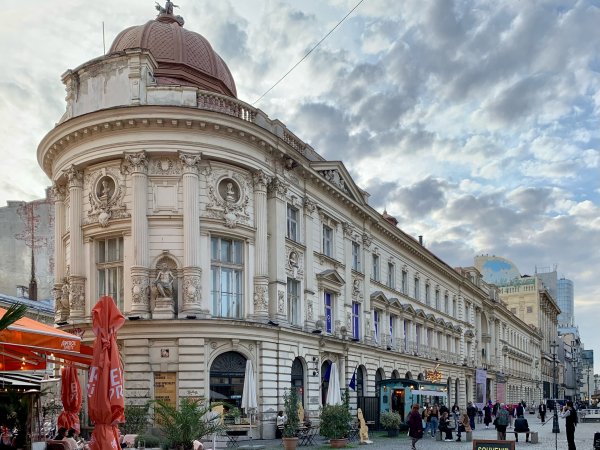
Few buildings in Bucharest's Old Town encompass such a rich history as the present-day Dacia-România Palace, the future headquarters of the Bucharest Municipal Pinacotheque. Built on one of the most valuable plots of land in the city's old commercial center, the building is the result of an evolution spanning almost five centuries, during which churches, inns, bank headquarters, cultural institutions, and commercial spaces succeeded one another. Located at 18–20 Lipscani Street, at the intersection with Smârdan and Stavropoleos Streets, the palace still dominates one of the most important historic areas of the Capital. Included in the List of Historic Monuments and forming part of the architectural ensemble of Lipscani Street, the building is not only an architectural jewel but also a witness to the economic, cultural, and social transformations that Bucharest has undergone. With the establishment of the Bucharest Municipal Pinacotheque here, the building is regaining its cultural vocation and will house one of the city's most important art collections.
From the church built by Ghiorma Banul to a landmark of old Bucharest
The story of this site begins in the second half of the sixteenth century. In 1564–1565, the Greek-born nobleman Ghiorma, Grand Chamberlain in the Princely Council of Petru the Younger and later granted the title of Ban, built here a church dedicated to the Nativity of the Lord.
Originally from the Pogoniana region in Epirus, Ghiorma was among the most influential officials of his time. The church built at his initiative quickly became one of Bucharest's landmarks and came to be known as the Church of Ghiorma Banul.
The history of this religious building would, however, be a turbulent one. During Michael the Brave's campaign against the Ottoman Empire, the church was set on fire by Ottoman troops in 1595 and remained in ruins for several decades.
Only during the reign of Leon Vodă, between 1629 and 1632, was the church restored to religious life. With the consent of Despa, Ghiorma's granddaughter, the church was dedicated to the Archbishopric of Pogoniana in Epirus. From that moment, it came under the administration of Greek monks and also became known as the Church of the Greeks.
This period was not free from hardship either. During the reign of Constantin Brâncoveanu, another fire severely damaged the building, and documents from the end of the seventeenth century describe its walls as being in a state of serious deterioration.
The Greeks' Inn, one of the city's most important commercial centers
At the beginning of the eighteenth century, the Greek merchants' community in Bucharest contributed to rebuilding the church. The building was repainted in 1713–1714 at the expense of Archbishop Eftimie of Dipalița, and the works were completed in 1719, when a new inscription in the Greek language was installed.
To provide the religious establishment with a steady income, the monks received permission to build an inn on the surrounding land. Over time, it expanded through the construction of several building wings erected in successive stages.
Shops rented to merchants operated on the ground floor, while the upper floors contained rooms intended for travelers and traders arriving in the Capital. As a result, the church gradually became known as the Church of the Greeks' Inn.
During the first half of the nineteenth century, the Greeks' Inn was considered one of the largest monastic inns in Bucharest, ranking third among the city's ten most important inns.
However, poor administration, repeated fires, and earthquakes gradually took their toll on the entire complex. In 1847, the city's architect, Xavier Villacrosse, officially recommended the demolition of the inn, considering that its condition had become dangerous.
Demolition began in 1861 and was completed two years later. During the same period, the church had also reached an advanced state of decay. Closed as early as 1858, it was eventually demolished, and by 1871 only the old inscription and several stone columns remained on the site.
The disappearance of both the church and the inn brought to an end a chapter of more than three hundred years in the history of this location.
The construction of the Dacia-România Palace
The destiny of the site changed radically in 1882. On July 9, the property was purchased at public auction by the Dacia-România Insurance Company, which intended to build its representative headquarters there.
Construction of the palace began that same year and continued until 1889, although most of the building had already been completed by 1885–1886.
The new building occupied the entire surface of the former inn, a fact confirmed both by the military maps of Bucharest drawn up at the end of the nineteenth century and by the cadastral map of 1911.
Although the identity of the architect has not been established with certainty, some sources identify the Austrian architect Adolf Lang as the author of the project, one of the most highly regarded designers of the period.
The palace impressed through its size, elegance, and privileged location in the heart of the Capital's commercial district, quickly becoming one of the most representative headquarters of a Romanian company.
The story of Romania's most important insurance company
The Dacia-România Insurance Company was created through the merger, completed in 1881, of two important insurance companies: Dacia, founded in 1871, and România, established two years later.
The new company possessed impressive financial resources for its time, with a fully paid-up capital of four million francs and substantial reserves. Its activity covered fire insurance, hail insurance, transport insurance, and life insurance.
By the beginning of the twentieth century, the company had already paid compensation amounting to hundreds of millions of francs and had become the oldest and most important insurance company in Bucharest.
Its Board of Directors included numerous prominent figures from Romania's political and economic life, reflecting the company's importance within the national economy.
Within a short time, the Dacia-România Palace had become a symbol of financial prosperity and of the economic development that Romania experienced at the end of the nineteenth century and the beginning of the twentieth century.
From the headquarters of a major bank to an institution at the heart of historic events
In 1914, the Dacia-România Palace entered a new stage in its existence. The Dacia-România Insurance Company first leased, and later sold, the building to the Romanian General Bank, one of the most powerful financial institutions of the time, regarded by contemporaries as a stronghold of German finance in Romania.
Shortly after the outbreak of the First World War, the history of the palace became intertwined with one of the most difficult periods in the history of the Romanian state. When the Romanian authorities withdrew to Iași, the property's title deeds and all documents relating to the building were evacuated to Moscow together with other valuables belonging to the Romanian state. This later made it more difficult to reconstruct certain aspects of the building's history and to identify the original documentation.
During the German occupation of Bucharest between 1916 and 1918, the bank was placed at the service of the military administration. Part of its assets was confiscated, and by ordinance issued on January 18, 1917, the occupation authorities ordered the circulation of banknotes and coins bearing the name of the Romanian General Bank.
After the end of the war, the Romanian state considered this monetary issue illegal and ordered the bank to be placed under sequestration. The shares owned by subjects of the enemy states were confiscated, and the institution entered an extensive process of reorganization.
Beginning in 1919, the bank changed its name to the General Bank of Wallachia, only to return to its original name, Romanian General Bank, in 1938. A few years later, in 1941, it merged with the Discount Bank of Romania.
A new cultural destination before the communist era
The year 1938 marked another important milestone in the palace's history. On July 9, the National Bank of Romania sold the building to the Union of Royal Cultural Foundations, an institution that played an essential role in promoting Romanian culture during the interwar period.
Until its nationalization in 1948, most of the building was occupied by the Central Office of the Royal Publishing Houses. At the same time, other spaces were leased to banks and commercial companies, transforming the palace into an important center for both financial and publishing activities in Bucharest.
Its location near the Capital's principal commercial and financial thoroughfares made it one of the most sought-after headquarters for institutions of the period.
Transformations during the communist period
Following the establishment of the communist regime and the nationalization of private property, the building's purpose changed once again.
Between 1950 and 1955, it housed the "Ciprian Porumbescu" Conservatory of Music and Dramatic Arts, one of Romania's leading institutions of higher artistic education.
In the following decades, the premises were assigned a variety of functions. Between 1960 and 1977, a restaurant and a cafeteria operated at No. 18, while No. 20 was occupied by a branch of the Applied Art Cooperative.
Although the building's original purpose had disappeared, the palace continued to be an important part of everyday life in Bucharest's Old Town.
Restoration following the 1977 earthquake
The devastating earthquake of March 4, 1977, caused considerable damage to the building, forcing the authorities to decide its future.
In 1979, the Council of Socialist Culture and Education approved the preparation of a comprehensive restoration and structural reinforcement project. At the same time, it was decided that the building would be converted into a space dedicated to fashion and luxury retail.
The restoration works were carried out between 1979 and 1983, based on a project prepared by the Carpați Design Institute. The project aimed not only to strengthen the building's structure but also to preserve the valuable architectural elements that gave it its distinctive character.
Once the works were completed, the palace received new functions. The basement and ground floor housed the Lipscani Self-Service Restaurant, while other areas accommodated shops selling footwear, leather goods, fabrics, and knitwear.
The upper floors were occupied by design and production workshops, as well as the Women's Fashion House and the Men's Fashion House, projects regarded as representative of the retail and light industry sectors of that period.
After 1990, a new beginning for the Dacia-România Palace
The political changes of 1989 marked the beginning of another chapter in the building's history. At different times, parts of the palace were occupied by the Romanian Commercial Bank (BCR) and CEC Bank, continuing the building's long-standing tradition of housing important financial institutions.
However, the most significant transformation came after 2012, when the Bucharest City Hall and the General Council of Bucharest launched the project aimed at establishing the Bucharest Municipal Pinacotheque.
In 2013, the municipality purchased the Dacia-România Palace specifically for this purpose. The decision represented one of the most important cultural projects dedicated to the artistic heritage of the city in recent decades.
The administrative and technical procedures continued over the following years, and through General Council Decision No. 419 of July 31, 2019, the building was transferred to the administration of the Bucharest Municipality Museum for the establishment of the Bucharest Municipal Pinacotheque. In August of the same year, the official handover documents were signed.
The Bucharest Pinacotheque, a new chapter for the Capital's artistic heritage
The current purpose of the Dacia-România Palace is perhaps the one that best reflects its historical and symbolic value. The building will house the Bucharest Municipal Pinacotheque, an institution that forms part of the Art Department of the Bucharest Municipality Museum and possesses an impressive artistic heritage.
Its collection includes 2,543 Romanian and European paintings, 402 sculptures, 87 works of decorative art, and 2,425 graphic works, making it one of the most important public art collections in Romania.
The creation of this exhibition space gives Bucharest the opportunity to properly showcase an artistic heritage that, for decades, lacked a permanent home worthy of its significance.
At the same time, the restoration and reopening of the palace contribute to the revitalization of the Old Town and to strengthening the city's cultural identity.
Today, the Dacia-România Palace is far more than a historic monument. It represents the synthesis of almost 500 years of Bucharest's history, a place where the memory of the Church of Ghiorma Banul, the commercial atmosphere of the Greeks' Inn, the economic development of the modern era, and the contemporary ambition to transform heritage into a living space dedicated to art and the public all come together.
Through the future Bucharest Municipal Pinacotheque, this remarkable building is reclaiming its status as one of the Capital's defining landmarks while continuing its story in a form adapted to the present, without losing its connection to the past that has made it so valuable.
We also recommend: The Museum of Communism in Bucharest, a gateway to the past beyond nostalgia: Opening hours, exhibits, ticket prices