Famous houses in Bucharest: The Istrate Micescu House, the brilliant lawyer and the largest private library in the Capital
By Bucharest Team
- Articles
- 07 JUL 26
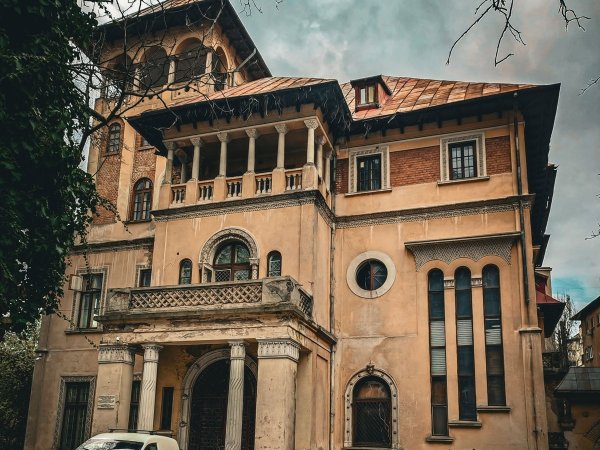
Hidden in one of the most elegant areas of Bucharest, right at the entrance to Cișmigiu Park, the Istrate Micescu House is one of the buildings with the most fascinating history in the Romanian capital. Impressive through its architecture and filled with the stories of an outstanding figure of Romanian law, the villa stands out both for its exterior beauty and for the cultural heritage it housed throughout the years. Although today it is in a visible state of deterioration, with time and the lack of investment having left their mark on it, the Micescu House continues to be regarded as one of the most valuable historic residences in Bucharest. Its destiny is closely linked to the name of Istrate Micescu, one of the most renowned Romanian lawyers of the 20th century, a university professor and politician, as well as to the existence of the most impressive private library ever owned in the Capital.
An elegant residence built in the Neo-Romanian style
The Micescu House is located at 12 Ioan Zalomit Street, in a quiet area situated in the immediate vicinity of Cișmigiu Park. Its privileged location, in a neighborhood dominated by elegant residences and historic buildings, contributes to the property's unique charm.
The construction plans date back to 1911, but the surviving documents do not provide clear information about the identity of the first owner. From the very beginning, the building was designed in the Neo-Romanian style, one of the most appreciated architectural movements of the early 20th century. This style harmoniously combines elements inspired by traditional Romanian architecture, Brâncovenesc influences, and decorative details typical of aristocratic residences.
Its impressive volume, high roof, elegant tower, and carefully crafted ornamentation give the building the appearance of a true urban manor house. Even today, despite its deterioration, the house continues to attract the attention of passersby, preserving part of the elegance that made it famous.
However, the most spectacular transformations came only after the property entered the possession of the man whose name it still bears today.
Istrate Micescu, one of Romania's greatest lawyers
In 1923, the property was purchased by Istrate Micescu, an outstanding figure in Romanian legal and political life. Born on May 22, 1881, he built an impressive career in the field of law and became recognized as one of the most brilliant lawyers of his time.
In addition to his professional activity, Micescu was a university professor and held important positions within the Romanian state. He served as Minister of Foreign Affairs during the Goga-Cuza government, a mandate that ended on February 10, 1938. Afterward, he was entrusted with drafting the new Constitution through which King Carol II established his authoritarian regime in Romania.
Later, between November 24, 1939, and May 10, 1940, Istrate Micescu also served as Minister of Justice in the government led by Gheorghe Tătărescu.
His professional prestige and social status enabled him to transform the residence into a home worthy of his position. Wanting a space that reflected both artistic refinement and his passion for culture and law, the lawyer turned to some of the most respected specialists of the era.
The architects who transformed the villa into a masterpiece
After acquiring the property, Istrate Micescu hired architect Edmond van Saanen Algi to redesign the house. The architect was already well known in Romanian architecture as one of the co-authors of the Telephone Palace project in Bucharest.
The interventions carried out during the 1930s completely changed the appearance of the building, giving it the monumentality for which it is still admired today. Historian Costin Zamfir noted that Edmond van Saanen Algi transformed the house into a magnificent residence, turning it into a genuine aristocratic mansion.
Among the most remarkable modifications were the design of the child's bedroom inside the tower, the addition of spacious exterior terraces, and the creation of an entrance inspired by Italian architecture. All these elements added elegance to the building without altering the Neo-Romanian character of the overall design.
The interior was completed by another celebrated name in Romanian architecture: Daniel Renard.
A leading architect of the Art Nouveau style and the designer of the famous Constanța Casino, Daniel Renard was responsible for one of the most impressive interior designs ever created for a private residence in Bucharest.
The library that made history in Bucharest
The centerpiece of the residence was Istrate Micescu's private library, regarded as the largest private library in Bucharest and one of the most impressive in interwar Romania.
Between 1931 and 1932, Daniel Renard designed the library furniture using boiled linden wood, a material appreciated for both its durability and the finesse of its craftsmanship. The result was a spectacular room that impressed visitors through both its size and the richness of its decorative details.
The collection comprised more than 30,000 volumes, most of them leather-bound, bringing together legal works, literature, philosophy, history, and numerous rare editions. For the intellectual world of the time, the library represented not only a place for reading but also a symbol of culture and the owner's prestige.
The interior decoration was executed with extraordinary attention to detail. The columns featured marble capitals decorated with the symbols of Justice. The Scales, the emblem of balance and fairness, appeared alongside the image of Themis, the Greek goddess of justice.
A particularly interesting detail is that the sculpted face of the goddess was modeled after Istrate Micescu's wife. Thus, the library combined legal symbolism, artistic refinement, and personal elements in a truly unique interior.
The central stove was also inspired by traditional Transylvanian architecture, perfectly complementing the elegant atmosphere of the room.
All these details transformed the library into a genuine masterpiece of decorative art, comparable to the interiors of Europe's great aristocratic residences of the period.
The confiscation of the house and its transformation into a public library
The political changes that took place after the Second World War radically altered the fate of the property.
In 1945, the communist regime confiscated the house, and the Micescu family lost ownership of the residence. Like many other properties belonging to Romania's intellectual and political elite, the villa was nationalized and transferred to state administration.
From 1959 until 2014, the building housed the National Pedagogical Library. For more than five decades, numerous teachers, researchers, and students crossed its threshold, allowing the building to preserve, to some extent, the cultural purpose envisioned by its former owner.
Although its institutional use helped preserve part of the building for many years, time and the lack of extensive restoration work gradually took their toll.
A valuable building in danger
Since 2014, the house has once again been privately owned, belonging to Istrate Micescu's granddaughter. Unfortunately, the extremely high restoration costs exceed the current owner's financial possibilities.
Today, the building is no longer connected to the electricity network and continues to deteriorate year after year. Although its structure has not yet suffered irreversible damage, the absence of specialized restoration work could accelerate the decay of one of Bucharest's most important architectural landmarks.
Heritage specialists believe that the property can still be saved through a restoration program supported by the authorities and by the institutions responsible for protecting Romania's built heritage.
One aspect that continues to generate debate is the fact that this building, despite its undeniable historical and architectural value, is not included on Bucharest's official list of historical monuments.
The absence of this status limits its protection and significantly reduces the chances of accessing restoration funding programs. For this reason, numerous historians, architects, and heritage enthusiasts advocate for the inclusion of the Micescu House among Romania's protected historical monuments.
A symbol of Bucharest's heritage that deserves to be saved
The Istrate Micescu House is much more than an elegant building located near Cișmigiu Park. It stands as a testament to an era when Bucharest was known as "Little Paris," and when the country's intellectual elite invested not only in spectacular residences but also in culture, education, and heritage.
The story of lawyer Istrate Micescu, the architectural transformations carried out by Edmond van Saanen Algi, and the extraordinary library designed by Daniel Renard together form a heritage of exceptional value. The more than 30,000 volumes, the decorations inspired by the symbolism of Justice, and the innovative architectural solutions demonstrate the remarkable level of refinement achieved by this residence during the interwar period.
Despite its current state of deterioration, the Micescu House still preserves enough original elements to make restoration possible and to allow it to return to the cultural circuit. A timely intervention could save one of the finest examples of Neo-Romanian architecture in the Capital and enable future generations to discover the story of a man who left a lasting mark on the history of Romanian law.
Protecting such a building means much more than preserving old walls. It means safeguarding the memory of an important period in Bucharest's history. The Istrate Micescu House remains a symbol of elegance, culture, and intellectual excellence, and its value fully justifies its inclusion among the city's protected architectural heritage and the initiation of restoration works capable of restoring its former splendor.
We also recommend: