The National Bank of Romania Museum, the Most “Expensive” Location in the Capital: Opening Hours, Exhibitions, Ticket Price
- Articles
- 20 MAY 26
In the heart of Bucharest, on one of the city’s most elegant and historically significant avenues, lies a place that many tourists discover with surprise: The National Bank of Romania Museum. Considered by many visitors to be the most “expensive” location in the Capital, not because of the ticket price, but because of the exceptional value of the exhibits and of the building that houses them, the museum offers a fascinating journey through the history of money, the economy, and the institution that safeguards Romania’s monetary stability. Paradoxically, although some of the most valuable objects related to the country’s financial history are kept inside, admission is free. All you need to do is reserve your place in advance for a guided visit. For approximately one hour, you will discover a monumental palace, impressive numismatic collections, and lesser-known stories about the evolution of the Romanian banking system.
A monumental palace with an impressive history
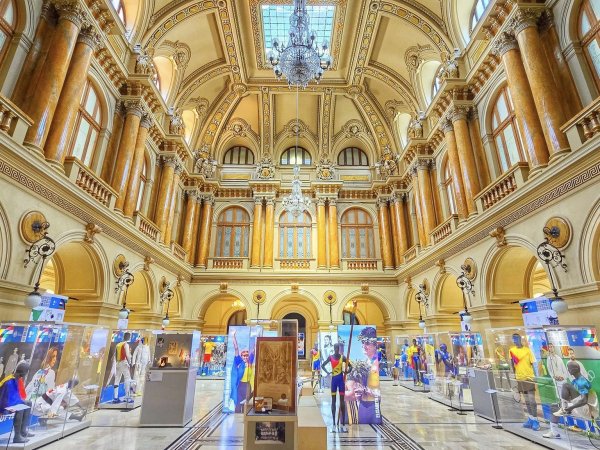
The old headquarters of the National Bank of Romania is one of the most representative architectural monuments in Bucharest. The building was erected between 1884 and 1890, according to the plans of the French architects Cassien Bernard and Albert Galeron, the same specialists who helped define the monumental style of many European edifices at the end of the nineteenth century.
The works were supervised by the Romanian architects Grigore Cerchez and E. Băicoianu, and the result is an imposing palace inspired by French academic architecture, with elegant façades, monumental columns, and spectacular interiors. The most recent major restoration took place between 1992 and 1994, when the building was restored to its original splendor.
Visitors are impressed from the moment they enter by the sumptuous halls, the decorative details, and the solemn atmosphere that recalls the era when Bucharest was nicknamed “Little Paris.” The palace itself represents one of the most valuable historical attractions in the city.
How the National Bank of Romania Museum came into being
The idea of establishing the museum dates back to 1914, when the General Council of the National Bank of Romania decided to create an institution dedicated to preserving the bank’s numismatic and documentary heritage. The project, however, was implemented gradually.
The actual organization of the museum began in 1933, and the first exhibition was inaugurated in July 1943. In the following years, the collections were moved and reorganized several times. In 1949, the exhibits were reopened in the Rosenthal building on Calea Victoriei, and in 1952 a special space was arranged on the ground floor of the building to house the entire collection.
The museum’s history also included difficult periods. When the Ministry of Finance occupied the space, the collection was transferred to the Romanian Academy, where it remained for several decades. Only in 1997 did the heritage return to the National Bank Palace, and the museum was officially inaugurated on May 3.
What you can see in the museum
The collections of the National Bank of Romania Museum are exceptionally valuable and illustrate the evolution of money on Romanian territory, as well as the history of the institution itself. One of the main attractions is represented by the numismatic series issued by the National Bank of Romania, including jubilee and commemorative coins.
In addition, visitors can admire items of major importance to monetary history, banking documents, seals, official insignia, and other objects that reflect the bank’s activity over time. A special section is dedicated to the gallery of portraits of the governors of the National Bank, personalities who played an essential role in the development of the Romanian financial system.
The guided tour offers detailed explanations and a wealth of historical information, making the experience accessible both to adults and to pupils or students interested in economics, history, and art.
How long the visit lasts and how it takes place
A complete visit to the museum lasts, on average, approximately one hour. The tours are guided and thoroughly documented, and the presentations include details about the building’s architecture, the collections on display, and the role of the National Bank in Romania’s economy.
The atmosphere is quiet and exclusive. During certain periods of the year, the number of visitors is high, but there are also days when you may enjoy an almost private experience, exploring the museum halls in very small groups.
This intimate character adds to the charm of the visit and allows for more direct interaction with the guide, who can answer participants’ questions in detail.
Opening hours, reservation, and ticket price
The most surprising aspect is that admission to the museum is free. Although the exhibits and the building house priceless treasures, no entrance fee is charged.
In order to take part in the visit, an advance reservation is required, preferably at least two days ahead. During busy periods, places fill up quickly, which is why booking in advance is recommended.
You may take photographs during the tour without paying any additional fee, an advantage appreciated by enthusiasts of history and architecture.
Why it is considered the most “expensive” location in Bucharest
The expression “the most expensive location in the Capital” refers to the exceptional value of the heritage and to the symbolic importance of the building. The National Bank of Romania Museum brings together rare objects, historical documents, and numismatic pieces that illustrate the country’s economic evolution.
In addition, the National Bank Palace is one of the most impressive monuments in Bucharest, and the simple opportunity to enter such an edifice is a special experience in itself.
A cultural experience you should not miss
The National Bank of Romania Museum is one of the most interesting cultural attractions in Bucharest and, at the same time, one of the least known. The visit offers a rare combination of history, architecture, and financial education in a setting of remarkable elegance.
The fact that admission is free and that the tour is guided turns this experience into an excellent opportunity for anyone who wishes to discover another side of the Capital. If you are passionate about history, monumental buildings, or simply looking for a special place to visit, the National Bank of Romania Museum certainly deserves a place on your list.
We also recommend: Nicolae Minovici Museum of Folk Art, a century of history. From the “Bell Villa” to today’s folkloric treasure