The House of Experiments in Bucharest, the first non-profit science center in Romania. Here children have fun while learning
- Articles
- 11 MAY 26
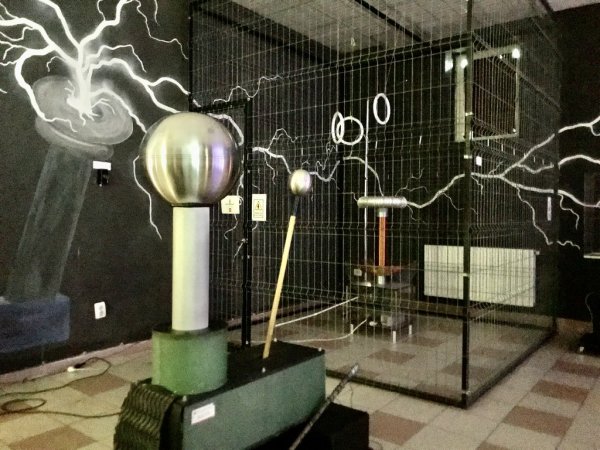
In a city where education is often split between rigid theory and children’s curiosity left in the background, Casa Experimentelor manages to completely change the way science is perceived. It is the first non-profit science center in Romania dedicated to learning through experimentation and play, a space where children, teenagers, and adults discover scientific phenomena not from textbooks, but through direct experience. Its concept is simple yet revolutionary: learning becomes effective when it is fun, interactive, and accessible. Instead of a classic approach, the center promotes an informal educational model based on free exploration, where visitors do not only observe, but touch, test, ask questions, and discover. It is no coincidence that future great scientists are encouraged here, perhaps even “the next Marie Curie or Henri Coandă of Romania.”
An educational concept based on play and discovery
At the core of the House of Experiments lies a fundamental idea: children learn best when they play. Instead of being passive observers, visitors become active participants in the learning process. The scientific exhibits are specially designed to be interactive, allowing the exploration of natural phenomena in an intuitive way.
Each installation is built to trigger curiosity. Visitors are encouraged to test, make mistakes, repeat experiments, and observe the results. This type of “hands-on” learning transforms science from an abstract field into a concrete experience, easy to understand and remember.
Instead of strict rules, freedom of exploration dominates here. Essentially, the message of each exhibit is clear: “touch me and discover what happens.”
A space dedicated to science accessible to everyone
The House of Experiments is not a classical museum, but an interactive science center where informal education plays the main role. Visitors do not need special knowledge to understand the exhibited phenomena, because everything is designed to be intuitive.
The audience is extremely diverse: from kindergarten children starting at the age of 3, to high school students, teachers, educators, and entire families. The concept of “Science for all” reflects the center’s mission to make knowledge accessible regardless of age or educational level.
Each visit becomes a different experience, because interaction with the exhibits depends on each participant’s curiosity. Thus, the same experiment can be perceived differently by a small child, a teenager, or an adult.
The origin of the project and the role of the Association for Training
The House of Experiments was created through a project co-financed by a grant from Switzerland, through the Swiss contribution to the enlarged European Union. The project took place over 18 months, between January 1, 2015 and June 30, 2016, during which the concept of the center was developed and implemented.
The initiative belongs to Association for Training, a non-governmental, non-profit organization founded in 2010. Its mission is to form responsible people through motivation, attitude, and resources for excellence.
The association does not limit itself to science education, but has a broader vision of human development, integrating culture, arts, sports, and complementary education into its programs.
Education as a complex process of human development
The objectives of the Association for Training are built around the idea of full human development. Among them are preparing human capital – children, youth, and adults – to become competitive on the labor market, as well as promoting social values and human rights.
Another important objective is combating discrimination of any kind, whether cultural, ethnic, religious, racial, or gender-based. At the same time, the organization aims to change the way children and young people perceive education, turning it into an attractive and relevant process.
Complementary education to the traditional school system plays a central role, emphasizing creativity and the development of each child’s individual potential.
“Children’s School” and learning beyond the classroom
All activities of the Association for Training are integrated into the initiative Children’s School, a program dedicated to complementing traditional education. It includes courses, workshops, sports activities, artistic and cultural programs, all designed to support the educational process in a modern way.
The goal is for learning not to be limited to the classroom, but to become a continuous experience connected to real life. Through this model, children are encouraged to think critically, experiment, and discover answers on their own.
Interactive science centers and the “hands-on” philosophy
The House of Experiments is part of the category of interactive “hands-on” science centers, an educational model widespread internationally. These centers are built around direct experimentation, where visitors learn through action.
The exhibits are designed to stimulate thinking and curiosity. They are not passive objects to observe, but tools that respond to user interaction. Essentially, nothing works without active involvement from the visitor.
This approach completely changes the relationship between student and knowledge. Instead of memorization, the focus shifts to discovery, testing, and personal experimentation.
Visitor experience and the atmosphere of the center
The House of Experiments is open to visitors from all over the country, who come in organized groups or as families. The atmosphere is dynamic, full of energy and curiosity, where children freely explore the space and interact with the exhibits.
The visiting schedule is flexible, and reservations can be made online, from Monday to Sunday, between 10:00 and 18:00. This accessibility contributes to the center’s popularity, making it easy to integrate into educational or recreational activities.
Accessibility and visitor pricing
Prices are designed to keep the center accessible to a wide audience. An adult ticket costs 45 lei, while children over 3 years old, students, and pensioners pay 38 lei. There are also group offers, so a group of 10 adults can visit the center for 430 lei.
An important advantage is that tickets are valid for 180 days, offering flexibility to visitors who want to return or plan their visit over time.
A place where science becomes experience
The House of Experiments is not just an educational space, but a complete experience that changes the way science is perceived. Here, learning is not an obligation but a discovery born from curiosity and interaction.
Through its innovative approach, the center succeeds in transforming complex scientific concepts into simple and entertaining experiences. Children do not only learn about physics, chemistry, or technology—they experience them directly through experimentation.
In a world where education is constantly searching for new ways to capture the attention of younger generations, the House of Experiments demonstrates that science can be not only useful, but also extremely captivating.
We also recommend: The Museum of Romanian Records, an impressive collection of objects unique in the world: schedule, tickets, exhibitions