The Museum of Romanian Records, an impressive collection of objects unique in the world: schedule, tickets, exhibitions
- Articles
- 23 MAR 26
Bucharest hides many surprising places, but few manage to combine so spectacularly the idea of heritage, rarity, and world record as the Museum of Romanian Records. For the public that wants to discover something different from the classic routes of the capital, this space is more than a museum in the usual sense of the word. It is a universe of unusual collections, a demonstration of passion carried on an impressive scale, and an invitation to look at old objects not as simple relics, but as witnesses of a fascinating material history. The museum’s official website presents it as the place where unique collections can be seen and brings to the forefront several sections dedicated to the public, from permanent exhibitions and tickets to the organization of events.
A discreet but unique museum
The museum’s fame is linked especially to the scale of its collections. According to the official presentation, the building houses some of the largest collections in the world, especially those of corkscrews, irons, and trivets, alongside other equally impressive collections. This wording is not accidental at all: the institution builds its identity precisely around the idea of record and exceptionality, transforming objects that many would once have considered strictly utilitarian into points of maximum museum interest. Precisely here lies the charm of the place: in the ability to convert the ordinary of yesterday into the spectacular of today.
On the museum’s website, visitors find the main categories of interest clearly organized: “Records,” “Collections,” “Tickets,” “Event organization,” “Media,” and “Contact.” In the collections section, irons, trivets and stoves, philately, multiple collections, and corkscrews are explicitly mentioned, a sign that the visiting experience is designed around well-defined thematic cores. Therefore, whoever arrives here does not enter a generic space, but a museum with a very clear identity, in which each object is part of a broader story about craftsmanship, history, design, and passion for collecting.
A museum of passion for collections and of world records
What differentiates the Museum of Romanian Records from many other exhibition spaces is precisely its philosophy. We are not talking about a museum built around a single historical period or a single field, but about one that values the rare object and exceptional accumulation.
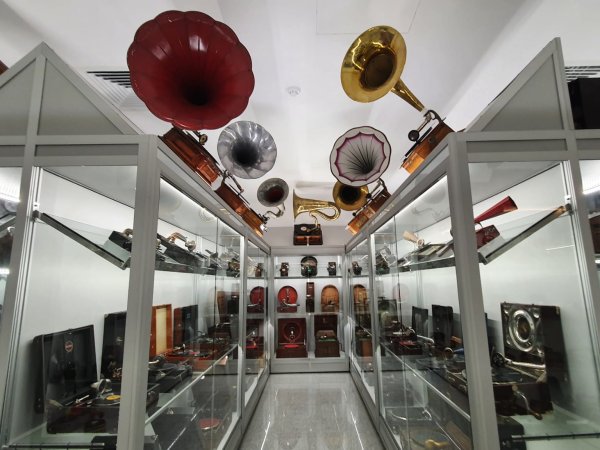
The museum formula is a special one: the visitor is invited to discover not only individual exhibits, but large-scale collections, which impress through volume, diversity, and their often unique character. The institution’s English-language website explicitly underlines that the museum brings together unique collections of amazing objects and invites the public to see the collections of corkscrews, irons, trivets, and others like these.
Another important element is the connection between the museum and international recognition. In the official presentation from the blog and press articles section, the museum mentions that Bucharest holds the Guinness world record for three of the largest collections in the world: the corkscrew collection, the iron collection, and the trivet collection. This information offers the real dimension of the place. It is not only about an interesting museum on a local scale, but about one that places Romania’s capital in an area of international prestige of collecting and of private heritage transformed into public experience.
The idea of record has, of course, an emotional effect on the visitor as well. In such a space, one does not enter only to look at some beautiful or old objects, but also to understand the dimension of a passion carried through to the end.
To see together hundreds or thousands of pieces from the same family means to understand better the evolution of an object, technical refinement, changes of style, and the way in which objects of daily use reflected, in fact, different mentalities and eras. In essence, the museum does not exhibit only metal, wood, ceramic, or paper, but ways of life.
This particularity makes it attractive not only for tourists, but also for collectors, lovers of urban history, design enthusiasts, and families looking for an unusual cultural experience in Bucharest. The statements about the structure of the collections and the emphasis on records appear constantly in the museum’s official presentation.
What you can see at the Museum of Romanian Records
From the structure presented on the website, it clearly results that one of the museum’s major attractions is the corkscrew collection. This is, probably, one of those perfect examples of an ordinary object that becomes extraordinary when it is viewed in its variety and evolution.
The corkscrew is no longer, in this context, a simple instrument, but becomes an object of design, an expression of technical ingenuity and a sign of social refinement from different eras. The fact that the museum places this collection at the center of its identity and that it figures among those associated with world records explains why it is one of the strongest attractions of the space.
Just as spectacular is the collection of irons. For today’s public, accustomed to standardized household appliances, the encounter with the history of the iron can be surprisingly interesting. In a collection of such dimensions, each piece gains value not only through age, but also through differences of shape, material, mechanism, and origin.
The Museum of Romanian Records thus transforms an object associated with domestic work into a chapter of technical and social history. The fact that this collection is highlighted among the largest in the world gives the whole experience an extra relevance and spectacular character.
Also in the central exhibition core is the collection of trivets and stoves. Here too, the strength of the museum lies in the way it makes visible the beauty of utilitarian objects. The trivets, often ignored outside the domestic context, become in such an exhibition proofs of craft creativity and of taste for ornament.
Their association with stoves amplifies the historical perspective and sends toward the interior space of the past, toward everyday life, the heating of the house, and the aesthetics of the objects that populated the domestic universe of past centuries. The museum not only preserves these pieces, but recontextualizes them, offering them a new status, as objects worthy of contemplation and study.
Besides these three major landmarks, the museum’s website also mentions sections dedicated to philately and to “multiple collections,” which suggests that the visiting experience is richer than the already known image of corkscrews, irons, and trivets. Philately adds the documentary and visual dimension of the stamp, while the wording “multiple collections” suggests that the museum also gathers other categories of exhibits, capable of completing the image of a universe of rarities and of collecting passion. Even if the brief presentations from the available results do not go into details for each category, their simple enumeration on the website shows that the museum is conceived as a rich and diverse space, not as an experience limited to one or two emblematic display cases.
Visiting schedule and useful information for the public
For those who want to plan a visit, the schedule is one of the first important pieces of information. In a promotional page published by the museum, the schedule is indicated as follows: from Monday to Friday, between 10:00 and 20:00, with the last entry at 19:00, and on Saturday and Sunday between 11:00 and 17:00. That same page explicitly states the time of the last entry and the fact that the closing time is 20:00 during the week.
There is, however, also another recent mention, available on the museum’s Facebook page, where a slightly different schedule appears: Monday-Friday 11:00-19:00, with the last entry at 18:00, and Saturday-Sunday 11:00-17:00, with the last entry at 16:00.
Because this information differs from the promotional announcement on the website, the most prudent conclusion is that visitors should check the updated schedule before leaving, especially in periods with special events or seasonal changes. The difference between the two mentions does not, however, change the main idea: the museum operates both during the week and on the weekend, being relatively accessible to the general public.
Another useful detail is that the museum offers the possibility of buying tickets and clearly separates on the website the “Info and Prices” section from the “Buy Ticket” section. This shows that the visitor’s experience is organized practically, with information dedicated both to those who want to find out the costs and to those who prefer advance purchase.
Even if the full complete price grid does not appear in the available results, the snippet-type section indicates a promotional price offer for “2026 at the Museum,” with rates of 30 lei for adults per person for one section and 70 lei for all sections. Children and other categories are also mentioned separately there, a sign that there is a differentiated tariff structure.
This pricing model is important because it suggests that the museum can be visited by sections or in full. In other words, the public has the flexibility to choose either a shorter and more concentrated experience, or a complete tour of all exhibition areas. For families, hurried tourists, or people especially interested in a certain category of objects, this option can be a clear advantage. At the same time, the fact that the museum promotes online tickets shows an adaptation to the needs of today’s public and an openness toward a more convenient organization of visits.
Exhibitions, events, and the role of the museum in cultural life
The Museum of Romanian Records does not limit itself to the static display of collections. The structure of the website clearly shows that the institution also has an events component, with distinct sections for “Current events,” “Past events,” and planning an event. This organization suggests that the space also functions as a living place, capable of hosting cultural projects, meetings, and special moments, not only classic museum visits.
A relevant example is the mention of the EFIRO 2024 philatelic exhibition, presented on the website in the past events section. According to the official description, EFIRO 2024 was a specialized philatelic exhibition, with the participation of 67 countries, held in the period April 16-19, 2024 at the National Library of Romania. Even if the event was not held in the museum’s headquarters, its presence in the archive on the website shows that the institution relates actively to the exhibition area and to broader cultural networks, especially in fields such as philately.
In the “Current events” section, the museum also promotes activities with an emphasis on creativity, color, and texture, presented as taking place right in the heart of the museum. This type of communication shows that the space is also used for complementary cultural experiences, which can attract different audiences, from enthusiasts of rare objects to people interested in workshops, thematic exhibitions, or niche events. The museum does not appear, therefore, as a frozen place, but as an active one, which tries to create new contexts of encounter between heritage and the public.
Besides the cultural component, the website also indicates an openness toward the area of organizing private or corporate events. The page dedicated to this subject invites the public to discover a special location for organizing events, strategically placed in Bucharest. The wording suggests that the museum can also function as a special decor for launches, meetings, receptions, or other types of events, relying precisely on the originality of the collections and on the memorable character of the place. It is a direction increasingly frequent in the contemporary museum world, where heritage meets experience and new forms of cultural use of space.
Why it is worth visiting the Museum of Romanian Records
The main merit of this museum is that it transforms amazement into a coherent cultural experience. In a Bucharest where the leisure offer is increasingly varied, the Museum of Romanian Records manages to stand out through specificity, identity, and memorable character. You do not visit only a space with exhibits, but a place where collecting becomes spectacle, and apparently minor objects gain an almost monumental aura. The fact that the institution is linked to world records and to collections of rare scale gives it a clear and strong profile.
At the same time, the museum has the advantage of speaking in several cultural languages at once. For some, it will be an incursion into the history of domestic objects. For others, a lesson about design, technique, and taste. For others, simply a spectacular experience, different from traditional museums. And for tourists, it is one of those places that can be told further precisely because they go out of the usual patterns of an urban visit. The official structure of the website, the emphasis on collections and records, the information about tickets and events outline the image of a well-organized and attractive space.
Through everything it offers, the Museum of Romanian Records confirms that heritage does not have to be solemn in order to be valuable, nor predictable in order to be educational. On the contrary, sometimes exactly surprise is what brings the public closer to culture. And this museum lives precisely from surprise: the surprise of quantity, of rarity, of detail, and of unexpected beauty. For those who are looking in Bucharest for a different experience, with objects unique in the world, with thematic exhibitions, possibility of visiting by sections, and a calendar of events in continuous motion, the Museum of Romanian Records remains one of the most interesting options.
We also recommend: