From the Neighborhood Midwife to the Private Clinic: How Giving Birth Changed in Bucharest
- Articles
- 08 JUL 26
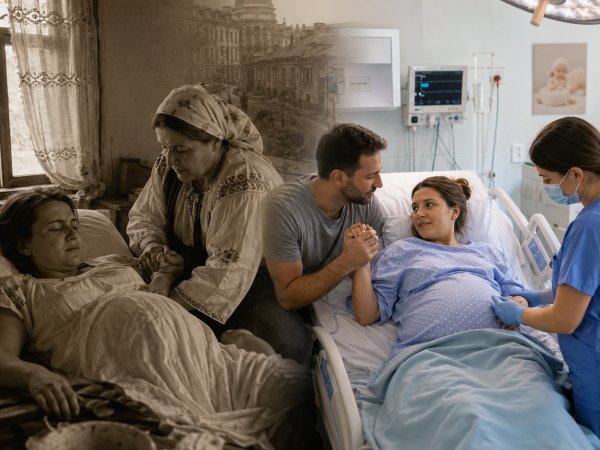
A Bucharest woman in 1850 gave birth at home, with the neighborhood midwife beside her, no alternative on the table. Hospitals existed, but there were few of them, reserved for serious cases — birth remained, for most women, a family matter rather than a medical procedure. Today, a few hundred meters from where the old neighborhoods once stood, a pregnant woman in Bucharest chooses between a crowded state ward and a private clinic with a private room, a birth package often paid off through a personal loan.
Filantropia and the Start of Institutional Birth Care
The institutional story starts in 1813, when construction begins on Filantropia Hospital, built with public donations. Two years later it opens with 20 beds — the city's third hospital, after Colțea and Pantelimon, and the first to accept patients regardless of nationality, religion, or wealth. Only between 1881 and 1883 does the Eforia Spitalelor Civile build a dedicated maternity wing in the hospital's courtyard, with 120 beds — the point at which obstetrics starts functioning as its own specialty rather than an extension of general medicine.
Gynecology only enters the curriculum of Bucharest's Faculty of Medicine in 1898, through professor George Assaky, a surgeon trained in Paris and Montpellier who had returned to the country a year or two earlier. Filantropia already ran the country's first Midwifery School, dating from the second half of the 19th century — the hospital had become, as its own institutional history puts it, "the cradle of Romanian obstetrics." So midwifery already had a formal, school-based track running alongside the informal apprenticeship still common in the city's neighborhoods.
The gynecology clinic itself came later than the timeline would suggest. In 1917, Constantin Daniel is appointed lecturer in gynecological clinic and starts teaching free courses at Filantropia. Only in 1920, three years later, is the clinic formally established, with Daniel becoming the first head of the Romanian school of gynecology. Filantropia remains today the country's oldest obstetrics-gynecology unit, a status confirmed by several independent sources, from business press to the hospital's own institutional record.
The Hospital Becomes the Default
Over the 20th century, home birth steadily disappears, and the state hospital becomes the near-universal path for every woman, regardless of income — a natural shift, driven by the expansion of the healthcare network and the falling risks of medically assisted birth. The flip side of that institutionalization shows up in more recent accounts of what actually happens inside public maternity wards: strict internal rules, often inconsistent from one hospital to another, where breastfeeding and mother-child contact weren't automatically treated as a priority. A 2022 investigation by DoR describes, for instance, a mother told to throw away milk she'd pumped for her baby in neonatal care, because "that's how we do it here" — a specific case, not necessarily a universal rule, but telling of the lack of a shared standard.
The real shift in approach comes in the 1990s, when UNICEF and the World Health Organization launch the "baby-friendly hospital" concept, with ten mandatory steps: breastfeeding within the first half hour after birth, rooming-in, staff specifically trained in lactation support. Romania adopts the concept late and, again, unevenly — each maternity ward ends up interpreting the rules its own way, with no central authority enforcing a common standard.
The C-Section Debate Dominating 2026
Where the past debate was about access to a hospital, today's is about what happens once you're inside one — and the numbers point to a sharp shift in medical practice. A study published by Springer Nature, based on 2020 data, puts the national C-section rate at 52.9%, with a stark gap between public hospitals (49.7%) and private ones (79.8%). In Bucharest and a handful of other counties, some private clinics reportedly exceed 80-90%, according to the same data. The World Health Organization recommends the rate stay under 10-15%.
The explanations overlap: doctors' fear of malpractice suits over complications arising during labor, pressure to shorten hospital stays, and a growing preference among women for a scheduled birth, seen as less painful and more predictable. The debate spilled out of medical offices in April 2026, when billboards appeared around Bucharest comparing natural birth to C-sections in terms the Romanian College of Physicians called scientifically unfounded, publicly demanding the messages be taken down.
The private sector has grown visibly in recent years, offering services that in other countries are standard and free: water birth, a partner present in the delivery room, a dedicated midwife.
Midwives Are Back in the Conversation
As a counterweight to that trend, recent years have brought a visible push to restore the midwife's role outside strict hospital logic. Asociația Moașelor Independente runs free prenatal and postnatal courses in Bucharest. The Romanian Midwives Association launched, in 2026, the national platform Sfera de Sănătate, offering online and in-person courses taught exclusively by licensed midwives, covering everything from natural birth and C-sections to breastfeeding and perimenopause.
Also in 2026, the pilot project MATERNA+ got underway, publicly backed by actress Judith State — not in Bucharest, but at the maternity ward in Miercurea-Ciuc, where the full integration of midwives into the medical team, per European standards, is being tested: free movement during labor, physiological birthing positions, immediate skin-to-skin contact after birth. If the model works there, the idea is for the practice to become a reference point for maternity wards in the capital too.
At street level, the movement has a more personal face as well. Irina, a midwife with a practice near Circus Park, carries the message "Give birth your way" painted on the bicycle she rides across the city — an individual example, but representative of a generation of midwives and doulas working outside the traditional hospital system. June 2026 saw the thirteenth edition of the free seminar Naște Natural, open to anyone wanting to better understand labor, breastfeeding, and the first days with a newborn.
The most recent official data, published by the National Institute of Public Health for 2023, put Romania's maternal mortality rate at roughly 13.5 per 100,000 live births — down from the 17-18 peak recorded in 2020, but still close to the WHO European region's average. The gap between the public conversation about respectful birth and what actually happens on the delivery wards of state hospitals remains, for now, one of the unresolved tensions in Bucharest's healthcare system.