Thriller and noir Bucharest. 5 contemporary books that turn the capital into a maze of mysteries and crimes
By Raluca Ogaru
- Articles
- 30 JUN 26
Bucharest has many literary faces. It can be a nostalgic city, a city of lost loves, a city of communist memory or a city of cafés and old houses. But there is also a darker Bucharest, tense and almost cinematic, which works perfectly in mystery, thriller and noir literature.
Communist apartment blocks, crowded squares, passages, dark alleyways, peripheral neighbourhoods, hidden villas, state institutions and newsrooms can become, in the hands of a good author, more than just setting. They turn into characters. Bucharest is no longer only the place where a crime happens, but the city that hides traces, creates pressure, complicates investigations and brings old fears to the surface.
For readers who want to discover the capital differently, through contemporary crime novels and anthologies, these five titles are a good starting point. They are not tourist guides, but they can work as an alternative map: one in which Bucharest is read through suspense, manipulation, neighbourhoods, crimes and people living on the edge between truth and lies.
Why Bucharest works so well in noir literature
A noir city needs contrasts. Bucharest has plenty of them. On the same day, you can go from an elegant street in the Kiseleff area to a boulevard suffocated by traffic, from a house with a garden in Cotroceni to a grey apartment block in Pantelimon, from a café in the centre to a popular market where the city looks completely different. For mystery literature, these breaks are pure gold.
Thrillers and crime novels do not only look for beautiful places, but for places that carry tension. Bucharest has a special urban tension: between old and new, between institutions and the street, between wealthy neighbourhoods and forgotten areas, between people who seem to know everyone and the anonymity of a large city. That is why the capital can easily become a literary maze.
In contemporary Romanian literature, the mystery and thriller genre has grown around publishers, collections and authors who have tried to bring local suspense closer to local reality. We are no longer talking only about abstract crimes placed in a generic city, but about stories that use Romanian space, institutions, language, the press, politics, neighbourhoods and the post-1989 atmosphere.
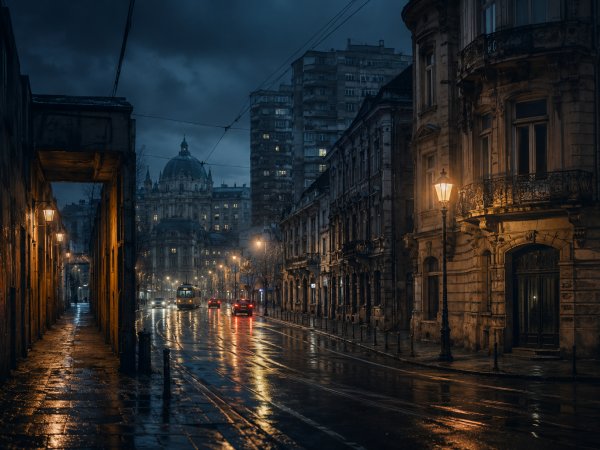
Thriller Bucharest is not necessarily the tourist city. It is the Bucharest you feel when you go down into a passage at night, when you cross a dark parking lot, when you see lights on inside apartment blocks, when a central street looks elegant during the day but completely different after dark. It is precisely this instability that makes it literary.
“Noir de București”, the anthology that divides the city into crimes and neighbourhoods
If we had to choose one volume that explicitly turns the capital into a noir map, “Noir de București” is probably the first title to put on the list. The anthology, coordinated by Bogdan Hrib, brings together crime stories by several Romanian authors and builds a Bucharest of cases, neighbourhoods, streets and small urban darknesses.
The volume works so well precisely because it does not offer a single image of the city. Bucharest appears fragmented, seen through several voices and several types of suspense. Some stories lean towards classic investigation, others towards atmosphere, others towards social observation. The result is a city where mystery does not lie only in a dead body, but in the way people move through urban space.
For București.ro, this book matters because it has exactly the city angle: it shows how neighbourhoods can become literary stages. Lacul Morii, Armenească Street, antique dealers, apparently ordinary places or everyday incidents can be turned into crime fiction. The capital is no longer just background, but narrative material.
“Noir de București” is suitable for readers who want a varied read, not a single plotline. It is also a good introduction to Romanian mystery literature, because it brings together several styles and sensitivities in one volume. If you want to see what Bucharest looks like when viewed through the lens of crime fiction, this is one of the most direct choices.
Bogdan Hrib and the Stelian Munteanu series, where investigation moves through the world of books and the city
Bogdan Hrib is one of the important names in recent Romanian crime fiction, and the series featuring Stelian Munteanu has contributed greatly to the genre’s visibility. The central character is connected to the publishing world, books, investigations and an area where culture, crime and power games can unexpectedly meet.
For an article about thriller Bucharest, the Stelian Munteanu series is relevant precisely because it brings forward a different type of investigator. We do not have only the classic police officer or professional detective, but a character who moves through cultural, publishing and international circles. Bucharest thus becomes more than a city of crimes; it becomes a node of relationships, secrets and interests.
Volumes such as “Filiera grecească”, “Ucideți generalul” or “Reziliență” can also be read as parts of a broader geography, in which Romania and Bucharest connect with other spaces. But the city remains important through the atmosphere it offers: bookstores, publishing houses, newsrooms, people who know more than they say and investigations that are never solved through simple logic alone.
The charm of the series also comes from the fact that cultural Bucharest becomes compatible with suspense. Instead of seeing only dark neighbourhoods and dangerous streets, we enter a noir of books, manuscripts, apparently civilised meetings and conversations in which every line may hide a clue.
“Spada”, by Bogdan Teodorescu, the political thriller of manipulation
Bogdan Teodorescu is one of the Romanian authors who have used the area of political and social thriller very effectively. “Spada”, included in “The Manipulation Trilogy”, is the kind of novel in which suspense does not come only from a crime or an investigation, but from the mechanisms through which power, public image and manipulation can change reality.
For Bucharest, such a novel matters because the city is the natural centre of these games. Politics, the press, institutions, image strategies, influential people and the obscure areas of public decision-making inevitably meet in the capital. Bucharest becomes the place where versions of truth are manufactured and where people can be pushed into believing what others have built for them.
“Spada” should not be read as a classic detective thriller, but as a novel about mechanisms. Here, noir does not necessarily lie in alleyways and night chases, but in cynicism, calculations and the way an event can be used, distorted or turned into a public weapon. It is a Bucharest of behind-the-scenes dealings, strategies and people who understand that truth never travels alone.
For readers interested in politics, media and the grey area between information and manipulation, Bogdan Teodorescu remains one of the relevant reads. And for București.ro, he offers another key to reading the capital: the city not only as a space of crimes, but as a laboratory of power.
“Cumsecade”, by Petru Berteanu, the thriller in which the neighbourhood becomes the corpse
“Cumsecade”, Petru Berteanu’s novel, is one of the most interesting choices for a top about noir Bucharest, even if it does not work as a classic police novel. The book has been described as an atypical thriller in which “the main corpse is that of a neighbourhood”. This phrase says almost everything about its urban stakes.
Here, the mystery is no longer only about who died, who killed or who is investigating. The suspense comes from the way everyday life deteriorates, from disappearances, from community and from the feeling that a place you thought was stable is beginning to dissolve. It is a type of social noir, in which the neighbourhood itself becomes a sick organism.
For Bucharest, this perspective is very powerful. The capital is not only the centre, museums, boulevards and tourist landmarks. It is also the sum of its neighbourhoods: places with neighbours, habits, small tensions, slow disappearances and forms of life that change before anyone notices in time. In this sense, “Cumsecade” can be read as a book about the fragility of urban community.
The novel is suitable for readers who want a more unusual thriller, with social stakes and a strange atmosphere. It does not necessarily promise the comfort of a classic investigation, but the unease of a place that seems familiar and then begins to stop obeying the rules.
“Julieta avea un pistol”, by Tony Mott, crime as a game of masks
Tony Mott, the literary pseudonym of Antoneta Galeș, has become a familiar name for Romanian mystery and thriller readers. “Julieta avea un pistol” is a crime novel in which the death of a character causes the masks of those around her to fall. Every person close to her has a hidden agenda, and each could have a motive for murder.
The book is interesting for noir Bucharest because it brings suspense into an area of relationships, lies, love, betrayal and hidden interests. We do not have only crime as a brutal fact, but crime as a moment of revelation. The city becomes the space in which people seem to lead normal lives until a death breaks through appearances.
In noir literature, this mechanism is essential: truth is never on the surface. Every character may be hiding something, every relationship may have a double face, and every explanation may be only a convenient version. Bucharest, with its mix of intimacy and anonymity, works very well for such a story.
For readers who want a thriller with pace, suspense and tension between characters, “Julieta avea un pistol” is a suitable choice. In addition, the novel shows how Romanian crime fiction can also move towards emotional areas, not only towards technical investigation or procedure.
What these books say about Bucharest today
The five titles show that Bucharest can be read as a city of mystery, not only as a crowded capital. Each book uses it differently: as a map of neighbourhoods, as a publishing and cultural node, as a political laboratory, as a social organism or as a space of hidden relationships.
This is, in fact, Bucharest’s literary strength. The city does not have a single identity, and noir literature feeds precisely on this instability. The capital can be elegant and brutal, familiar and foreign, central and peripheral, comic and threatening. Depending on the book, the same city can become a place of investigation, a field of manipulation or the stage of a collective disappearance.
For readers who know Bucharest, these volumes also have a special effect: the places are no longer abstract. A street, a square, a bookstore, a neighbourhood or a building can be recognised, and the reading gains an extra layer. You are not reading only about a crime, but about a crime that could happen in a city you cross every day.
For tourists and expats, such books can work as an unofficial guide to the darker Bucharest. They do not replace walks through the city, but they can change their tone. After reading a thriller set here, alleyways, passages, squares and apartment blocks no longer seem like mere urban scenery, but parts of a possible story.
Where to start if you want to discover noir Bucharest
If you want a broad and fragmented image of the city, start with “Noir de București”. It is the most direct entry point, because it brings together several voices and several ways of turning the capital into a crime scene. If you prefer a series with a recurring character, Bogdan Hrib and Stelian Munteanu are a natural choice.
For political thriller, “Spada” is one of the best options, especially if you are interested in manipulation, institutions and the backstage of power. If you want a stranger book, with a focus on community and neighbourhood, “Cumsecade” deserves a place on the list. And if you prefer a thriller built around relationships, lies and personal suspicions, “Julieta avea un pistol” may be the right read.
READ ALSO:
Symbols of Bucharest: The Cartea Românească Bookstore, the Favorite Place of Interwar Intellectuals
Noir Bucharest is not a city separate from the real Bucharest. It is the same city, only seen in lower light. The same boulevards, the same neighbourhoods, the same houses and the same apartment blocks gain a different weight when placed inside a mystery story.
Perhaps that is precisely why the genre suits the capital so well. Bucharest never tells all its stories from the start. Some are visible, others must be searched for. And thriller and noir literature does exactly that: it lifts the curtain a little and shows us that, behind the familiar city, there is always another city.