Symbols of Bucharest: The Cartea Românească Bookstore, the Favorite Place of Interwar Intellectuals
- Articles
- 06 MAR 26
Interwar Bucharest was a city of ideas, debates, and an intense cultural effervescence that shaped the intellectual life of Romania. During that period, cafés, editorial offices, and bookstores were not merely commercial spaces, but genuine meeting points for writers, professors, students, journalists, and artists. Among the places that left a profound mark on the cultural landscape of the Romanian capital was the Cartea Românească Bookstore, a space where books stood at the center of the intellectual universe.
The Birth of the Cartea Românească Publishing House
More than just a bookstore, Cartea Românească became a gathering place for the cultural elites of the era. It was a place where readers could discover the latest publications, where literary ideas were debated, and where relationships between authors, publishers, and the reading public were formed. Around this institution a true cultural community developed, one that contributed significantly to the evolution of modern Romanian literature.
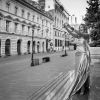
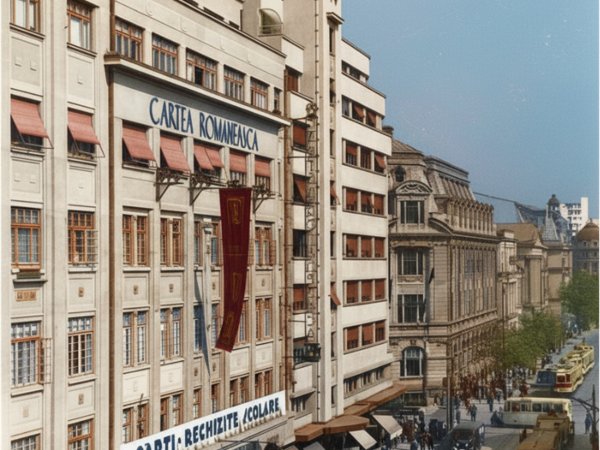
The building that housed the bookstore was located in a central area of the city, at the intersection of Academiei Boulevard (today Regina Elisabeta Boulevard) and Calea Victoriei, one of the most important streets in Bucharest. Over time, this location became a landmark for lovers of books, and the atmosphere within the bookstore was frequently described by writers as unique.
Although the building was destroyed during the bombing raids of the Second World War and the bookstore disappeared from the urban landscape, the cultural legacy of the Cartea Românească Publishing House continues to this day through the books it produced and the important role it played in the history of Romanian literature.
The Cartea Românească Publishing House was established in 1919, during a period of profound transformation for Romania following the end of the First World War and the achievement of national unification. The creation of this editorial institution was the result of the collaboration between several well-known printing houses and publishing companies of the time.
The new publishing society was formed through the association of several already established institutions in the world of printing and bookselling. Among them were the workshops of C.I. Rasidescu, which continued the tradition of the old printing house founded by C.A. Rosetti, the bookstore and publishing house “Ioanițiu and Sons,” founded in 1858, and the “School Bookstore,” established in 1891.
These were joined by the Institute of Graphic Arts “Flacăra,” formed around the magazine of the same name in 1911, as well as the “Minerva” Institute, founded in 1898. The latter provided the headquarters for the new publishing company, located in an imposing building on Academiei Boulevard, at the corner with Calea Victoriei.
By bringing together these institutions, a powerful editorial structure was created, capable of publishing literature, school textbooks, scientific works, and numerous other types of books. In a short time, Cartea Românească became one of the most important publishing houses in Romania.
The Emblematic Building in the Center of the Capital
The headquarters of the publishing house and the Cartea Românească bookstore was located in a building that was representative of interwar Bucharest. Initially, the building had three floors, but the development of editorial activities led to its gradual expansion.
In 1930 the building was raised to four floors, and eight years later, in 1938, it reached six floors. This transformation reflected not only the growth of the publishing house but also the cultural dynamism of the city.
Located in a highly frequented area, the building attracted numerous readers, students, professors, and writers every day. The bookstore on the ground floor was one of the liveliest places in central Bucharest, constantly filled with people interested in the newest editorial releases.
Unfortunately, the building was severely damaged during the bombing raids of the Second World War, and the destruction was so extensive that the structure could not be saved. Later, part of its location was occupied by the building known during the communist period as the “Romarta block.”
The disappearance of the building represented an important loss for the cultural landscape of Bucharest, as the place had been associated with one of the most important editorial institutions of the time.
The Atmosphere Inside the Bookstore and the People Who Brought It to Life
The Cartea Românească bookstore was not only a place where books were sold, but also a genuine cultural center. Writer Vlaicu Bârna described the interior of the bookstore as an impressive space organized in a huge quadrilateral, where shelves and counters were filled with volumes.
In the front area there were tables and shelves with books, while in the back visitors could find school textbooks, stationery, and writing supplies. Students, teachers, and literature lovers all came here in search of reading material.
One of the well-known figures of the bookstore was Mișu Brandeski, the head of the literary books section. Described as a dark-haired man with raven-black hair and quick movements, Brandeski was famous for the attention he paid to every customer.
He was not simply a bookseller. He knew literature extremely well and could recommend suitable volumes to readers depending on their interests. He was also on friendly terms with many writers of the time, which turned the bookstore into a meeting place for the literary world.
Thus, the bookstore became a space where authors and readers met, discussed literature, and exchanged ideas. This atmosphere contributed to the consolidation of the cultural life of the Romanian capital.
The Basement with French Literature
A special feature of the bookstore was the French book section located in the basement. Visitors reached it by descending a wide staircase that led to a spacious room arranged in a rather unusual manner.
This section was managed by Miss Mitzi, a woman whom contemporaries described as difficult to place in a specific age category. Although she maintained a severe appearance and a sober manner, she was known for her kindness and generosity.
In the middle of the room there was a circular concrete structure shaped like a deep bowl, with a radius of approximately two meters. Inside it were placed books by French classical authors, in popular editions that were accessible to a wide audience.
Readers could purchase important works of French literature at very low prices. For example, the work “Le Génie du christianisme” could be bought in two volumes at a price comparable to that of a simple meal.
This accessibility contributed to the spread of French culture among Romanian readers, at a time when France exercised a strong cultural influence in Romania.
A Bookstore with Surprising Offers
In addition to books and magazines, the Cartea Românească bookstore offered a wide variety of products. Visitors could find albums, school textbooks, stationery items, and writing materials.
During the holiday season, the bookstore also became an ideal place to buy gifts. Toys, decorative objects, and other items appeared on the shelves, attracting the attention of customers.
An advertisement published in the magazine “Realitatea ilustrată” shows that during the summer the bookstore even sold bathing suits. This diversity of products demonstrated the ability of the establishment to attract a wide public.
Near the bookstore there was also the famous Herdan automat, an American-style self-service bar where food was extremely cheap. Many students and young intellectuals would buy a snack there and then enter the bookstore to browse through books. In this way, the area became a genuine meeting point for young people interested in culture and literature.
The Destruction of the Building During the War
The fate of the Cartea Românească bookstore was dramatically marked by the events of the Second World War. In April 1944, Bucharest was heavily bombed by American aviation, and many buildings in the city center were destroyed.
The building that housed the publishing house and bookstore was severely damaged during these air raids. The destruction was so extensive that the structure could not be restored. Thus, one of the most important cultural centers of interwar Bucharest disappeared permanently from the city’s landscape.
Later, another building was constructed on part of the site, known during the communist period as the “Romarta block.” Although the new building occupied part of the same space, it never carried the same cultural significance as the former bookstore.
The Fate of the Publishing House After 1948
Although the building had disappeared, the Cartea Românească publishing house continued to function for a short period of time. Its activity was interrupted in 1948, when the communist regime was established in Romania.
That year the authorities dissolved the publishing house as part of a broader process of reorganization and nationalization of cultural institutions.
The last major title published before its dissolution was the short-story volume “Întâlnirea din pământuri,” written by Marin Preda. The book appeared in 1948 and became one of the representative works of postwar Romanian literature. After its dissolution, the publishing house disappeared for more than two decades from the Romanian cultural scene.
The Rebirth of the Publishing House and a New Period of Glory
In 1970 the Cartea Românească publishing house was re-established, this time as the publishing house of the Romanian Writers’ Union. The leadership of the institution was taken over by writer Marin Preda, one of the most important Romanian novelists of the twentieth century.
Under his direction, the publishing house entered a new period of development and prestige. Numerous important literary works were published, and Cartea Românească once again became one of the most influential publishing houses in the country.
After Marin Preda, the leadership of the publishing house was taken over by the writer George Bălăiță. During the communist period, the publishing house produced more than 5,000 titles in approximately 10 million copies. This impressive editorial activity contributed to shaping the literary tastes of several generations of readers.
The Cultural Legacy of Cartea Românească
Today, the Cartea Românească publishing house still exists and belongs to the Romanian Writers’ Union. The books are published under the administration of the Paralela 45 publishing house, which allows the continuation of the editorial tradition.
Although the emblematic bookstore in the center of Bucharest no longer exists, its memory remains alive in the cultural history of the city. For the intellectuals of the interwar period, Cartea Românească was not simply a place where books were purchased. It was a space for meetings, literary discussions, and cultural discoveries.
Today, the history of this bookstore represents an important part of Bucharest’s cultural heritage. Its story recalls a time when bookstores were genuine centers of intellectual life and when the book occupied a central place in society.
We also recommend: Symbols of Bucharest: Socec Bookstore, the temple of culture on Podul Mogoșoaiei, the interwar jewel of the Capital