Symbols of Bucharest: Socec Bookstore, the temple of culture on Podul Mogoșoaiei, the interwar jewel of the Capital
- Articles
- 03 MAR 26
During the interwar period, the perimeter around the intersection of Elisabeta Boulevard and Calea Victoriei was one of the most effervescent cultural centers of the Capital. Here operated a true constellation of bookstores, which transformed the area into a pole of ideas, debates, and intellectual meetings. In this space were located some of the most important names in the world of books: Socec Bookstore, Alcalay, and Cartea Românească, whose headquarters was situated on the site where, during the communist period, the building known as Romarta Copiilor would later rise.
A bookish constellation at the intersection of the great boulevards
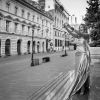
At that time, Calea Victoriei – previously known as Podul Mogoșoaiei – was not only a promenade artery, but also a symbolic space of Romanian modernity.
Cafés, theaters, commercial galleries, and bookstores composed an urban landscape comparable to the great European capitals.
In this context, Socec Bookstore established itself as a true temple of culture, a place where the book became an object of worship, and reading – an act of social prestige.
From the apprenticeship of Ioan V. Socec to the affirmation on the book market
The founder of the bookstore, Ioan V. Socec, was the apprentice of the bookseller Gheorghe Ioanid, whose name is today remembered especially through the park in the Icoanei neighborhood that bears his name.
In April 1856, in a period of political turmoil and cultural transition, Socec opened his own bookstore. It was a moment when the Romanian language had not yet established its modern orthographic and orthoepic norms, and texts were often printed with a mixture of Cyrillic and Latin characters.
Despite this unstable context, Ioan V. Socec managed to assert himself rapidly on the Bucharest book market, which, although numerically limited, was animated by an authentic thirst for culture. An enterprising and visionary spirit, Socec did not limit himself to the activity of bookseller.
About fifteen years after opening the shop, having accumulated capital and experience, he established a graphic arts workshop together with the Brașov printer Dumitru Teclu, the brother of the well-known chemist Nicolae Teclu.
Over time, Ioan V. Socec became the sole owner of the business and constantly developed the workshops. He added lithography, zincography, artistic bookbinding, and cardboard sections, transforming his enterprise into a first-rank editorial and typographic complex. The book was no longer only sold, but entirely produced under the Socec imprint, which offered control over the quality and diversity of publications.
A palace of the book in the heart of the city
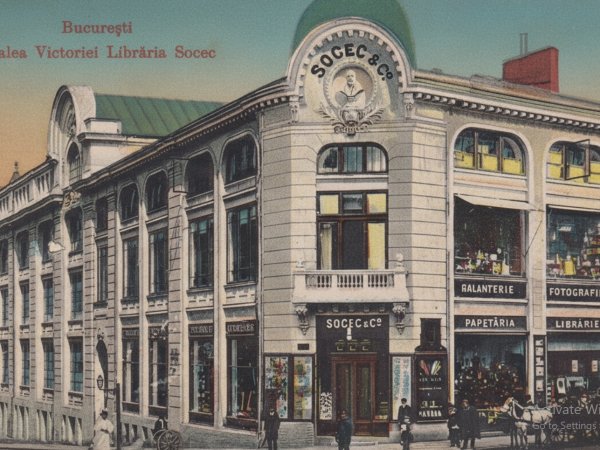
In 1907, the bookstore erected an imposing headquarters at the intersection of Calea Victoriei and Lipscani Street, marking a new moment of affirmation. The building became a visual and cultural landmark of the area. After Socec’s death, the business was taken over in 1919 from his heirs by Iancu Șaraga and S. Schwartz, two entrepreneurs who were to carry forward the tradition of modernization and expansion.
Four years later, the two also purchased the Alcalay shop, thus consolidating their position on the market. Under their leadership, Socec Bookstore experienced spectacular development. If at the beginning there were only three branches in the country – in Ploiești, Iași, and Craiova – the network expanded to a total of eleven cities. Besides those mentioned, bookstores were opened in Galați, Constanța, Călărași, Slobozia, Târgoviște, Oradea, Râmnicu-Sărat, and Turnu-Severin.
Modernization was not limited to geographical expansion. Modern typographic and lithographic machines were acquired, capable of printing in two colors, and the zincography produced clichés for illustrations in three or four colors. The quality of the prints rivaled that of Western products, a remarkable fact for the Romanian industry of the time.
The workshops were diversified, including sections for registers, envelopes, photography, stereotyping, type foundry, stamp making, typewriter repair, and fountain pen holders. The complexity of the activity demonstrated the ambition to create a true editorial empire.
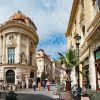
The initial space, however, quickly became insufficient. Consequently, the old building was demolished, and in its place an elegant edifice in Art Deco style was erected. From 1928, the new building was shared with the famous Galeries Lafayette, in a commercial association that was to transform the area into a node of the economic and cultural life of the Capital.
The building, with six floors and three basements, spread over an area of 1,800 square meters, impressed through its monumentality. Galeries Lafayette, important financiers of the construction, brought a Western air, with 80 departments, spectacular shop windows changed weekly, and four elevators in continuous movement. Under the same roof were found diverse products, from books to clothing items, which allowed Bucharest residents to save time and experience modern shopping.
Socec Publishing House and the cultural mission
Beyond the commercial dimension, Socec Publishing House continued to play an essential role in the cultural life of Romania. The established collections of school textbooks, scientific works, literature volumes, and legal treatises were maintained. Through these publications, Socec contributed to the formation of generations of pupils, students, and professionals.
On the anniversary of 80 years since its founding, a new collection entitled “Our Library” was launched, intended for youth. The initiative reflected the concern for cultivating the taste for reading among the new generations and for making written culture accessible.
Through its vast network of branches, Socec had a decisive role in spreading books throughout the country. According to Ioan Massoff, the activity of the bookstore significantly contributed to the development of reading in Transylvania and to the establishment of village and urban libraries. The book thus became an instrument of cultural and social emancipation.
An interwar jewel and a symbol of modernity
Socec Bookstore was not only a successful business, but also a symbol of Bucharest modernity. Through its Art Deco architecture, through the association with Galeries Lafayette, and through the scope of its editorial activity, it represented a model of integrating culture into the economic dynamics of the city.
On Podul Mogoșoaiei, later becoming Calea Victoriei, Socec functioned as a true temple of culture. In its halls met passionate readers, intellectuals, teachers, and students. Each volume sold or printed bore the imprint of an era in which the book was considered the foundation of progress.
Today, the evocation of Socec Bookstore brings back to memory the image of an elegant Bucharest, open toward Europe and thirsty for culture. The building and its story remain part of the symbolic heritage of the Capital, a testimony of an era in which entrepreneurial spirit and passion for the book gave birth to a genuine interwar jewel.
We also recommend: Symbols of Bucharest: Ion D. Berindey, the architect with golden hands who designed the city’s most beautiful buildings