The history of the TNB Museum, the temple of the artifacts of the greatest Romanian actors
- Articles
- 12 AUG 26
At the heart of the National Theatre “I.L. Caragiale” in Bucharest there is a place where time seems to have stood still, and the history of Romanian theatre can be discovered through objects that belonged to some of the greatest actors, directors, playwrights and cultural figures. The TNB Museum is more than a collection of exhibits. It is a genuine journey through the history of the Romanian stage, from its beginnings to almost the contemporary era, built through photographs, documents, manuscripts, paintings, costumes, personal objects and props. The story of the museum is, in turn, a troubled one. It was established during the directorship of Liviu Rebreanu, went through the bombings of 1944, was evacuated, moved to several different spaces, closed for long periods and, eventually, found its place in the current building of the National Theatre. Its history thus reflects not only the evolution of theatre, but also the dramatic moments through which Bucharest passed during the 20th century.
A museum born from the passion of George Franga
The idea of creating a museum dedicated to the history of the National Theatre belongs to George Franga, an actor and later assistant librarian of the institution. He understood that the memory of theatre risked being lost if the objects, documents and testimonies of those who had built the Romanian stage were not preserved in a special place. For this reason, he began searching among elderly actors and the descendants of great theatre personalities for objects and documents that could tell the story of an era.
His efforts produced impressive results. Books, manuscripts, letters, photographs, paintings, busts and numerous objects connected with stage activity were collected. These were not merely pieces of artistic value, but genuine testimonies of theatrical life: objects that had been used in performances or had belonged to actors and cultural figures.
An important role in transforming the initiative into a museum institution was played by Liviu Rebreanu, director of the National Theatre between 1941 and 1944. During his tenure, on September 10, 1942, the National Theatre Museum was opened to the public. Thus, in the middle of the war, the theatre was creating its own institutional memory, bringing together in one place fragments from the past of the Romanian stage.
The first headquarters, near the National Theatre on Calea Victoriei
The museum's first headquarters was arranged in the group of buildings located next to the old National Theatre on Calea Victoriei. Today, the area is associated with the Novotel hotel, whose entrance faithfully reproduces the façade of the former National Theatre. For the contemporary visitor, this reconstruction offers one of the most interesting visual connections with the lost building, destroyed during the Second World War.
The establishment of the museum must also be viewed in the context of an older tradition of preserving theatrical memory. TNB notes that as early as 1921, during the directorship of Victor Eftimiu, the institution had acquired busts and paintings depicting important actors and personalities of Romanian theatre, created by representative visual artists. These pieces contributed to the creation of the heritage that would later be displayed in the museum.
The museum was therefore not conceived as a simple commemorative exhibition. The intention was to create a visual and documentary history of theatre, in which the great names could be discovered not only through portraits, but also through the objects that accompanied their careers.
The 1944 bombing and the beginning of the museum's wanderings
The museum's destiny was radically changed by the events of August 1944. On August 24, the National Theatre building on Calea Victoriei was destroyed during the bombings at the end of the war. The museum, located in the immediate vicinity, could no longer operate in its original form. Its heritage was evacuated in order to be protected, reaching Pucioasa.
After this period, the museum's objects were brought back to Bucharest and displayed in two rooms of Saint Sava High School. They remained there until 1952, when the collection was moved to the Majestic Passage, a space corresponding today to the Odeon Theatre. The museum's wanderings reflect the difficult situation of the National Theatre, which, after losing its building on Calea Victoriei, was forced to operate in several locations.
In the years following the bombing, the National Theatre continued to stage performances in spaces such as the present-day Odeon Theatre, the Studio in Amzei Square and the assembly halls of Saint Sava and Matei Basarab high schools. This period explains why the history of the museum cannot be separated from the history of the theatrical institution it represents.
From the new TNB building to the museum's current location
The reconstruction and development of the new National Theatre brought hope for a stable headquarters for the museum as well. After the inauguration of the current TNB building, the museum was opened to the public between 1975 and 1978. However, this stage did not mean definitive stability for the collection.
For approximately 12 years, until 1990, the objects were once again stored in warehouses. Only after this period was the museum reopened, this time in the foyer of the Main Hall. It was another step toward recovering the institution's memory, but the solution was not yet definitive. In the winter of 2001, the TNB Museum received its current location, and the collection has remained displayed in this form to the present day.
The fact that the heritage survived evacuations, storage and successive changes of location is, in itself, a spectacular story. Behind each exhibit there is therefore not only the history of an actor or a performance, but also the complicated history of preserving theatrical memory during a period when Bucharest and its cultural institutions underwent radical transformations.
Portraits of the great actors and objects that preserve the memory of the stage
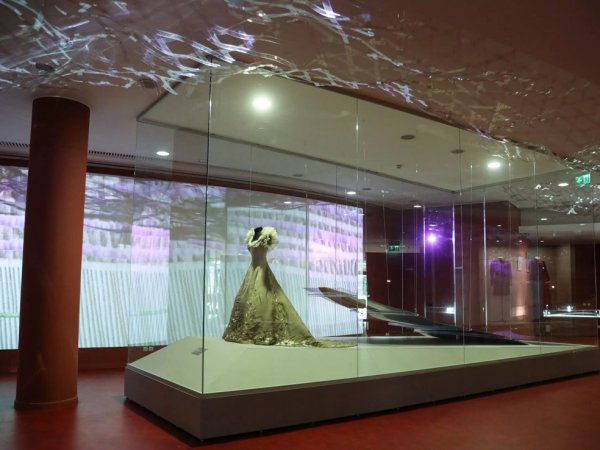
One of the most spectacular aspects of the museum is the variety of its heritage. Visitors encounter paintings and busts of actors and personalities important to Romanian theatre, alongside books, documents, manuscripts, costumes and props. Each category contributes to reconstructing a world in which theatre did not mean only the performance on stage, but also an entire artistic community.
Among the works presented by TNB are the painting of Agepsina Macry-Eftimiu in the play “The Dolls”, painted by Camil Ressu, the portrait of Constantin Nottara in “The Fountain of Blanduzia”, created by Traian Cornescu, as well as the image of Ion Brezeanu in the role of the Drunken Citizen in “A Lost Letter”, painted by Jean Steriadi. These works transform the museum into a gallery of Romanian theatrical memory.
There are also objects of particular memorial value. The costume worn by Maria Filotti in “The Fountain of Blanduzia”, the props used by George Calboreanu in “Sunset”, C.I. Nottara's make-up box or Aristizza Romanescu's fan are seemingly ordinary objects, but they acquire special significance through their connection with great artists of the stage.
Among the exhibits there are also objects connected with personalities from outside the strictly theatrical field, such as the bust of Bogdan Petriceicu Hasdeu, created by Dimitrie Paciurea, as well as postcards sent by I.L. Caragiale from Berlin to friends in Romania between 1905 and 1912. The museum thus becomes a perspective on the entire intellectual universe that revolved around theatre.
Ion Ghica and the beginnings of the modern organization of Romanian theatre
The museum also offers the opportunity to understand how difficult the creation of the Romanian theatrical institution was. One of the lesser-known pieces of information presented during the tour is that, for a period, the theatre was a building owned by the state and leased to great actors. Maintaining a building the size of the one on Calea Victoriei was so costly that the institution repeatedly faced financial difficulties and bankruptcies.
An essential name in the professionalization of the institution is Ion Ghica. General director of theatres between 1877 and 1881, he contributed to reorganizing theatre according to the model of the Comédie-Française. In 1877, at his initiative, Parliament promulgated the Theatre Law, inspired by the regulations of the Comédie-Française drafted during the era of Napoleon. Ghica also supported the Dramatic Society, assistance for actors and the development of the national repertoire.
The presence of Ion Ghica in the museum's history is important precisely because it demonstrates that Romanian theatre was not built exclusively through the talent of actors. Behind the great performances were people who laid the foundations of institutional organization, legislation and the professionalization of the stage.
A theatre that survived the loss of its headquarters
After the 1944 bombing, the National Theatre demonstrated that a cultural institution can continue to exist even when it loses its building. Performances moved successively to other spaces, and theatrical activity continued under difficult conditions. The present-day Ion Creangă Theatre, Odeon Theatre and Little Theatre are connected, at different stages, with this period when the Bucharest National Theatre had to find temporary stages.
This history makes every object in the museum carry a broader meaning. A photograph, a costume or a piece of stage property is not merely a memory of a performance. They can be viewed as fragments of the history of an institution that went through war, political changes, relocations and periods of uncertainty, yet preserved its artistic continuity.
A history that continues today
The TNB Museum is, ultimately, a living archive of the Romanian stage. Its heritage includes testimonies of the evolution of dramaturgy and stage art, from documents and period photographs to posters, programmes, manuscripts, letters, costumes, props, paintings, sculptures and graphic works.
Another detail presented by the museum is the large number of directors who have succeeded one another at the helm of the National Theatre. The museum's materials mention 45 directors, information that should be understood in the context of when that presentation was created; the current official TNB chronology lists many more mandates and periods of leadership, including managers from recent decades.
From George Franga and Liviu Rebreanu to the great generations of actors and directors who have appeared on the National Theatre stage, the museum preserves the memory of an institution essential to Romanian culture. In this space, theatre is no longer merely an ephemeral art, consumed in one evening and then disappearing with the final line. It becomes an object, an image, a document and a testimony.
Perhaps this is precisely the charm of the TNB Museum: it gives visitors the opportunity to see what usually remains hidden behind the curtain. Costumes worn by great actors, objects used in performances, manuscripts, portraits and documents reconstruct the world behind the stage and bring back to the present figures who made a decisive contribution to the development of Romanian theatre.
That is why the TNB Museum can be regarded as a true temple of theatrical memory. It is the place where history is not told only through dates and names, but through things that were touched, worn, written or used by the people who made the Romanian stage one of the fundamental institutions of national culture. And the fact that this collection survived bombings, evacuations, storage and changes of location means that every exhibit carries with it not only the memory of a great artist, but also the story of the resilience of Romanian theatre in the face of time.
We also recommend: The National Theatre of Bucharest, from its beginnings to the present: a boyar legacy turned into the cultural heart of the Capital