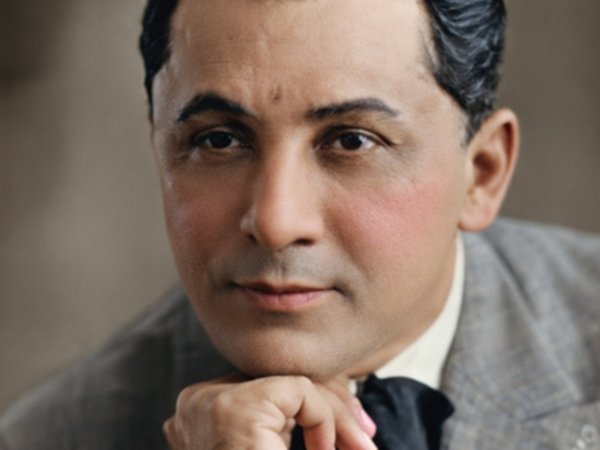
The stars of interwar Bucharest: Pepe Georgescu, the actor with the most charming "Mofturi"
- Articles
- 03 JUL 26
Interwar Bucharest was one of the most vibrant periods in Romania's cultural history. The city was nicknamed "Little Paris," and its artistic life flourished through theaters, cinemas, cultural magazines, and cafés where writers, actors, and directors gathered. During those years, numerous personalities emerged who would contribute to the development of Romanian theater and cinema, among them actor Pepe Georgescu. Although his name is no longer as well known to today's audiences as those of other great artists of the last century, Pepe Georgescu belonged to the generation of actors who laid the foundations of Romanian cinema and helped consolidate the theatrical scene in Bucharest. His career spanned several decades, crossing the interwar period, the years of the Second World War, and the early decades of modern Romanian filmmaking. Today, the actor is remembered primarily for his appearance in the film Mofturi 1900, as well as for his work on the stage of the Giulești Theatre in Bucharest. Beyond these milestones, Pepe Georgescu's story speaks of the evolution of an artist who built his career during a period when Romanian theater and cinema were beginning to establish their own identity.
The early years and artistic training
Pepe Georgescu was born on March 9, 1902, in Bucharest, at a time when Romania's capital was experiencing spectacular urban and cultural development. The city was becoming increasingly cosmopolitan, while theatrical performances and the first film screenings were beginning to attract large audiences.
From an early age, Georgescu directed his attention toward acting, choosing to pursue specialized studies. He graduated from the Academy of Arts in 1924, an institution that trained future generations of artists and represented one of the most important schools of its kind in Romania at the time.
His years of study coincided with major transformations in Romanian theater. Directors and actors were beginning to adopt new acting techniques inspired by the great European schools, while audiences became increasingly receptive to modern performances and cinematic productions.
Graduating from the Academy of Arts provided Pepe Georgescu with the foundation necessary to begin a professional career in a highly competitive field.
His debut in cinema
Only one year after completing his studies, in 1925, Pepe Georgescu received his first important role in the film Manasse, one of the representative productions of Romanian silent cinema.
The making of this film marked an important moment for the national film industry, at a time when Romanian productions were still relatively few and the cinema industry was only beginning to develop.
For a young actor, participating in such a project represented an opportunity to establish himself in a field that was rapidly evolving. Silent films placed great emphasis on the actors' expressiveness, since the story had to be conveyed mainly through facial expressions, gestures, and stage movement.
This type of performance required exceptional artistic discipline and contributed to the development of actors capable of conveying emotions without the support of spoken dialogue.
Bucharest, the entertainment capital of the interwar period
During the interwar years, Bucharest became the center of Romanian cultural life. Every evening, theater performances, concerts, and film screenings took place, while actors were regarded as true celebrities of the era.
The public followed the artists' appearances with great interest, newspapers devoted extensive coverage to premieres, and theatrical criticism played an important role in determining a production's success.
It was within this artistic environment that Pepe Georgescu built his career, developing both as a stage actor and as a film performer.
Although relatively little information about his professional activity has been preserved, it is known that he belonged to the generation of artists who contributed to the development of the Romanian stage during a period of remarkable cultural vitality.
An actor of the Giulești Theatre
An important stage of his career was his activity on the stage of the Giulești Theatre in Bucharest.
Over time, this theater became one of the capital's significant cultural institutions, earning recognition for its diverse repertoire and the distinguished actors who performed there.
His theatrical experience enabled Pepe Georgescu to refine his acting style and perform before large audiences at a time when theater represented the principal form of entertainment for the people of Bucharest.
The stage offered actors the opportunity to demonstrate their versatility, while direct interaction with audiences made every performance a unique experience.
Encountering Caragiale's universe
One of the defining moments of Pepe Georgescu's career was his participation in the film Mofturi 1900, directed by Jean Georgescu and inspired by the literary universe of Ion Luca Caragiale. The film premiered in 1964 and brings together several of the great Romanian playwright's best-known sketches.
Caragiale's literary universe has always represented a challenge for actors. His characters are built upon subtle nuances of irony, humor, and social observation, and portraying them requires a careful balance between comedy and realism.
Pepe Georgescu's participation in such a production demonstrates the experience he had accumulated throughout a career spent both on stage and in front of the camera.
Mofturi 1900 would go on to become one of the most highly regarded Romanian films inspired by Caragiale's work and is still considered today a landmark of Romanian cinema.
A career divided between theater and film
Unlike contemporary actors, performers during the first half of the twentieth century frequently alternated between theater and cinema.
Pepe Georgescu belonged to this category of versatile performers who developed their experience on stage before bringing it to cinematic productions.
At that time, Romanian cinema was still in the process of development, and every production represented another step forward for the entire industry.
Actors often maintained extremely demanding schedules, dividing their time between theater rehearsals and film shoots. This experience enabled them to develop a complex and adaptable acting style.
Why Pepe Georgescu deserves to be rediscovered
Today, Pepe Georgescu's name appears less frequently in discussions about the great personalities of Romanian theater and cinema. Nevertheless, his contribution remains important for understanding the beginnings of Romanian filmmaking and the cultural life of twentieth-century Bucharest.
He belonged to a generation of actors who built the prestige of the Romanian stage at a time when resources were limited and the national film industry was still taking shape.
His career also illustrates the way interwar artists successfully combined theatrical work with cinematic performances, contributing to the development of both fields.
The legacy of an actor from old Bucharest
Although biographical information about Pepe Georgescu remains relatively limited today, the known facts outline the portrait of an artist deeply devoted to his profession. Born in Bucharest, educated at the Academy of Arts, making his cinematic debut in Manasse, and later performing on the stage of the Giulești Theatre, the actor belonged to the generation that contributed to the maturation of Romanian performing arts.
His appearance in Mofturi 1900 represents a symbolic bridge between two eras of Romanian culture: the interwar period, during which he began his career, and the 1960s, when Romanian cinema was already producing films that would become classics. Through this continuity, Pepe Georgescu remains a witness to the evolution of Romanian theater and cinema over several decades.
The artistic history of Bucharest includes many famous names, but also actors who, although they did not permanently remain in the spotlight, made an essential contribution to the development of the Romanian stage and screen. Pepe Georgescu belongs to this category. Rediscovering such personalities means, in fact, recovering an important part of the cultural heritage of both Bucharest and Romanian cinema.
We also recommend: The stars of interwar Bucharest: Niki Atanasiu, the most talented Ștefan Tipătescu in the history of Romanian theatre