The oldest shops in Bucharest that still operate today. From economy to tradition and history
By Raluca Ogaru
- Articles
- 30 JUN 26
Bucharest has radically changed the way it shops over the past 100 years. From the elegant shops on Calea Victoriei and the interwar department stores, the city moved through the centralised commerce of the communist period, then through the explosion of malls, supermarkets, online shops and large international chains.
Even so, a few commercial landmarks have survived. Some have reinvented themselves, others have remained open more out of inertia, a few have lost much of their former strength, but they continue to say something important about the city. They are places where economy mixes directly with memory: buildings through which generations have passed, shops where people bought clothes, books, musical instruments, stationery, gifts, household products or objects that were hard to find elsewhere.
These shops are not important only for shopping. They show how Bucharest moved from promenade commerce to mass commerce, from interwar shop windows to communist-era departments and from the “department store” to the modern shopping centre. The fact that they still operate, even in changed forms, turns them into small living archives of the capital.
Victoria Store, the former Galeries Lafayette of Bucharest
Victoria Store is one of the oldest commercial landmarks in Bucharest that can still be found today on Calea Victoriei. Its history begins in the interwar period, when, in 1928, the first large department store in Romania was inaugurated, inspired by the Galeries Lafayette model in Paris. At the time, Bucharest wanted to look like a Western capital, and large stores were part of this urban ambition.
In its glory days, the store was associated with luxury, elegant shop windows, goods brought from Paris and a shopping experience different from that of ordinary shops. After nationalisation, the former Lafayette became Victoria Store and continued to function as a department store, entering the collective memory of Bucharest residents during the communist period. Historia notes that, under communism, Victoria was promoted as “50 shops in one”, and the department-style structure was largely preserved.
Today, Victoria no longer has the power of attraction it once had. It is more of a survivor than a commercial magnet. In 2025, Wall-Street.ro described the building as a symbol of luxury that had become a much more discreet presence, with few shops still active and an atmosphere far from the effervescence of a century ago.
Even so, Victoria Store remains relevant. Not because it competes with today’s malls, but because it preserves the idea of historic commerce on Calea Victoriei. For Bucharest residents, the place is a memory. For tourists, it can be an interesting stop on a route about interwar Bucharest, alongside the Telephone Palace, Casa Capșa, the Military Circle and other landmarks of the old centre.
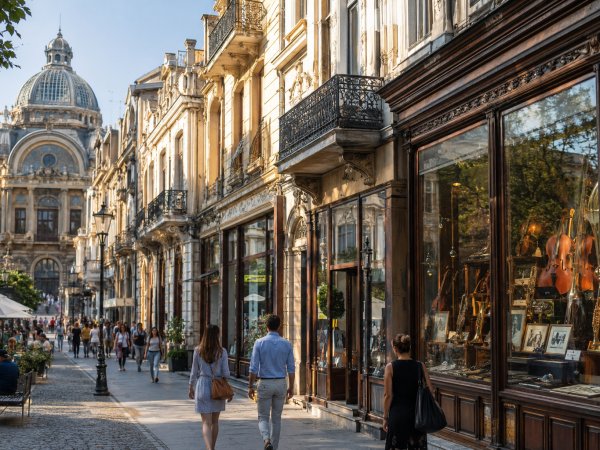
Muzica Store, the place where Calea Victoriei still has sound
Muzica Store is one of the best-known specialised shops in Bucharest. For entire generations, it was the place to go for records, sheet music, instruments, listening devices and later for musical equipment, guitars, keyboards, microphones, accessories and everything connected to the world of sound.
Its history is linked to the central area of the capital. The Union of Composers and Musicologists of Romania records that, towards the end of 1963, the new “Muzica” store opened in Bucharest, on Calea Victoriei 41, in a new building, on the site where an older building had previously stood.
READ ALSO:
The store was designed as a space for instruments, sheet music, records and listening devices, and during the communist period it had special importance for musicians, teachers, art high school pupils, Conservatory students and music lovers. In a city where access to cultural products was limited, such a store had a role much greater than simple sales.
Today, Muzica Store continues to operate on Calea Victoriei 41-43, within the Senia Music network, and the company’s official website lists the address, opening hours and contact details for the “Magazinul Muzica” location. This makes it one of the few traditional Bucharest shops that have preserved, at least partly, their original function: that of a space dedicated to music.
For Bucharest, Muzica Store matters precisely because of this continuity. Around it, Calea Victoriei has changed enormously: shops have disappeared, banks, restaurants, hotels, cafés and company offices have appeared. But the idea that you can still walk into a musical instrument store on the same historic artery preserves something of the old cultural spirit of the city centre.
Bucur Obor, the department store still tied to popular commerce
Bucur Obor is one of the most resilient commercial landmarks in Bucharest. It does not have the interwar elegance of Victoria Store or the cultural aura of Muzica Store, but it has something else: a very strong connection with the practical life of the city. Obor has always been a place of lively, popular, crowded and necessary commerce, and the Bucur Obor department store took over this energy.
READ ALSO:
According to the company’s official presentation, Bucur Obor opened its doors in 1975 and, from its first year, became a shopping destination offering a complete range of products and services. The same presentation notes that these characteristics have been preserved to this day, which explains why the store continues to be perceived as a place where you can find “a bit of everything”.
During the communist period, a department store of this type was an important part of everyday economy. People did not go to Bucur Obor for a premium experience, but for usefulness: clothing, footwear, household goods, various departments, services and proximity to one of the capital’s best-known markets.
Today, Bucur Obor operates in a completely different Bucharest. It faces competition from malls, large retailers, online platforms and modernised neighbourhood shops. But it continues to have an advantage that is hard to copy: foot traffic. The Obor area remains one of the strongest commercial zones in the city, and the store is still caught in this flow of shoppers.
Bucur Obor is perhaps the best example of Bucharest commerce that has survived through usefulness. It does not rely on elegant nostalgia, but on the concrete habit of people going where they can find many things in one place, close to the market, public transport and a neighbourhood with heavy pedestrian traffic.
Cocor, the communist-era store trying to survive in the present
Cocor Store is one of the commercial symbols of central Bucharest from the communist period. Built in the 1970s, the store opened on 13 September 1973 and quickly became one of the capital’s major department stores.
Cocor had a distinct identity: a central location, close to Unirii and the Old Town, a modernist façade, large retail spaces and the promise of organised, urban-style commerce. For the generations who experienced the communist period and the years after 1990, the name Cocor remained associated with going “downtown” for shopping.
After 2000, the store went through modernisation and repositioning processes, but it never regained its former strength. The appearance of malls and the change in consumer behaviour hit classic department stores hard. Even so, Cocor continues to function as a commercial space, and its official website lists fashion, leisure and active stores inside the complex.
Cocor matters for this article precisely because it shows a difficult transition. It is not just an old store, but an example of a commercial building that tried to adapt from the communist economy to mall capitalism and then to digital commerce. The fact that it still operates, even in a different form, keeps it on the map of Bucharest’s historic commercial landmarks.
For tourists, Cocor is not necessarily a classic attraction. For Bucharest residents, however, its name still resonates. It is a central landmark, a building you pass when heading towards Unirii, the Old Town or the Sfântul Gheorghe area, and a reminder of the era when department stores were the city’s “malls”.
Unirea Shopping Center, the former flagship of socialist commerce
Unirea is probably the best-known communist department store in Bucharest. Located in Piața Unirii, at a strategic point in the capital, it was inaugurated in the autumn of 1976 and was considered at the time one of the largest and most modern commercial units in the country, according to Agerpres.
Before modern malls, Unirea was one of the places where Bucharest learned the idea of multi-level commerce, with departments, shop windows, large flows of shoppers and a central position almost impossible to ignore. During communism, the store had both economic and symbolic value: it showed how the regime wanted to present urban consumption in an organised, massive and representative space.
After 1990, Unirea remained a landmark, but gradually entered increasingly tough competition with new malls. Today, Unirea Shopping Center continues to operate, and its official website still lists stores, restaurants, banks, fashion brands, jewellery shops and services active in the centre.
At the same time, Unirea is also an example of a commercial space undergoing transformation. In 2025, the economic press noted that the store was expected to go through a major reconfiguration process, with the redefinition of commercial spaces and the attraction of new tenants. This stage shows that large department stores cannot survive on memory alone; they must adapt to a public that now shops differently.
For Bucharest, Unirea remains essential not only through its history, but also through its location. Piața Unirii is one of the capital’s busiest transport and commercial hubs, and the store was, for decades, part of the image of the city’s shopping centre. Even if its future depends on transformation, the name remains one of the strongest in Bucharest’s commercial memory.
Mihai Eminescu Bookshop, cultural commerce with tradition in the city centre
Mihai Eminescu Bookshop can be included in this map of old stores because it represents another form of commerce: cultural commerce. Located on Regina Elisabeta Boulevard, close to University Square, the bookshop has a tradition of more than 50 years and is presented even on its own website as an “online bookshop with more than 50 years of tradition”.
In Bucharest, bookshops have always been more than commercial spaces. They have been places for meetings, book launches, searches, discoveries and intellectual memory. Mihai Eminescu Bookshop preserves something of this role, especially through its central location and the fact that it remains a recognisable name for book lovers.
The bookshop’s contact page indicates its address at Bd. Regina Elisabeta 16, confirming its current operation as both a physical and online shop. At a time when many independent bookshops have disappeared or moved into malls and online platforms, the continuity of this space is relevant for the city.
Mihai Eminescu Bookshop does not have the size of a department store, but it has a different kind of weight. It is a landmark for cultural Bucharest, for the University area and for people who still prefer to browse a book before buying it. In an article about the capital’s old shops, it reminds us that commercial tradition is not only about clothes, food or household products, but also about books, education and culture.
What these shops say about Bucharest’s economy
The old shops that still operate today show that Bucharest’s economy did not evolve in a straight line. The city had periods of commercial refinement, then centralisation, then privatisation, then competition with malls and online commerce. Each shop on this list carries traces of a different era.
Victoria speaks about interwar Bucharest’s ambition to be “Little Paris” even in the way people shopped. Muzica Store speaks about specialised culture and the city’s need for spaces dedicated to artists and enthusiasts. Bucur Obor shows popular, practical, mass commerce. Cocor and Unirea tell the story of communist department stores that tried to become modern centres of urban consumption.
Today, these spaces can no longer be judged only by sales or by the number of customers. Some are struggling, others are transforming, others have found a niche. But all of them have value for the city’s memory. They show how Bucharest changes when the way people shop changes.
At the same time, these shops also raise a question about the future. What do we do with old commercial spaces that can no longer compete directly with malls? Do we let them fade away, transform them completely or integrate them into an urban route that combines commerce, history and tourism? For a city like Bucharest, the answer matters, because these places are more than buildings with shop windows.
Why locals and tourists should rediscover them
For locals, these shops are emotional landmarks. Many Bucharest residents have memories connected to them: shopping with parents, queues, shop windows, first musical instruments, books bought near University Square, clothes bought downtown, trips through Obor or stops at Unirea before malls became part of everyday life.
For tourists, they can function as points on an alternative route. Instead of seeing only the capital’s major attractions, you can follow the history of Bucharest commerce: Calea Victoriei, Victoria Store, Muzica Store, the University area, Cocor, Unirea and Obor. It is a map that says a lot about the city, without being a classic museum route.
It is important, however, to look at these places correctly. Not all of them are spectacular today. Some are tired, others fragmented, others in the process of reinvention. But that is precisely what makes them interesting. They are not perfect sets, but real spaces that have gone through harsh economic changes.
Bucharest needs to preserve not only its old houses and monuments, but also its commercial memory. Shops tell the story of a capital through its everyday gestures: where it shopped, what it wanted, what was hard to find, what it considered elegant, what was useful and what, after decades, has remained open.
In the end, the oldest shops in Bucharest that still operate today are more than places for shopping. They are fragments of the city. Some have lost their shine, others have adapted, but each preserves a part of the capital’s economic and social history.