Symbols of Bucharest: Bucur Obor Passage, the Capital’s first underground road passage, was completed in 15 months
- Articles
- 01 APR 26
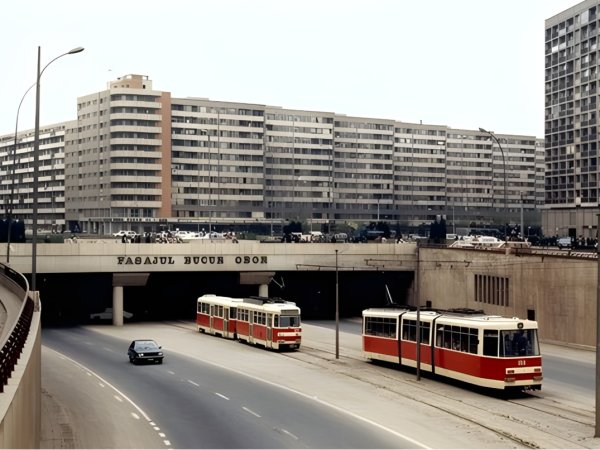
The Bucur Obor Passage represents one of the most important infrastructure works carried out in Bucharest in the second half of the 20th century, during the period of accelerated modernization. Inaugurated in 1979, it was designed as a radical solution to ease traffic in one of the Capital’s most congested commercial areas.
A major urban intervention in the heart of a crowded city
Its construction lasted only 15 months, an extremely short period for a project of such scale. At the time, this achievement was seen as a demonstration of technical and organizational capacity, and the inauguration took place in the presence of the communist president Nicolae Ceaușescu and his wife.
The passage permanently changed the way traffic flowed in the north-eastern part of Bucharest, becoming an essential landmark of the city’s urban infrastructure.
An area overwhelmed by commerce and traffic before modernization
Before the construction of the passage, the Obor area was an extremely lively but heavily congested space. The intersection of major arteries - Ștefan cel Mare Avenue, Mihai Bravu Avenue, Calea Moșilor, and Colentina Road, functioned as a dense commercial and traffic hub.
Calea Moșilor was known for its shops, craft workshops, and small businesses that gave the area a vibrant character. Nearby, the Central Halls area concentrated a large part of the city’s commercial activity.
In this context, traffic became chaotic: cars, buses, trams, carts, motorcycles, and pedestrians all shared the same space. As the number of vehicles increased over the years, congestion worsened significantly, making a radical redesign necessary.
The decision for redevelopment and the start of the project
In 1970, the authorities decided to completely reorganize the Obor area, concluding that the existing infrastructure could no longer handle the traffic volume. The chosen solution was ambitious: the construction of an underground passage designed to separate traffic flows and allow faster transit through the intersection.
The project was developed by the Bucharest Design Institute, under the coordination of engineer Siranuș Vasilache. The project manager for the Bucur Obor Passage was engineer Gheorghe Constantin, who oversaw both the design and execution stages.
Construction was initially estimated to take 30 months and was assigned to the Industrial Construction Trust. For the duration of the works, traffic in the area was completely closed, significantly impacting urban mobility.
A record-breaking construction timeline
Although the initial deadline was set at two and a half years, the works were completed in just 15 months. Romanian builders thus delivered the project in half the estimated time, which was considered a major technical achievement of the era.
The inauguration took place on July 25, 1979, in an official ceremony attended by state leadership. The event marked the commissioning of a completely new infrastructure designed to radically transform traffic in the area.
The Bucur Obor Passage thus became the first major underground road passage in the Capital, a symbol of urban modernization during that period.
Technical structure and traffic organization
The final design of the passage included a complex infrastructure adapted for heavy traffic. It featured four traffic lanes for vehicles, arranged with two lanes per direction, allowing continuous and efficient vehicle flow.
In addition, the passage included two tram lines equipped with an underground station. The station was fitted with access stairs leading to the surface, ensuring integration between public transport and pedestrian movement.
The technical solution was complex, as traffic was distributed across multiple levels. The Colentina Avenue – Calea Moșilor direction remained at ground level, while traffic on the Ștefan cel Mare Avenue – Mihai Bravu Avenue axis was redirected underground.
An underground parking facility was also built on both sides of the traffic lanes, increasing the functionality of the entire structure.
Capacity, efficiency and separation of traffic flows
The passage was designed to handle approximately 900 vehicles per hour, a significant capacity for that period. Its main purpose was to reduce congestion and increase travel speed through one of the city’s busiest intersections.
An important aspect of the project was the separation of pedestrian and vehicle traffic. Pedestrians were redirected to two different levels, avoiding direct interaction with road traffic and reducing accident risks.
This multi-level organization represented a major shift in urban planning, being one of the earliest implementations of such a system in the city.
Urban spaces arranged above the passage
Above the underground structure, the area was redesigned to create a pleasant and functional urban space. Green areas, lawns, and floral carpets were installed, offering a visual contrast to the underground infrastructure.
Decorative lighting poles were also added, contributing to the modern appearance of the square and improving nighttime visibility and safety. Thus, the project was not only technical but also aesthetic, integrated into the urban landscape.
This approach reflected the era’s tendency to combine infrastructure development with urban design, transforming busy intersections into organized and visually coherent spaces.
A multidisciplinary team and technical contributions
The construction of the passage involved a large team of specialists from various fields. Road works were coordinated by engineer Lidia Dobrescu, who played a key role in organizing the road infrastructure.
Electrical installations were overseen by engineer Radu Hera, ensuring the proper functioning of lighting and technical systems. Sanitary, sewage, and water supply installations were designed by engineers B. Rauchwerger, Dorina Crîngași, and Ana Muntean.
The landscape and urban design component was developed by architect Valentin Donose, who contributed to the aesthetic integration of the passage into the city environment.
This interdisciplinary collaboration was essential to the success of the project and its long-term functionality.
The urban legacy of the Bucur Obor Passage
The Bucur Obor Passage remains an important part of Bucharest’s infrastructure even today, despite the city’s continued development and modernization.
It represents a significant stage in the Capital’s urban evolution, marking the transition toward complex engineering solutions designed to address heavy urban traffic. At the same time, the passage stands as a testament to how the city was reshaped in the second half of the 20th century.
Today, the Obor area continues to be an important commercial and traffic hub, and the passage remains a central element in this urban system, highlighting the importance of integrated planning in a constantly evolving city.
We also recommend: Obor Market in Bucharest, the history of the old "Outside Fair": from cattle market to place of execution