How School Uniforms Have Changed in Bucharest: From the Elegant Caps of Interwar High School Students to Communist-Era Identification Patches and the Return of the Uniform Debate in 2026
By Eddie Țone
- Articles
- 02 NOV 26
A century ago, you could recognize Bucharest schoolchildren by their school caps, the cut of their jackets and their school insignia. Under communism came the blue pinafore, the identification patch sewn onto the sleeve and the famous Pioneer neckerchief. After the Revolution, uniforms gradually disappeared from most schools, replaced by jeans and T-shirts. Now Parliament is debating whether school uniforms should once again become compulsory. It is an idea more than a century old, and one that still divides Romania into two camps.
Bucharest in the 1980s had a daily fashion spectacle that unfolded with remarkable punctuality every school morning. Groups of children appeared on the streets dressed in navy blue, with identification patches sewn onto their sleeves, white collars and schoolbags on their backs. Girls often wore pinafores or blue smocks, while boys wore blazers and dark trousers. The scene became a little more colorful when Pioneer neckerchiefs were worn. Otherwise, the school wardrobe showed rather limited chromatic imagination.
For many families, preparing for the start of the school year also meant checking the uniform. The child had grown over the summer, the trousers had become too short, and last year's pinafore was very likely now too tight. The identification patch had to be in its proper place, and the outfit had to comply with school rules. Freedom of sartorial expression generally began after classes ended.
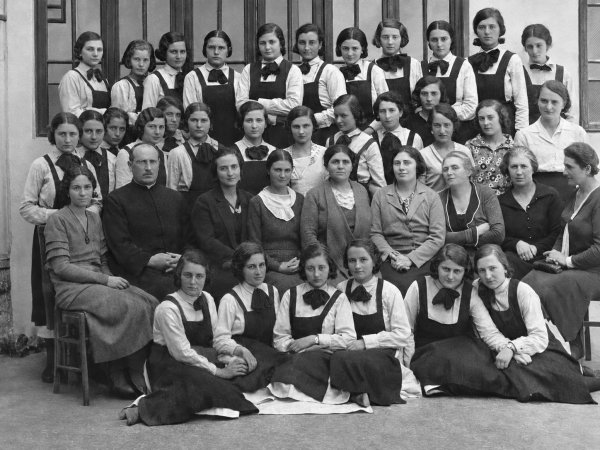
But school uniforms in Bucharest already had a long history. During the interwar years, pupils at some prestigious high schools wore them with pride, and their school insignia told passersby where they studied. Under communism, the same idea of standardized clothing acquired different meanings, associated with discipline and ideological education.
And today, more than three decades after the Revolution, uniforms are back on the agenda. On September 21, 2026, Romania's Senate passed a bill making school uniforms compulsory. The document went to the Chamber of Deputies, where debate continues. On October 13, a meeting devoted to the subject brought together lawmakers, students, teachers and parents. General agreement proved difficult to achieve, confirming that few items of clothing can generate as much controversy as an ordinary school blazer.
Bucharest's First School Uniforms
Romanian school uniforms developed their distinct identity in the second half of the nineteenth century and the early twentieth century, as modern education expanded. Bucharest's major high schools adopted Western styles, particularly from French and German educational traditions, in which a student's clothing expressed membership of an institution.
In Bucharest, long-established schools such as Saint Sava and Gheorghe Lazăr educated generations of pupils in an atmosphere where school discipline extended beyond the classroom. Uniforms made pupils recognizable on the street, and their behavior could affect their school's reputation.
Boys generally wore dark suits, with tunics or jackets of a sober cut. A school cap, sometimes bearing a distinctive badge, completed the outfit. Styles varied between institutions and periods, so a Bucharest high school student in 1910 might have looked quite different from one in 1935.
Girls had their own dress codes, particularly in secondary schools and girls' institutes. Dresses and pinafores, often in muted colors, followed the period's conventions of modesty. In the early decades of the twentieth century, sailor-style collars also appeared, reflecting a fashion seen in children's clothing across several European countries.
A uniform was also a substantial investment for a family. A garment made from good-quality wool and tailored for everyday wear came at a cost that lower-income parents certainly felt. In a society marked by sharp class divisions, simply attending a prestigious high school already carried a certain social value.
There was a rather charming paradox, too. Uniforms were supposed to make pupils look alike, yet the different colors and insignia of individual schools helped them develop rivalries of their own. A high school student could fairly easily spot someone from a competing institution. And adolescence, whatever the era, always finds reasons to compete.
Cișmigiu et Comp. and the High School Students Who Wore Their School Identity on Their Sleeves
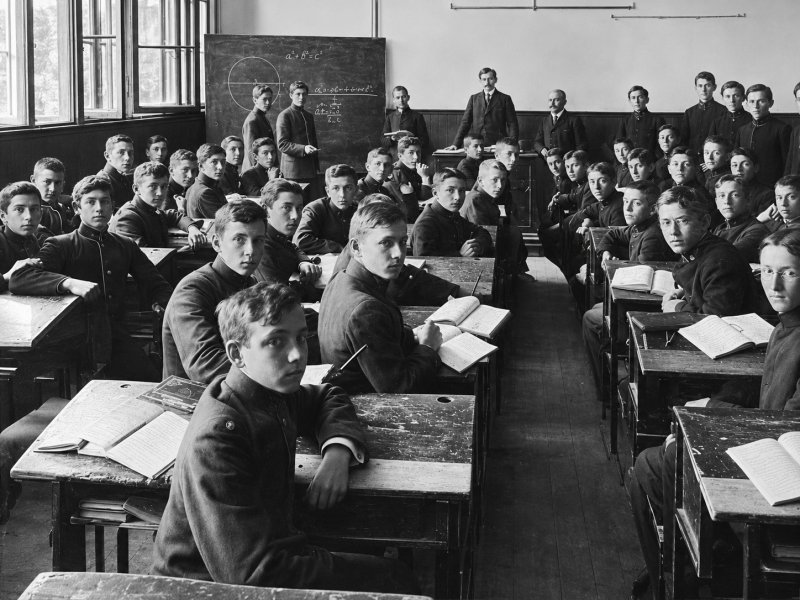 Gheorghe lazar students in the interbelic age / Photo: Gh. Lazăr highschool
A valuable literary account of the atmosphere of interwar Bucharest high schools is the autobiographical novel Cișmigiu et Comp., written by Grigore Băjenaru and published in 1942.
The book follows the experiences of a student at Gheorghe Lazăr High School, located beside Cișmigiu Gardens. Its pages take readers through a teenage Bucharest where students had strict teachers, got up to mischief and turned the park next to their school into a very convenient extension of school life.
Băjenaru evokes a world in which uniforms and identification patches marked both students and their schools. The patch, worn on the sleeve, made it possible to identify a pupil and their school, turning every escapade into an activity involving a certain degree of administrative risk.
It is worth pointing out that the identification patch, now so strongly associated with the communist period, actually has older roots. It was part of school life before the communist regime was established, and its use was linked to identifying pupils and holding them accountable for their behavior.
Băjenaru's novel offers, above all, a student's perspective, filtered through the author's humor and nostalgia. That is precisely why it remains useful for understanding the atmosphere of the period, although it should be read as autobiographical literature rather than as an official school dress code.
One thing is clear from the world the writer describes: a school's prestige mattered, and pupils were conscious of belonging to it. A cap or an identification patch could say something about its wearer before the young person had even opened their mouth.
The 1930s and Straja Țării: Students Also Wear Patriotic Uniforms
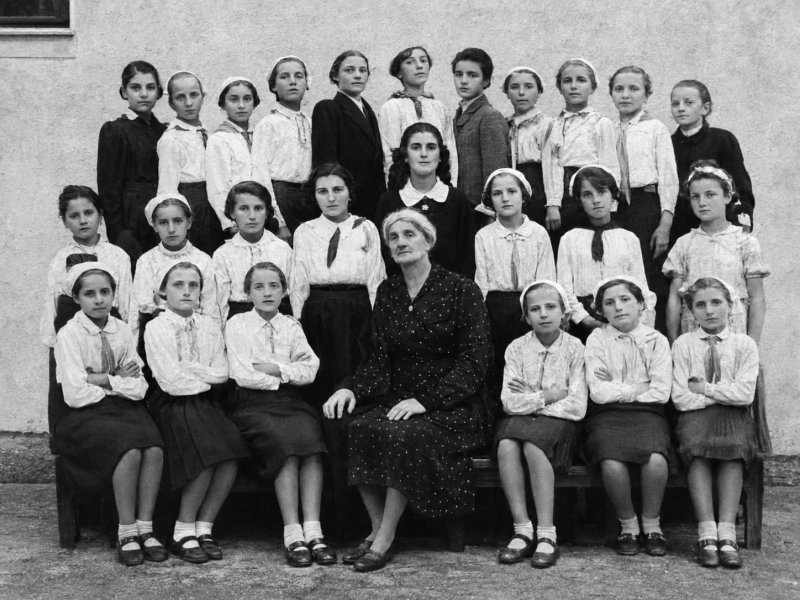 Children in Straja Țării uniforms / Photo: Wikipedia
Toward the end of the interwar period, uniforms acquired a new dimension with the development of state-backed youth organizations.
Straja Țării (The Guard of the Country) was established in 1935 and would grow in importance under King Carol II. In 1937, membership of the movement became compulsory for the categories of children and young people specified by the legislation of the time. Its purpose was to educate the young in a patriotic spirit through organized activities and collective discipline.
Members of Straja Țării had a distinct uniform, including a shirt and tie, while their insignia featured badges and other accessories specific to the organization. Public ceremonies, parades and group demonstrations were part of the movement's activities.
Bucharest, the kingdom's capital, frequently hosted such ceremonies, providing a fitting backdrop for official displays of discipline and loyalty to the monarchy.
Straja Țării nevertheless had an identity distinct from the ordinary school uniform. Participation in the organization required special clothing for its activities, and confusing the two types of uniform can lead to misinterpretations of historical photographs.
In 1940, after the collapse of Carol II's regime, Straja Țării was disbanded. What remained were photographs of impeccably lined-up pupils and the experience of a generation that had known not only school rules but also the discipline of a mass patriotic organization.
That experience would later acquire a particular significance. Some practices used to organize children collectively would reappear, in a different political setting, in communist Romania. Remember PTAP, the civil defense training program?
Communism Changes the Rules: Uniforms Become a Matter of Collective Discipline
With the establishment of the communist regime, Romanian schools underwent radical changes. The reforms of 1948 reshaped the education system, and education became one of the main tools through which the new authorities sought to mold socialist citizens.
School uniforms remained, but differences between institutions and the distinctive dress traditions of individual high schools gradually gave way to standardized designs.
Admittedly, the standardization of school clothing had already begun toward the end of Carol II's reign. In 1938, the authorities imposed the Straja Țării uniform as school attire, and regulations published in 1940 confirmed that it was compulsory in education. The communists therefore inherited a society in which schoolchildren's clothing was already subject to strict regulation.
Over the following decades, school attire took on the forms familiar to generations who grew up before 1989.
For girls, a blue smock worn over a checked dress, or a dark pinafore dress, became a familiar part of school clothing. Detachable white collars and hair bows completed the look. Boys wore navy trousers, shirts and blazers, with variations according to age and historical period.
Uniforms were designed for daily use and a reasonable degree of durability. Styles changed over time, and schools could have different rules for particular items.
In Bucharest, as elsewhere in Romania, the uniform was part of a pupil's daily routine. In a class photograph from the 1970s or 1980s, the similarity between the outfits is immediately striking. Differences between the children are most apparent in their expressions, hairstyles and the ways they managed to wear compulsory clothing with at least a little personality.
And teenage personality, as we know, finds ways to assert itself even under the most restrictive conditions.
The Identification Patch: The Piece of Cloth That Could Ruin a Trip Across Town

Among the best-known elements of the communist school uniform was the identification patch, known in Romanian as the matricolă. Sewn onto the sleeve, it displayed the student's identification number and information about the school they attended.
For school authorities, the patch made pupils identifiable in public. For teenagers, it was sometimes an extremely inconvenient accessory, particularly when the day's schedule involved activities their teachers would not have approved of.
In Memoria magazine, recollections of school life under communism describe high school students' attempts to wear the patch as little as possible. Some attached it temporarily with adhesive tape or snap fasteners so they could remove it later. It was a modest demonstration of sartorial ingenuity, with obvious benefits for anyone intending to skip school or roam around town at an inappropriate hour.
The patch also carried a social meaning. Students represented their school in public, and their behavior could bring disciplinary consequences. In a busy city such as Bucharest, where high school students traveled daily by tram and bus, visible identification made them easy to recognize.
Indeed, scrutiny of school clothing continued even after pupils entered the building. Students on duty or representatives of Pioneer organizations could check compliance with the rules, including whether the identification patch was being worn.
The Pioneer Neckerchief and the Falcons of the Fatherland
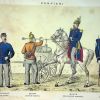
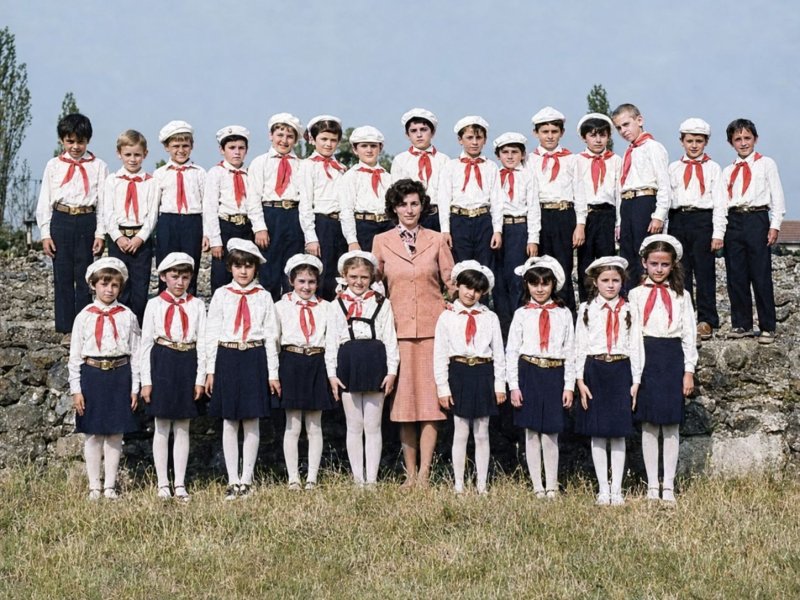 Pioneer uniforms
The uniforms of communist organizations for children and teenagers deserve a separate chapter.
The Pioneer Organization, whose first Romanian detachments were formed in 1949, became a component of communist education. Membership was marked by ceremonies and distinctive insignia, and Pioneer attire was different from the ordinary school uniform.
The Pioneer neckerchief, initially red and later red with a border in Romania's national colors, was fastened around the neck, in later versions using a plastic ring. The ceremonial uniform included a white shirt, dark trousers or skirt, and organization-specific accessories.
Pioneers could be assigned responsibilities within the organization. Group and detachment commanders wore distinctive insignia, including stripes, creating a visible hierarchy among children.
In 1976, Nicolae Ceaușescu's regime created the Șoimii Patriei (Falcons of the Fatherland), an organization intended for preschoolers and younger schoolchildren. Its uniform was easily recognizable thanks to its orange-and-blue color scheme. Girls wore blue skirts or pinafore dresses, while boys wore trousers in the same color. Orange shirts, blue hats and the organization's insignia completed the outfit.
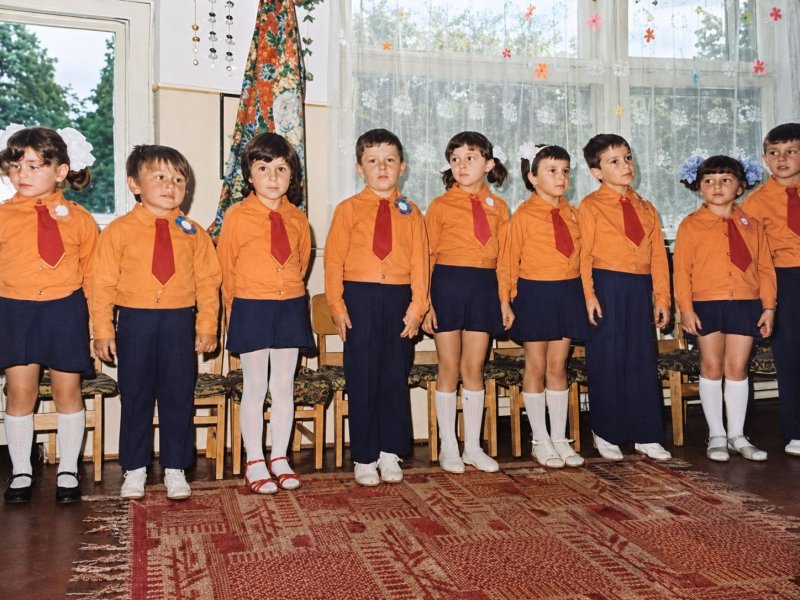 Uniforma for the Falcons of the Fatherland
Judged purely by its colors, such a uniform made for a fairly cheerful sight. The educational content that came with it, however, was deeply political.
Children took part in ceremonies and learned songs dedicated to the homeland and the party. The youth organizations' educational programs sought to instill loyalty to the regime from a very early age.
Museum curators and historians who have studied objects from everyday life under communism have documented numerous examples of these uniforms and insignia. Today, Pioneer neckerchiefs and Falcons of the Fatherland badges are collectors' items, and original examples can be found in exhibitions devoted to communism.
One distinction worth remembering is the difference between school uniforms proper and the uniforms of political organizations. A pupil might wear their ordinary school clothes in class and a Pioneer uniform at ceremonies. The two are frequently confused in historical photographs.
After 1989, Jeans Win the War Against the Blue Smock
The Revolution of December 1989 also changed the school wardrobe. The disappearance of communist organizations brought an end to Pioneer neckerchiefs and ideological insignia, while standardized uniforms ceased to be universally compulsory.
In everyday life, the change was gradual. Some schools kept the familiar outfits for a while, either out of habit or because families had already bought the uniforms.
During the 1990s, everyday clothes became increasingly common in Bucharest schools. Jeans, sweaters and T-shirts replaced the old outfits in many institutions, and teenagers began expressing their clothing preferences with considerably greater freedom.
It was also the period when the Romanian market was opening up to Western products. Youth fashion diversified quickly, and branded clothes became coveted possessions and indicators of a family's financial means.
Freedom of dress thus brought a new problem. Differences between children from different social backgrounds became more visible, and pressure to wear particular brands could affect relationships between classmates.
Meanwhile, nostalgia for the uniform survived. For some former pupils, it recalled school discipline and childhood. For others, it remained associated with the restrictions of the communist regime.
Both perceptions persisted, feeding the debates over the reintroduction of uniforms in the decades that followed.
How Uniforms Returned to Some Bucharest Schools
From the 2000s onward, some educational institutions introduced or reintroduced their own school outfits. The trend was especially visible in private education, where uniforms became part of institutional identity.
Instead of the standardized communist model, new designs drew inspiration from British schools or classic collegiate clothing. Some institutions adopted blazers with crests, shirts and custom ties, while others preferred simpler options, such as branded polo shirts.
Some state schools also introduced distinctive attire through decisions made within their school communities. The practice periodically sparked disputes over costs and students' rights.
The Student Statute approved in 2024 requires pupils to attend school in decent, appropriate clothing and to comply with rules concerning identification elements. That regulation, in itself, is different from imposing an identical uniform on every pupil in Romania.
The debates have again highlighted the distinction between decent dress, defined by general rules, and a precisely specified uniform that requires families to purchase particular items.
In Bucharest, where long-established public schools coexist with private institutions that have their own dress identities, the difference is visible from one school to another.
Compulsory Uniforms Return to Parliament in 2026: What the Bill Says
On September 21, 2026, the Senate passed legislative proposal L443/2026, amending Pre-University Education Law No. 198/2023, by 84 votes in favor, 18 against and four abstentions.
Under the version adopted by the Senate, pupils would be required to attend classes in school uniform, in accordance with each institution's regulations. The design would be determined by the school's governing board, with the consent of the representative parents' council.
The bill also allows uniforms to be provided free of charge or their purchase subsidized, depending on a family's financial circumstances. Funding could come from local and county authority budgets or from non-reimbursable external funds.
The text adopted by the Senate removed fines of 5,000 to 10,000 lei for schools that failed to enforce the requirement, penalties that had appeared in an earlier version.
PSD senator Daniel Zamfir argued that introducing uniforms would reduce visible social differences between pupils and improve school safety. Senator Alexandra Presură argued that common attire could lessen discrimination linked to families' financial resources.
Those arguments met opposition from some student representatives, who raised concerns about freedom of expression and the education system's real priorities.
The debate took on a very concrete form in Bucharest itself. On September 28, 2026, students at Gheorghe Lazăr National College staged a clothing protest, wearing black to express their opposition to compulsory uniforms, in a gesture rich in historical irony. At the very school whose students had worn distinctive uniforms during the interwar period, the class of 2026 chose a common outfit precisely to protest against compulsory common attire.
On October 13, 2026, the Chamber of Deputies' Education Committee organized a debate attended by student and parent representatives, lawmakers and education specialists.
The committee's chair, Alexandru-Mihai Ghigiu, acknowledged the difficulty of reaching a consensus. Representatives of the National Students' Council drew attention to issues such as school dropout rates and the underfunding of education, which they considered more urgent than changing pupils' clothing.
At the beginning of November 2026, the bill is still going through parliamentary procedure in the Chamber of Deputies, the decision-making chamber. Its passage through the Senate is one legislative step; the introduction of a new nationwide obligation depends on the completion of the procedure and the law's entry into force.
A Century of Uniforms, and the Same Question About Their Purpose
Looking back, Bucharest's school uniforms reveal quite a lot about the eras in which they were worn. Today, arguments in favor of uniforms focus particularly on reducing social differences and identifying pupils on school premises. Critics cite the right to personal expression, costs for families and the risk of turning clothing into another source of disciplinary conflict.
There is, however, a question worth asking before choosing the color of the blazers. How much can a uniform change relationships between pupils when financial differences reveal themselves in so many other ways, from mobile phones to extracurricular activities?
Identical T-shirts may blur visible differences in clothing. But their effects on discrimination and academic performance depend on far more complex factors, and a uniform alone offers few guarantees.
Likewise, discipline and respect for teachers also depend on the school environment, the quality of relationships between pupils and how rules are enforced.
Looking at old photographs of Bucharest high school students, one thing remains constant. Whether they wore interwar caps, communist identification patches or contemporary hoodies, pupils had their own concerns and their own ways of interpreting adults' rules.
And if future legislation brings back compulsory uniforms, the experience of the past century suggests that Bucharest teenagers will find a way to personalize them fairly quickly. After all, school fashion has always been a negotiation between the rulebook and the mirror in the hallway at home.
You may also like: What childhood looked like in Bucharest during the communist years, between 1960 and 1989