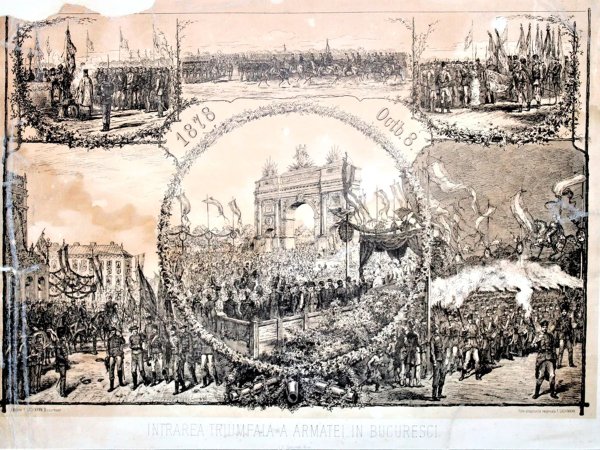
October 8, 1878, Bucharest: The Romanian Army enters the capital in triumph after Romania gains its independence
- Articles
- 28 OCT 26
On October 8, 1878, Bucharest witnessed one of the most spectacular days in its modern history. Following the military campaign of 1877–1878, Romanian soldiers returned to the capital, where they were welcomed in an unprecedented atmosphere of celebration. The troops, led by Prince Carol I, passed beneath a triumphal arch erected at the entrance to Kiseleff Road and then marched through the central streets, before an enormous crowd. For the people of Bucharest, the ceremony represented more than the return of a victorious army. It was a celebration of an achievement for which generations of Romanians had fought: the affirmation of Romania as an independent state. The war fought alongside the Russian Empire against the Ottoman Empire had brought the Romanian army its first major modern victories, while the sacrifices made at Grivița, Plevna, Rahova and Smârdan had already become part of the collective memory. The ceremony on October 8 therefore carried the significance of a major national celebration. The streets were decorated with flags, buildings were adorned for the occasion, and people from Bucharest and other parts of the country gathered along the route the troops were scheduled to follow. Constantin Bacalbașa would later describe in his book Bucharest of Old the scale of the event and the extraordinary enthusiasm that swept through the capital.
Independence and the return of the victorious army
The events of October 1878 must be understood in the context of the Romanian War of Independence of 1877–1878. On May 9, 1877, Mihail Kogălniceanu proclaimed Romania’s independence in Parliament, while Prince Carol I assumed command of the country’s army during the conflict that followed. The Romanian army crossed the Danube and took part decisively in the fighting around Plevna, while other military operations took place at Grivița, Rahova, Smârdan and Vidin.
Victory, however, did not immediately bring full international recognition of Romania’s new status. The independence proclaimed in 1877 was recognized during the international negotiations that followed the war, while the Congress of Berlin in the summer of 1878 confirmed Romania’s new political status, together with certain territorial and diplomatic conditions.
Against this background, the return of the troops to Bucharest carried enormous symbolic significance. The army was not simply returning from a military campaign. It was coming home after a war that had fundamentally changed the international position of the Romanian state.
The program for October 8 was carefully organized. The morning was announced by 21 cannon shots fired from the Army Arsenal. The trophies captured during the war had been brought to Băneasa, where Prince Carol I, Princess Elisabeth, ministers, diplomatic representatives and other prominent figures arrived to witness the ceremony.
A religious service followed, celebrated by Metropolitan Primate Calinic Miclescu. The religious and military ceremonies complemented each other in a public ritual designed to transform the battlefield victory into a solemn moment for the entire nation.
The triumphal arch on Kiseleff Road
For the army’s reception, a triumphal arch was erected especially for the occasion at the entrance to Kiseleff Road. The structure was temporary, made of wood and covered with stucco, but the authorities and the press of the time sought to give it as monumental an appearance as possible.
At the top stood a representation of Victory, approximately four meters high, surrounded by military trophies such as weapons, helmets and other elements associated with the war. Beneath the statue was the inscription “To the Defenders of Independence – The City of Bucharest,” while the arch also displayed the names of the principal battle sites: Grivița, Opanez, Plevna, Rahova, Arcer-Palanka, Lom-Palanka, Smârdan and Vidin.
Tribunes had been arranged on either side for members of the diplomatic corps, officials and invited guests. The location of the arch at the northern entrance to Bucharest was also symbolic. The route represented the victorious army’s entrance into the city and continued toward the center of the capital, where the public could watch the military procession.
The arch erected in 1878 eventually disappeared, like other temporary structures built in Bucharest for major national events. The present-day Arch of Triumph is therefore not the same monument as the one erected in 1878. The permanent structure we see today dates from the interwar period and was inaugurated in its current form in 1936.
Carol I at the head of the army and the parade through the capital
After the religious service ended, the military ceremony entered its most spectacular stage. Carol I passed beneath the triumphal arch at the head of the army, and the military column continued toward the center of Bucharest.
The parade was impressive because of the variety of units taking part. Mounted gendarmes, wounded veterans of the war, captured flags, the general staff, regimental bands, infantry units, chasseurs, engineers, artillery, dorobanți and cavalry all formed part of the procession. The captured cannons were also included in the military display.
The route continued toward Calea Victoriei and the center of Bucharest, with the parade eventually reaching Theater Square, where the prince was due to receive the troops. The city had become a vast ceremonial stage, and the streets had been filled with people since the early morning.
Contemporary accounts noted that the streets were already becoming crowded in the first hours of the day, and as the time of the parade approached, movement became almost impossible. The crowds stretched along the route toward Băneasa, demonstrating the extraordinary public interest generated by the soldiers’ return.
Amid this atmosphere, Carol I thanked the people of Bucharest for the welcome they had given the army. His speech emphasized the sacrifice of the soldiers and the future of the Romanian state, while the public responded enthusiastically with applause, cheers, flowers and wreaths thrown before the soldiers.
Podul Mogoșoaiei becomes Calea Victoriei
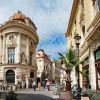
One of the most important urban legacies of October 8, 1878, was the renaming of one of Bucharest’s principal thoroughfares. Podul Mogoșoaiei, the old road connecting the center of the city with the road toward Mogoșoaia, was given the name Calea Victoriei, or Victory Avenue.
The new name transformed the military victory into a permanent landmark of the city. The avenue that would become one of Bucharest’s most famous streets thus received a name directly connected with the moment when the Romanian army returned triumphantly from the War of Independence.
Other streets were also renamed during the same festive period, preserving in the city’s collective memory the names of major battles from the war. Smârdan, Plevna and Rahova would remain on the map of Bucharest as lasting reminders of the military campaign.
This practice was not accidental. In modern Bucharest, street names became one of the ways in which political and military events were transmitted to future generations. Calea Victoriei is perhaps the best-known example: an urban thoroughfare whose name transformed a day of military triumph into a permanent element of the city.
A Bucharest transformed into a stage for celebration
Constantin Bacalbașa left one of the most evocative descriptions of the atmosphere on that day. In his account, the city had been decorated with flags and lanterns, while the crowds who had come to see the army were so numerous that Podul Mogoșoaiei had become almost impossible to cross.
That evening, Bucharest was illuminated for the celebrations. After a day dominated by military and religious ceremonies, regimental bands and public performances prolonged the festive atmosphere. The National Theatre also had a performance scheduled, and the city continued celebrating the victory well into the evening.
For the soldiers, however, the festivities also carried a deeply personal dimension. Many of those marching through Bucharest had been wounded, while others had lost comrades during the fighting in Bulgaria. The trophies carried through the city represented both proof of victory and a reminder of the human cost of war.
Documents preserved by the National Archives also provide details about the way the capital prepared for the event. The city authorities invited officials, schools, community representatives and residents to take part in the celebrations. Donations were also made for the Romanian soldiers, including significant quantities of beer and tobacco provided by merchants and communities in Bucharest.
The day when military victory entered Bucharest’s collective memory
October 8, 1878, remained one of the great symbolic days in Bucharest’s 19th-century history. The city welcomed its army not only with music, flags and flowers, but also through a series of gestures designed to preserve the victory in the urban memory.
The renaming of Podul Mogoșoaiei as Calea Victoriei was perhaps the most enduring of these gestures. The triumphal arch erected for the occasion disappeared, but the street name survived and continues to recall the moment when the Romanian army entered the capital in triumph.
The 1878 ceremony should also be clearly distinguished from the return of the Romanian army to Bucharest on December 1, 1918. At that time, Romania was experiencing another decisive moment in its history, associated with the Great Union and the return of the Royal Family to the capital after the wartime refuge in Iași. In 1878, the country was celebrating the independence won in the war against the Ottoman Empire; four decades later, Bucharest became the center of a united Romania.
Seen from the perspective of today, October 8, 1878, was more than a page in military history. It was the moment when Bucharest transformed a battlefield victory into a major public celebration and into part of its own urban identity. The soldiers who had fought for independence marched through the capital, and the city responded with a collective expression of gratitude.
And when Bucharest residents walk along Calea Victoriei today, few may think about the fact that the name of one of the capital’s most important thoroughfares was born from that October day. In 1878, after years of Ottoman suzerainty and following the sacrifice of an entire generation, the victory of the Romanian army literally became part of the map of Bucharest.
We also recommend: Famous Houses of Bucharest: The house of General Gheorghe Manu and the story of the hero who contributed to the conquest of Plevna in Romania’s War of Independence