Symbols of Bucharest: Ghencea Cemetery, the final resting place of Elena and Nicolae Ceaușescu
By Bucharest Team
- Articles
- 27 OCT 26
Few places in Bucharest carry as much historical and emotional weight as Ghencea Cemetery. Located in the southwestern part of the capital, the cemetery is closely associated with the memory of Romania’s military history, but also with one of the most controversial chapters in the country’s recent past. It is here that Nicolae and Elena Ceaușescu are buried, more than three decades after their execution on Christmas Day in 1989. Their graves have continued to attract visitors, journalists, history enthusiasts and people who experienced the communist period themselves. For some, the site represents a place of historical reflection; for others, it remains a controversial symbol of a regime that profoundly marked Romanian society for decades. Regardless of the perspective, Ghencea has become one of the places where the memory of Romania’s recent history is still very much alive.
Two cemeteries with different histories
The name Ghencea is associated with two important burial grounds in Bucharest: Ghencea Civil Cemetery and Ghencea Military Cemetery. Although they are located in the same broader area, they have different histories and functions. The military cemetery has a particularly important memorial role, being connected with the memory of Romanian soldiers and war heroes.
According to the National Office for the Cult of Heroes, the current form of Ghencea Military Cemetery dates back to 1921. More than 2,500 Romanian soldiers who died during the First World War, including those who fell in the battles around Bucharest, were subsequently brought together there. During the Second World War, special plots were also established for military heroes. Between 1941 and 1945, 1,376 heroes were buried in these plots, including 1,283 identified soldiers and 93 unidentified ones.
Over time, the cemetery underwent several changes, including the relocation of some remains to an ossuary. These layers of history explain why Ghencea is much more than an ordinary cemetery. It is also a memorial space where different periods of Romanian history coexist, from the wars of the first half of the 20th century to the dramatic events of December 1989.
How Nicolae and Elena Ceaușescu came to be buried at Ghencea
Nicolae and Elena Ceaușescu were executed on 25 December 1989, following a brief military trial held in Târgoviște. The execution marked the violent end of the communist regime led by Nicolae Ceaușescu and became one of the defining images of the Romanian Revolution.
The couple’s burial took place only a few days later, under circumstances that were deliberately kept secret. According to historical documentation from AGERPRES, Nicolae and Elena Ceaușescu were buried on 28 December 1989 at Ghencea Civil Cemetery. Their graves were not immediately marked in a manner that would make their location widely known, reflecting the authorities’ concern that the burial site could become a place of political gatherings or demonstrations.
For years, the exact circumstances surrounding their burial remained the subject of speculation. Questions were raised about the identity of the remains, the precise location of the graves and the way the burial had been organized. The lack of publicly available information contributed to the many theories that circulated in the years following the Revolution.
Nevertheless, the graves eventually became known, and the site gradually turned into a place visited by people with very different attitudes toward the former communist leader. Some came out of historical curiosity, while others continued to express nostalgia for certain aspects of the communist period. The cemetery thus became an unusual meeting point between personal memories, political controversy and the need to understand the recent past.
The 2010 exhumation and DNA testing
One of the most important moments in the history of the Ceaușescus’ graves came in July 2010, when their remains were exhumed for DNA testing. The operation was carried out decades after their execution, following persistent demands from members of the Ceaușescu family for a definitive identification.
According to AGERPRES documentation, the remains attributed to Nicolae and Elena Ceaușescu were exhumed on 21 July 2010, and specialists from the National Institute of Forensic Medicine collected biological samples for DNA analysis. The procedure attracted considerable public attention because it was expected to settle some of the controversies that had surrounded the identity of the remains since 1989.
In November 2010, DNA analysis confirmed that the male remains were those of Nicolae Ceaușescu. The comparison was made using genetic material from his son Valentin Ceaușescu and from one of Nicolae Ceaușescu’s brothers. The result was considered statistically conclusive, although investigators pointed out that there was no direct DNA sample taken from Nicolae Ceaușescu while he was alive.
The situation was somewhat different in Elena Ceaușescu’s case. The available material was not considered sufficient to provide an equally definitive identification. This distinction is important because the two cases have sometimes been presented in public as if they had produced identical forensic conclusions. In fact, the DNA evidence was considerably stronger in Nicolae Ceaușescu’s case.
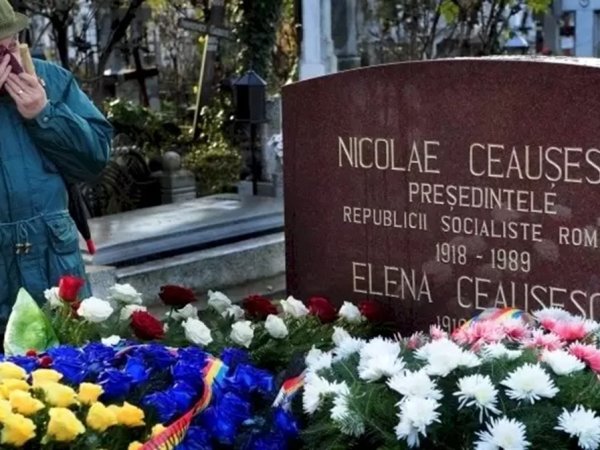
Following the forensic examination, the remains were reburied in December 2010. Nicolae and Elena Ceaușescu were placed together again in Ghencea Civil Cemetery, close to the location associated with their original graves.
The Ceaușescu grave, a place that still attracts visitors
Today, the graves of Nicolae and Elena Ceaușescu remain a point of interest for those exploring the history of communist Romania. Unlike conventional historical monuments, the site does not present a neutral narrative of the past. Instead, its significance depends largely on the visitor’s own memories and interpretation of the period.
For people who lived through the communist era, a visit to the graves can evoke very different emotions. Some remember shortages, censorship, political repression and the increasingly authoritarian character of the regime during its final years. Others associate the period with personal experiences that may be remembered differently, sometimes separating everyday life from the political reality of the dictatorship.
The cemetery has therefore become a place where competing memories meet. The presence of visitors interested in the Ceaușescu family demonstrates that the events of December 1989 have not lost their relevance. More than three decades later, the revolution, the trial and execution of the former leader and the subsequent transformation of Romanian society remain subjects of debate.
The grave itself is relatively modest compared with the historical importance of the people buried there. This contrast is striking: one of the most powerful couples in communist Romania ultimately rests in a cemetery space that does not resemble a grand political monument.
Nicu Ceaușescu, close to his parents
The connection between Ghencea and the Ceaușescu family extends beyond Nicolae and Elena. Nicu Ceaușescu, their youngest son and one of the most prominent figures associated with the final years of the communist regime, was also buried in the same cemetery area.
Nicu Ceaușescu was considered one of the most promising members of the political elite during the final period of his father’s rule. He became particularly well known after being appointed first secretary of the Communist Party in Sibiu County. His political career ended abruptly with the fall of the regime in December 1989.
His presence in Ghencea adds another dimension to the cemetery’s connection with the Ceaușescu family. The graves of the parents and their son form a small historical cluster that continues to attract people interested in Romania’s communist past and the dramatic events surrounding the collapse of the regime.
At the same time, the cemetery does not belong exclusively to the Ceaușescu family. It remains a burial ground with its own broader history, including numerous other graves that have nothing to do with the former political leadership. This distinction is important because the history of Ghencea extends far beyond the story of one family.
Why Ghencea Cemetery matters to Bucharest’s memory
Ghencea is significant precisely because several layers of Romanian history overlap there. The military cemetery preserves the memory of soldiers and war heroes, while the civil cemetery has become associated with one of the most controversial episodes in the country’s recent history.
The area illustrates how cemeteries can function as historical archives in their own right. Names, dates, monuments and graves preserve fragments of the past that cannot always be found in official buildings or traditional museums. In Ghencea Cemetery, the visitor can move, symbolically, from the history of Romania’s wars to the history of communism and the Revolution of 1989.
The presence of the Ceaușescu graves also illustrates the difficulty of dealing with a recent and contested past. Unlike events that took place centuries ago, the communist period is still within living memory. Many Romanians experienced it directly, and families continue to carry memories, stories and traumas connected with those decades.
For this reason, Ghencea is not simply a place to visit in order to see the graves of two former heads of state. It is a place where the visitor can reflect on the way a society remembers its past, how political regimes leave traces behind and how historical controversies can survive long after the events themselves have ended.
A place where the past is still present
More than 30 years after the fall of communism, the story of Nicolae and Elena Ceaușescu continues to generate questions, discussions and conflicting interpretations. Their graves in Ghencea have become one of the physical symbols of this unresolved relationship with the past.
The 1989 execution, the secret burial, the controversy over the graves, the 2010 exhumation and the subsequent DNA testing all form part of a complex story that cannot be reduced to a single political interpretation. The available evidence helps clarify important facts, but the emotional and social significance of the site remains much more complicated.
For Bucharest, Ghencea is therefore more than a cemetery. It is a place where military history, the memory of communism, the Revolution of 1989 and the personal stories of several generations intersect. The graves of Nicolae and Elena Ceaușescu are only one part of this much larger historical landscape, but they remain among the most recognizable symbols of the dramatic end of Romania’s communist era.
We also recommend: Dark Tourism in Bucharest: Sites of Repression, Death and Tragedy That Have Become Part of the City's Collective Memory