How the Bucharest Fire Brigade Was Established, the First Military Formation Created to Prevent and Fight Fires in Wallachia
- Articles
- 28 OCT 26
In the first half of the 19th century, Bucharest was a city undergoing rapid transformation, but also one extremely vulnerable to devastating fires. Most buildings were constructed from wood, streets were often narrow and densely built, and the lack of an organized firefighting service meant that a fire could quickly turn into a major disaster. Against this backdrop, the need for a permanent and professionally organized institution capable of intervening during fires became increasingly urgent. The solution came during the reign of Prince Gheorghe Bibescu, when the authorities of Wallachia took an important step toward modernizing the capital's public services. In 1844, the legal framework for the establishment of the Bucharest Fire Brigade, known as the Roata de Pompieri București, was adopted. The new formation became operational in 1845 and represented an important milestone in the history of organized firefighting in the Romanian Principalities. The creation of the unit was not an isolated decision, but the result of several years of discussions and projects concerning the need to protect Bucharest from fires. Its establishment marked the transition from improvised interventions to an organized military structure equipped specifically for firefighting.
Bucharest and the danger of major fires
During the first decades of the 19th century, Bucharest was expanding rapidly. The capital of Wallachia was becoming an increasingly important political, economic and commercial center, while its population and built-up area continued to grow. However, the city still lacked many of the modern public services that would later become indispensable.
Fire represented one of the greatest dangers. Wooden houses, shops and inns were often built close together, while candles, open fires and other sources of ignition were part of everyday life. Once a fire started, flames could spread rapidly from one building to another, particularly in densely populated neighborhoods.
The city had already experienced numerous serious fires, and the authorities understood that spontaneous intervention by inhabitants, craftsmen or soldiers was no longer sufficient. A permanent formation, with specially trained personnel, equipment and a clear chain of command, was needed.
There had already been earlier initiatives aimed at organizing firefighting in Bucharest. According to the history of the Bucharest-Ilfov Emergency Inspectorate, a project had been proposed as early as 1833 by Major General Starov, while in 1835 Dr. Zucker also advanced proposals concerning the organization of a specialized firefighting service.
These initiatives, however, did not immediately lead to the creation of a permanent military formation. The decisive moment came a few years later, under Prince Gheorghe Bibescu.
The 1844 law, the founding act of the Bucharest Fire Brigade
At the beginning of 1844, the Extraordinary Administrative Council submitted to the Wallachian Assembly a project concerning the creation of a firefighting unit for the capital. The project was subsequently transformed into a legal act.
On August 18, 1844, the law establishing the Bucharest Fire Brigade was sanctioned. It was later included in the second edition of the Organic Regulation under the title “Legiuire pentru întocmirea unei roate de pompieri pentru capitala București” — legislation concerning the establishment of a firefighting company for the capital, Bucharest.
The importance of this document goes beyond the mere creation of a new institution. It established a clear legal and organizational framework for a specialized military formation whose mission was to intervene during fires and protect the population and buildings of the capital.
The National Archives of Romania preserve documents connected to the creation of the unit, including the original project, the princely official letter and the 1847 edition of the Organic Regulation. Some of these documents are written in Romanian using the Cyrillic alphabet, reflecting the administrative and cultural context of the period.
Thus, August 18, 1844, can be regarded as the founding moment of the Bucharest Fire Brigade in its legally organized and permanent form.
How the first Bucharest Fire Brigade was organized
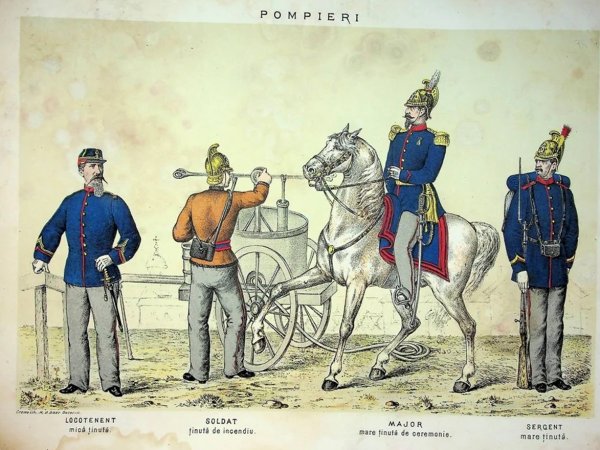
The new formation was structured according to military principles. Its organization reflected the authorities' desire to create a unit capable of intervening quickly in different parts of the capital.
The formation included seven officers, 23 non-commissioned officers and 256 soldiers. The personnel were divided into six sections. One section was stationed at the Agia, the institution responsible for maintaining public order, while the other five were distributed among the city's five administrative units.
This arrangement was designed to shorten intervention times. Instead of keeping all firefighters in a single location, the authorities created a network that allowed personnel to reach different neighborhoods of Bucharest more quickly.
The unit was also provided with specialized firefighting equipment. Among the most important items were fire pumps, water carts known as “sacale,” as well as horses needed to transport the equipment rapidly to the scene of a fire.
The organization of the Roata de Pompieri reflected a broader process of modernization taking place in Wallachia. Public administration, the army, urban infrastructure and public safety were gradually being reorganized according to more systematic principles.
The Fire Brigade officially enters service in 1845
Although the legal basis for the new institution was established in 1844, the Bucharest Fire Brigade became operational in 1845. The formation was organized and placed into service under the command of Captain Emanoil Boteanu.
This distinction between the legal establishment of the institution and its actual entry into service is important. The adoption of the law created the framework, but personnel had to be organized, equipment secured and the necessary procedures established before the unit could operate effectively.
The creation of the Roata de Pompieri marked an important change in the way fires were handled in Bucharest. Instead of relying primarily on improvised groups of inhabitants or soldiers, the capital now had a permanent military formation specifically prepared for firefighting.
Its members had to be ready to respond whenever a fire broke out, regardless of the time of day or location. Their duties required discipline, physical endurance and the ability to work under extremely dangerous conditions. The institution therefore became one of the first examples of a modern public emergency service in Bucharest.
The Great Fire of 1847, its first major test
Only a few years after the establishment of the new firefighting formation, Bucharest experienced one of the most devastating fires in its history.
On March 23, 1847, the so-called Great Fire of Bucharest broke out. According to information published by the Bucharest-Ilfov Emergency Inspectorate, approximately 300 large houses were destroyed in around three hours.
The disaster demonstrated just how vulnerable the capital remained despite the creation of a specialized firefighting service. The scale of the fire, the density of the buildings and the urban conditions of the period made intervention extremely difficult.
For the firefighters, however, such disasters represented precisely the reason why the institution had been created. The new military formation was expected to confront the flames directly, protect buildings and prevent the fire from spreading even further.
The Great Fire of 1847 subsequently became one of the events that highlighted the importance of having a permanent and organized firefighting service in Bucharest.
The disaster also reinforced the need for better urban planning, improved construction standards and more efficient public safety measures. Fires were not merely isolated accidents; in a densely built city, they could threaten entire neighborhoods within a very short period.
September 13, 1848, and the Battle of Dealul Spirii
The history of the Bucharest firefighters is closely associated with another major event: the Battle of Dealul Spirii on September 13, 1848.
During the revolutionary events of 1848, the firefighters became involved in the confrontation with Ottoman troops. The unit was commanded by Captain Pavel Zăgănescu, and the clash at Dealul Spirii became one of the most important episodes in the history of the Romanian military firefighters.
The battle was marked by fierce fighting and significant casualties. The firefighters demonstrated exceptional discipline and courage, with a large proportion of the unit being killed or wounded.
The event subsequently acquired a symbolic significance far greater than its immediate military consequences. The courage displayed by the firefighters became part of the institutional memory of the Romanian firefighting service and contributed decisively to the image of firefighters as professionals willing to risk their lives in the service of the community.
September 13 would eventually become associated with the Romanian firefighters' tradition of sacrifice and heroism. In later decades, the memory of the Battle of Dealul Spirii was officially commemorated.
During the reign of Alexandru Ioan Cuza, the surviving firefighters were decorated with the “Pro Virtute Militari” medal, while on September 13, 1863, the unit received flags bearing the symbols of its military tradition. The date September 13 is now celebrated in Romania as Firefighters' Day.
From the Bucharest Fire Brigade to the tradition of Romanian military firefighters
The Roata de Pompieri established in 1844–1845 represented an essential stage in the development of organized firefighting in Romania. Its creation demonstrated that the authorities had begun to understand fire protection as a permanent public responsibility rather than an occasional emergency.
The evolution of the institution continued throughout the 19th century. Firefighting formations were gradually established and developed in other cities, while equipment, training methods and intervention techniques were improved.
The experience gained in Bucharest contributed to the formation of a professional culture centered on discipline, rapid intervention and personal sacrifice. The military character of the service also helped establish clear rules of command and organization.
The memory of the firefighters who fought at Dealul Spirii became an essential part of this tradition. Their example was repeatedly invoked in the following decades as an expression of courage and devotion to duty.
The monument dedicated to the firefighters was inaugurated on September 13, 1901, further strengthening the symbolic connection between the institution and the events of 1848.
An institution born from the need to protect the city
The history of the Bucharest Fire Brigade begins with a simple but fundamental problem: a rapidly developing city needed a reliable way to protect its inhabitants from one of the most destructive dangers of the era.
The law sanctioned on August 18, 1844, provided the legal foundation for a permanent military firefighting formation, while 1845 marked its actual entry into service. The organization of personnel into sections distributed throughout Bucharest, together with the use of pumps, water carts and horses, represented a significant step toward modern emergency intervention.
The Great Fire of 1847 showed how necessary such a service was, while the events of September 13, 1848, transformed the firefighters into a symbol of courage and sacrifice.
More than 180 years later, the legacy of that first organized formation remains visible in the traditions of Romanian firefighters. What began in Bucharest in 1844 as a response to the city's vulnerability to fire eventually became part of the institutional foundation of modern emergency services in Romania.
The Roata de Pompieri was therefore much more than a military unit created to extinguish fires. It represented one of the first major attempts by the authorities of Wallachia to introduce an organized, permanent and professional system for protecting the population against disasters.
Its history is inseparable from the modernization of Bucharest and from the long tradition of Romanian firefighters, whose mission continues to be defined by the same principles that guided their predecessors: discipline, courage and service to the community.
We also recommend: The National Military Museum “King Ferdinand I”, a century of history and honor. The story of one of the most beautiful museums in Bucharest