The Italian community in Bucharest. The people and places connecting the capital with Italy
By Raluca Ogaru
- Articles
- 28 OCT 26
The Italian Church on Nicolae Bălcescu Boulevard, the name of Luigi Cazzavillan and the cultural gatherings at Casa d’Italia tell different parts of the same story: Bucharest has an Italian community with documented roots in the 19th century and a cultural life that continues today.
To discover its history, it is worth looking beyond architectural or culinary influences. This is a story of people who came to work, families who settled here, and schools and associations through which Italians maintained their language and culture while helping transform the city.
How Bucharest’s Italian community took shape
The presence of Italians in the capital is documented in the registers of Saint Anne’s Catholic Chapel from 1848 onwards. This reference is a documentary milestone, rather than the exact date when the first Italian arrived in the city. The community developed gradually, as temporary stays for work were followed by families settling permanently.
The study “The Italian community in Bucharest (1850–1918)”, written by Alina Dorojan and published in Revista Arhivelor, describes a community with diverse occupations: labourers, small traders, music teachers, architects, engineers and entrepreneurs. The growth of construction created opportunities for Italian craftsmen, whose skills were valued.
The research records 2,013 Italians in Bucharest in the 1899 census. This figure describes the city at that time and cannot be used to estimate the present-day community. It does, however, show that by the end of the 19th century, the Italian presence extended beyond a handful of individual biographies.
The Italian Church, a community landmark in the city centre
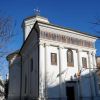
At 28 Nicolae Bălcescu Boulevard, the Italian Church preserves one of the most visible traces of this history. It was built in 1915–1916, to designs by architects Mario Stoppa and Giuseppe Tiraboschi, with financial support from the King of Italy, the Pope, the Italian Legation and the community.
Its architecture draws on the Lombard tradition, while its bell tower, known as a campanile, gives it a distinctive presence along the boulevard. If you pass through the area, look at the whole complex rather than just the façade: the church, tower and staff residence together form a small historic ensemble. Its construction and architectural influences are documented by Agerpres.
The church’s history also includes restrictions imposed during the communist period. The Romanian Institute for Research on National Minorities records that, between 1968 and 1989, access was reserved for Italian diplomats, with services held only a few times a year. On 1 November 1990, the church became a territorial parish and opened to the general public.
READ ALSO: 8 public street clocks that kept time through Bucharest’s history
Luigi Cazzavillan: a newspaper and a school for the community
One of the Italians who influenced life in Bucharest was Luigi Cazzavillan, who founded the newspaper Universul in 1884. His work extended beyond journalism: he was involved in the Italian mutual aid society and supported the community’s school.
The history published by the Dante Alighieri Society connects the newspaper’s success with Cazzavillan’s investment in education. The Regina Margherita Italian School operated on the street that now bears his name. For families settled in Bucharest, such an institution gave children the opportunity to maintain their connection with the Italian language.
The same source traces the establishment of a cultural circle in 1901, which affiliated with the Dante Alighieri Society the following year. The school, the press and community organisations show how Italians were building lives in Bucharest while maintaining connections with one another.
READ ALSO: Historic fountains of Bucharest: their stories, from the water carriers to Octav Doicescu’s Miorița
Casa d’Italia and today’s community
The contemporary Italian presence includes both descendants of families who have lived in Romania for generations and Italians who arrived more recently. These two groups should not be conflated: ethnic background, citizenship and residency are different criteria. The Association of Italians in Romania — RO.AS.IT. — makes this distinction in its account of the minority’s history.
In Bucharest, the association lists a secondary office at 24 Strada Ion Luca Caragiale, Sector 2, and its cultural venue, Casa d’Italia, at 13 Strada Popa Tatu, Sector 1. These are separate addresses, so check the location given in each event announcement. Contact details are available on the RO.AS.IT.
Recent events also document the community’s cultural activity. On 11 October 2026, Casa d’Italia in Bucharest hosted a concert by ArmoniE Trio, an ensemble from Puglia featuring flute, clarinet and piano. It is a concrete example of the gatherings through which the city’s connection with Italy continues to be nurtured.
Where to discover Italian language and culture
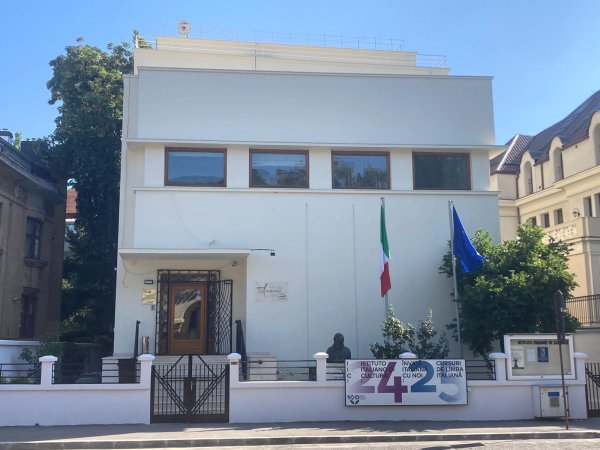
Another landmark is the Italian Cultural Institute at 41 Aleea Alexandru. An official institution of the Italian state, it organises cultural events, offers language courses and provides a library, reading room and lending services. Its activities and participation requirements can be found on the institute’s website.
The Dante Alighieri Society also has a Bucharest committee, revived in March 2021 by Italian and Romanian teachers. The organisation describes itself as open to anyone interested in Italian language and culture, and information about its work appears on the Bucharest committee’s page.
For those wishing to discover this side of the city, there are several straightforward starting points: a stop at the Italian Church, an event announced by Casa d’Italia or an activity at the institute. Check opening hours and admission arrangements separately; an organisation’s premises are not necessarily open for tourist visits.