8 Public Street Clocks That Kept Time Through Bucharest’s History
By Eddie Țone
- Articles
- 18 OCT 26
Bucharest spent a good part of its modern history wondering what time it was. The telephone stayed at home, the wristwatch was still a serious possession, and the official time belonged to institutions considered trustworthy enough to display it on enormous clock faces on their façades. The bank knew the time. The railway station knew it, of course, with almost moral precision. City Hall placed it in a tower. An Italian church installed it beside its bells. All Bucharest residents had to do was look up.
The city already had a tradition of public timekeeping. In 1691, Constantin Brâncoveanu installed a clock in the princely bell tower, and by the late 18th century, Colțea Tower displayed one of Bucharest’s earliest large public clocks. The earthquake of 1802 brought down the upper section of the tower and destroyed the clock. The idea, however, had taken firm hold in the city's imagination: an important building could offer the public both prestige and the correct time.
The 20th century turned this concept into a small urban gallery. Photographic documentation carried out by Lucian Muntean in 2014 for historian Volker Wollmann’s research recorded public clocks on the Central University Library, the Italian Church, Sector 1 City Hall, the CEC Palace, the Adriatica Building and several other Bucharest landmarks. The clock had become part of the architecture, rather like a company logo today: you could spot it from a distance and immediately understand who occupied the building.
Here are eight of the most interesting examples.
1. The University Clock – Where Bucharest Used to Meet
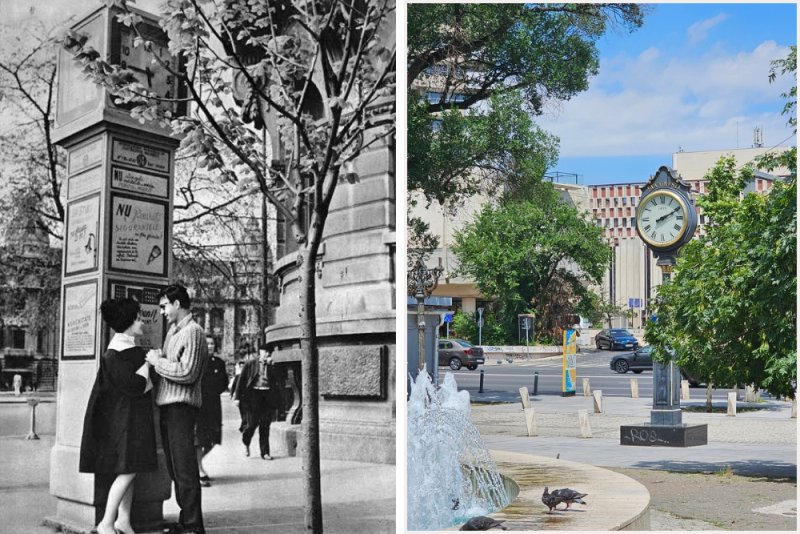
Some clocks tell you the time. Others occasionally define your social life. The University Clock belonged firmly to the second category. For several generations of Bucharest residents, the phrase “See you at the Clock” was all that was needed. The location was understood.
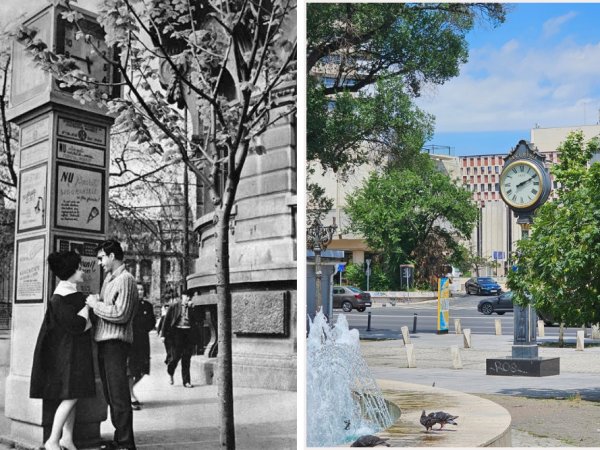
The street clock was installed in the early 1950s on the pavement in front of the University Palace, near the entrance to the University metro area. Period photographs show it standing on a substantial pedestal, perfectly positioned for anyone approaching from the city centre or crossing the square. A photograph published in the 1964 Bucharest Album captures it exactly as it would remain in the city's collective memory.
The clock quickly acquired a function that its designer probably never included in the technical specifications: it became an unofficial matchmaking agency, with no staff required. Friends, colleagues and, above all, couples arranged to meet there. In a Bucharest without mobile phones, the message “five o’clock, at the Clock” demanded a certain romantic discipline. If the other person was late, you had two options: patience or a remarkably thorough examination of the clock face.
Historian Dan Falcan recalled that the clock served as a familiar landmark for Bucharest residents and that it disappeared around the mid-1990s, during the area's redevelopment. Adrian Vasilescu also remembered the urban ritual of meeting “at the Clock, at University Square”, a custom deeply embedded in postwar Bucharest life.
There is a further touch of administrative irony to the story. The city subsequently brought clocks back to University Square, but none ever acquired the same social significance. In 2006, a clock installed in the central roundabout counted down the time until Romania joined the European Union. It was later relocated. Around 2010, one of the ornamental clocks commissioned by the municipality also appeared near the fountain.
The original clock, however, had disappeared along with a distinctly Bucharest way of finding people. Today, you say, “I'll share my location.” Back then, you simply said, “At the Clock.” The old arrangement probably required considerably more patience, but it certainly offered more literary possibilities.
2. The CEC Palace Clock – Time Safely Deposited on Calea Victoriei
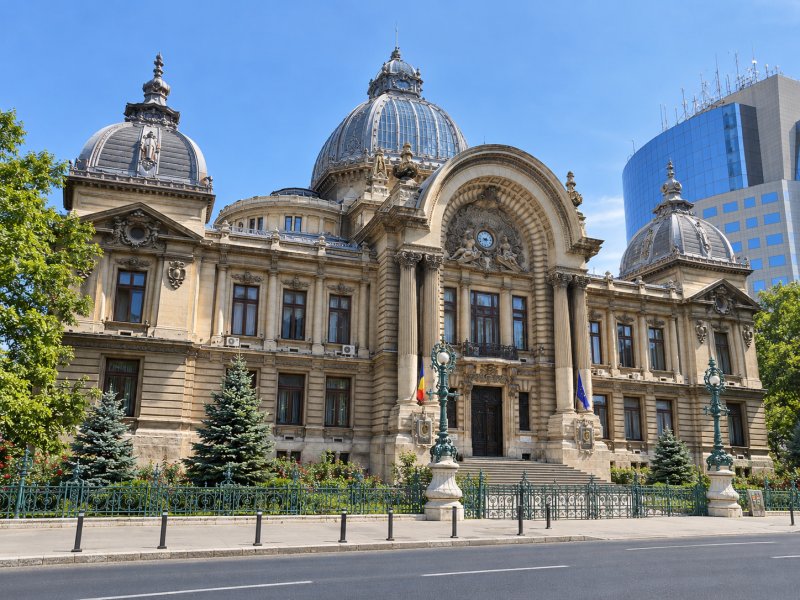
The CEC Palace looks almost as though it was specifically designed to accommodate a clock. After all, an institution entrusted with managing people's savings ought to manage their minutes with an equally serious expression.
The foundation stone of the present palace was laid in 1897, in the presence of King Carol I and Queen Elisabeth. Designed by French architect Paul Gottereau, with construction supervised by Ion Socolescu, the building was completed in 1900. It stands at 13 Calea Victoriei, directly opposite the former Postal Palace.
The clock sits immediately above the main entrance, set within the elaborate decoration of the semicircular pediment. Its position reveals quite a lot about the period. The correct time deserved a monumental setting, complete with sculpture, stonework and ornamentation, in an age when a public façade was allowed to be almost theatrical. Research into Bucharest's historic clocks specifically identifies it among the city's outdoor timepieces.
Seen up close, the clock face looks almost modest compared with the architectural spectacle surrounding it. That contrast is precisely what makes it appealing. The palace comes equipped with domes, columns and allegorical figures, while the clock quietly attends to the fundamental question: how long until closing time?
An excellent detail from the site's history lies beneath the geographical surface of Calea Victoriei itself. Before the financial institution was built, the Monastery and Inn of Saint John the Great occupied the site, and the monastery cemetery had once been the burial place of Ienăchiță Văcărescu. Bucharest occasionally manages to squeeze several centuries into a single address.
3. The Carol I University Foundation Clock – Keeping Time Above the Books
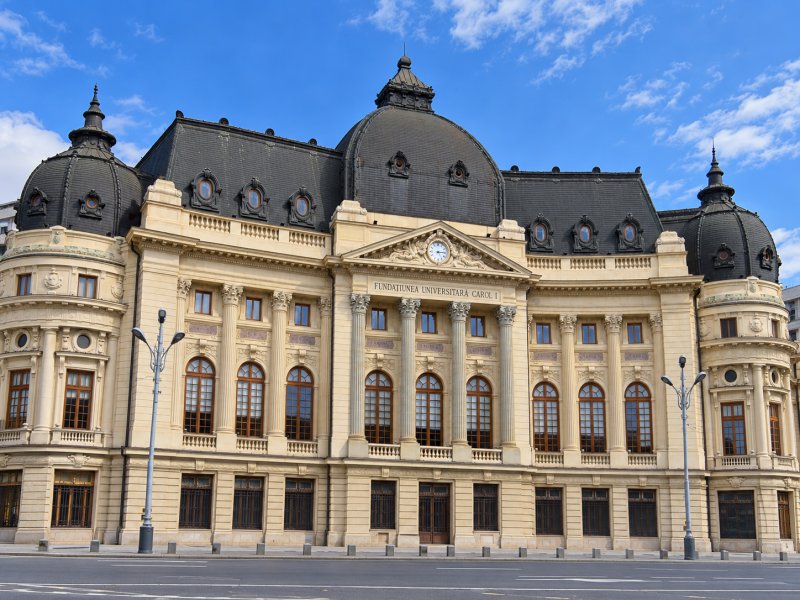
A few hundred metres away, the clock of the Carol I Central University Library plays a different role. Here, time belongs to studying, lectures and students who, judging by the universal experience of student life, have probably looked at its face with mixed feelings.
The Carol I University Foundation was inaugurated on 14 March 1895. King Carol I had entrusted the project to the same architect, Paul Gottereau. The complex subsequently expanded, with major construction work between 1911 and 1914 adding the central section facing Palace Square and the wing on C.A. Rosetti Street. The new ensemble was inaugurated on 9 May 1914.
It was this phase of construction that gave the monumental façade its clock-bearing pediment. An architectural description of the complex specifically highlights the clock face's role in emphasising the main entrance.
Visually, the clock fits perfectly into the composition. Beneath it runs the Foundation's inscription, followed by the monumental columns, while the equestrian statue of Carol I now stands in the square outside. Everything radiates the institutional discipline of an age when it seemed perfectly reasonable for a library to resemble a palace.
From its earliest days, the building possessed facilities that were extraordinary for Bucharest at the time. Books travelled through a pneumatic tube system and a lift connecting the reading areas with the storage rooms, while furniture and equipment came from specialist companies in London, Dresden and Munich.
In other words, the clock on the exterior was merely the visible part of a much broader concern with technology and organisation. Bucharest entered the 20th century with a clock on the pediment and books travelling through pneumatic tubes. Quite ambitious.
4. The Italian Church Clock – A Touch of Lombardy on the Boulevard
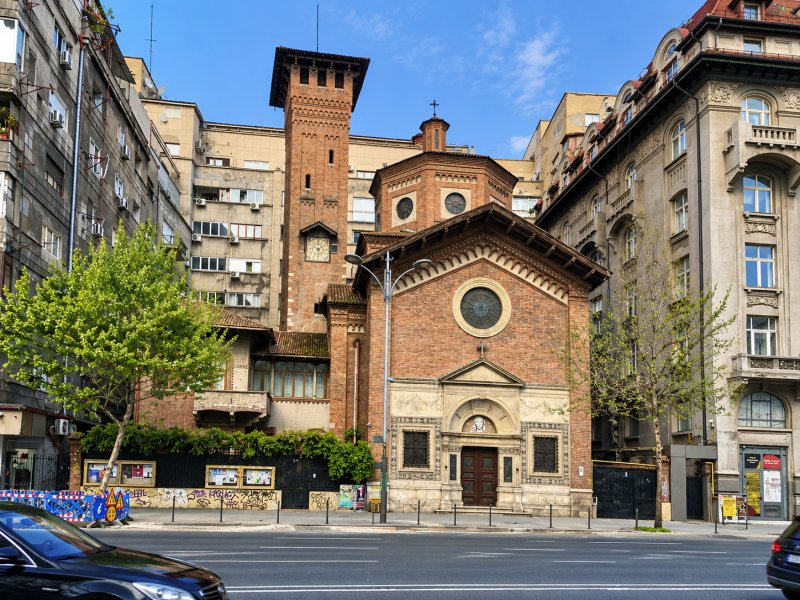
In the middle of bustling Bucharest, the bell tower of the Italian Church looks as though it has been imported from a town where people have time to drink an espresso standing at the counter and still manage to arrive punctually for appointments.
The Church of the Most Holy Redeemer, at 28 Nicolae Bălcescu Boulevard, was built between 1915 and 1916 to designs by architects Mario Stoppa and Giuseppe Tiraboschi. Its architecture drew inspiration from Lombardy, with references to Santa Maria delle Grazie in Milan. Funding came from King Vittorio Emanuele III of Italy, the Vatican, the Italian Legation and Romania's Italian community.
The bell tower features large clock faces with Roman numerals, clearly visible from the boulevard. Photographic research into Bucharest's public clocks includes it in the inventory, while images of the tower show just how naturally the clock fits into the campanile's architecture.
The urban context makes the story even more interesting. When the church was built, the surrounding area looked radically different. The large buildings that would later narrow the view appeared during the boulevard's transformation in the 1930s. Originally, therefore, the bell tower enjoyed a far more prominent position in the neighbourhood skyline.
The Italian Church clock almost perfectly fulfils the classic definition of a European urban clock. It is mounted high above the street, can be read from below and shares its tower with church bells. For a few moments, Magheru Boulevard takes on the atmosphere of an Italian avenue.
5. The North Railway Station Clock – Where Every Minute Really Mattered
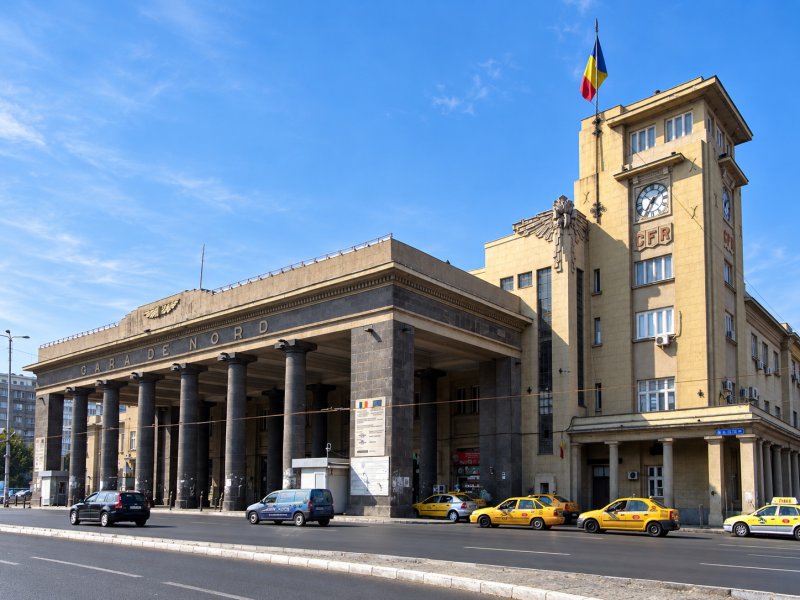
If there is one building in Bucharest that absolutely needed an enormous clock, the North Railway Station wins that contest by a locomotive's length.
The extensive redevelopment of the station in the early 1930s transformed the appearance of the entire complex. At the junction between the old building and the new monumental façade, a tower approximately 20 metres tall was erected, equipped with illuminated electric clocks. The tower and columned portico became the defining visual features of the new North Railway Station.
The station's story becomes far more interesting once we look beyond a simple clock face on the façade. As part of the modernisation, a Siemens-Halske central system was installed, featuring a master clock that transmitted electrical impulses to secondary clocks throughout the station. The system remained in operation until 1989, when it was replaced by an electronic one.
Accounts also describe an entire railway network synchronised through CFR clocks, with railway time acquiring a reputation as a standard of precision.
In the age of rail travel, a minute had very practical consequences. A departure scheduled for 2:03 p.m. meant exactly that, while arriving at 2:04 could mean spending the afternoon admiring the platforms. The North Railway Station clock therefore belongs to that fortunate category of urban objects in which architecture and utility come together perfectly.
Historic photographs show it already established as a landmark of the station square, while an image from 1940 captures its hands pointing to 1:20 p.m. A tiny detail, almost absurdly precise, preserved in a city then standing on the edge of a dreadful period in history.
6. The Sector 1 City Hall Clock – When Local Government Built Its Own Tower
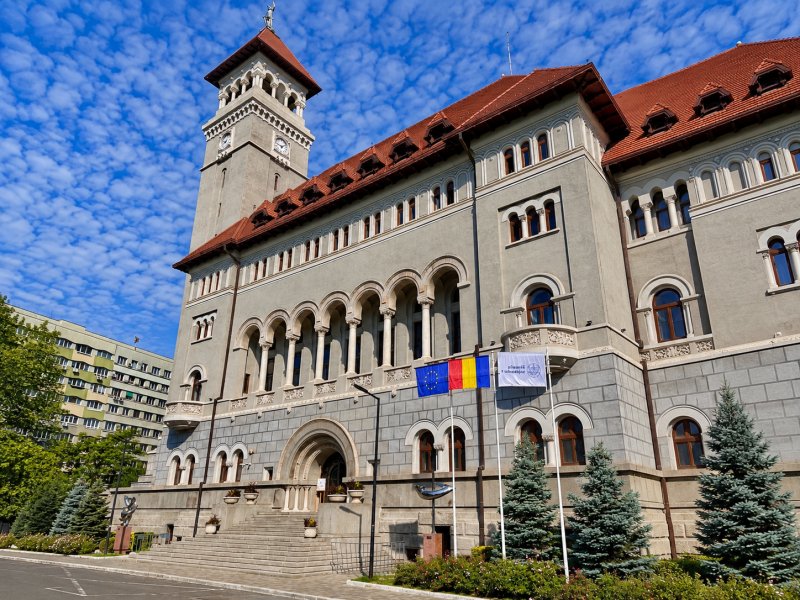
The Municipal Palace on Banu Manta Street looks exactly like the building an interwar administration might design if given the brief: “serious, monumental and visible from several streets away.”
The present Sector 1 City Hall has its origins in Bucharest's administrative reorganisation of 1926, when the Green Sector was established. Land for the new administrative centre was purchased in 1927, and the city hall, designed by Nicolae Georgescu and George Cristinel, was built mainly between 1928 and 1936.
The dominant feature of the complex is its clock tower, described in the building's heritage assessment as the principal vertical element of the architectural composition. The tower rises to approximately 56 metres and is crowned by an armoured knight affectionately nicknamed “Pandelică” in local folklore.
In practical terms, this is the complete interwar municipal package: a large clock, a tall tower, a council chamber, marble and a medieval knight on the roof. A touch of symbolic medievalism, delivered with such confidence that it is rather difficult to argue with.
The building has another noteworthy distinction: Sector 1 City Hall describes it as the only municipal headquarters in Bucharest built from the ground up specifically to serve as a city hall.
The clock is therefore part of the building's architectural DNA. The correct time sits high above the streets alongside the idea of municipal authority, from an era when public institutions expressed their status in metres of tower.
7. The Adriatica Building Clocks – Modernism That Keeps Time
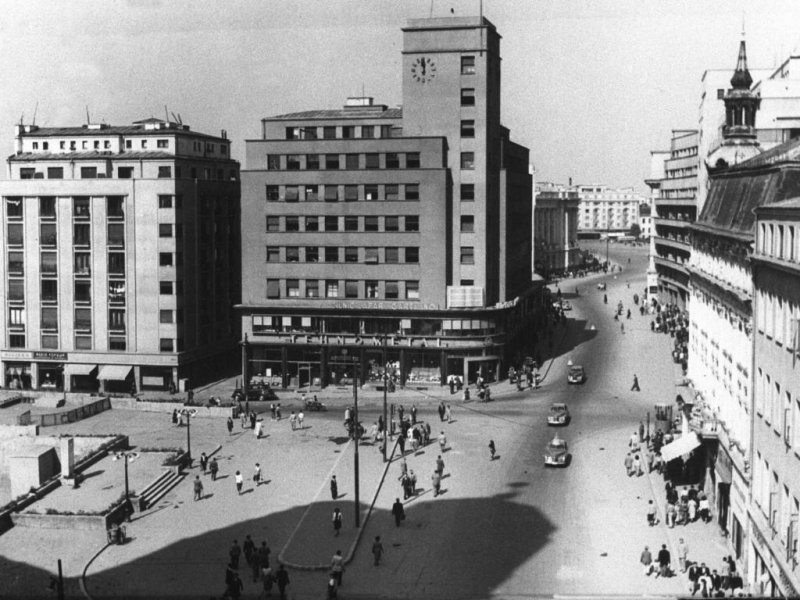 Photo: Agerpress
We return to Calea Victoriei for one of Bucharest's most elegant examples of a clock integrated into modernist architecture.
The Adriatica Building, associated with the insurance company of the same name, was designed in the 1930s by German-born architect Rudolf Fraenkel, a representative of the Neues Bauen movement. Fraenkel had arrived in Bucharest after leaving Nazi Germany and went on to design several important buildings in the Romanian capital.
The National Heritage Institute's record for a postcard depicting the building dates the subject to 1935 and notes an essential detail: the tower carries two clocks, facing different directions across the city.
This is a long way from the exuberance of the CEC Palace. The clock face is incorporated into a sober, geometric façade, entirely consistent with modernist design. The result looks surprisingly contemporary, even after almost a century.
The building also endured dramatic events. German bombing raids in August 1944 damaged it, in the same area where the old National Theatre was set on fire. Archive photographs preserve the tower's silhouette, and the clocks remained among the building's most distinctive features.
Their story has even found its way into contemporary design. Romanian watch brand Optimef created its Victoria model, inspired by the clocks of the Adriatica Building and the Autonomous State Monopolies Building, two interwar landmarks on Calea Victoriei.
How many street clocks find their way onto someone's wrist almost a century later? Quite a satisfying outcome for two clock faces that began their careers watching trams go by.
8. The State Monopolies Palace Clocks – A Monumental Finale to the Interwar Era
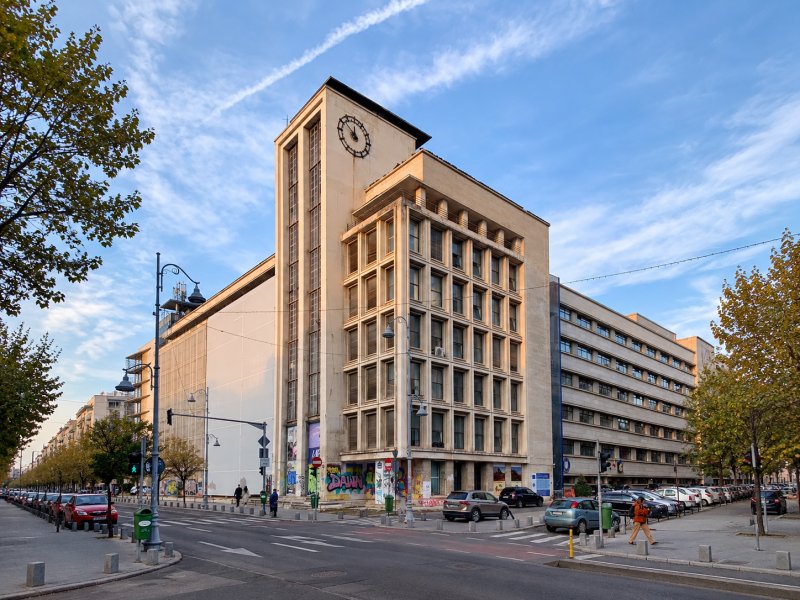
Further along Calea Victoriei, the State Monopolies Palace takes the idea of the urban clock into almost cinematic territory. Its vertical tower and clock faces look as though they were designed for a film populated by civil servants, black motorcars and Fedora hats.
The building was designed by Duiliu Marcu, one of Romania's leading 20th-century architects. Construction took place between 1934 and 1941, and the building belongs to his modernist period, with strong influences from Italian Rationalism.
The palace tower carries two clock faces, positioned on its northern and southern sides. The clocks themselves help make the building immediately recognisable in the architectural landscape of Calea Victoriei.
The contrast with the CEC Palace, further down the same street, tells the story of changing architectural tastes within just a few hundred metres. Around 1900, the CEC clock was surrounded by abundant sculptural decoration. Four decades later, Duiliu Marcu placed his clocks on an austere vertical surface, where geometry did almost all the work. Time had remained the same, but the century had changed its clothes.
The building subsequently became the headquarters of various state economic institutions, while its clocks continued to define its silhouette. In 2026, the palace is the subject of a major rehabilitation project, bringing renewed attention to one of Calea Victoriei's most impressive modernist monuments.
Looking Up at the City from the Pavement
Taken together, these eight clocks tell a surprisingly coherent story about Bucharest. Before them came Constantin Brâncoveanu's bell tower and the great Colțea Tower. After them arrived electronic clocks, mobile phones and screens that display the time at every touch. The old city, however, operated on a different scale: to find out the time, you looked at a building.
These clocks display time while simultaneously preserving it. A clock face on Calea Victoriei might show 3:42 p.m. on an afternoon in 2026, yet the architecture surrounding it keeps one foot firmly planted in 1900 or 1935. For an object invented to measure the passage of time, that is an admirably… ironic achievement.
You may also like: What makes Bucharest different from other cities in Romania. The open city that doesn’t wait for you