How the Nissa Cinema Disappeared from Interwar Bucharest
- Articles
- 15 OCT 26
In interwar Bucharest, going to the cinema was not simply about watching a film. For an important part of the capital’s population, going to the movies had become a form of urban entertainment, an outing in the city and, at times, even a social ritual. At a time when American and European productions were captivating Romanian audiences, dozens of cinemas appeared throughout the capital, ranging from major premiere venues to smaller theaters spread across the neighborhoods. Among these names that today can only be found in newspapers, yearbooks, collections of tickets or archives is the Nissa cinema. The theater operated in the Cișmigiu area, on Zalomit Alley, in a space with a history that predates the name Nissa. Period documents show that the cinema had previously been known as Lido, while in 1937 the press explicitly referred to it as “Nissa, formerly Lido.” The story of Nissa is interesting precisely because it did not end with a single spectacular event. The cinema was part of a constantly changing film world, went through the political transformations that followed the war, was included in the nationalization process of 1948, and later the space on Zalomit received other uses. Today, the cinema no longer exists, but the building associated with this address did not simply disappear.
A cinema just steps away from Cișmigiu
Zalomit Alley was located in central Bucharest, in the immediate vicinity of Cișmigiu Park. The address was sufficiently well known at the time for newspapers to identify the cinema simply as “Nissa (Zalomit Alley)” or “Nissa (Zalomit Alley-Cișmigiu).” Programs published in the period’s press demonstrate that the theater was part of the capital’s cinema circuit and had a regular schedule.
However, the history of the place goes further back. In the 1920s, the Amicitia hall operated at the same address and was mentioned in documents and newspapers of the time. In 1926, for example, the Official Gazette recorded a meeting that was to take place in “the Amicitia Hall at Zalomit Alley No. 6.” Important political and cultural events were also held in this hall, showing that the space had a public function before it became a well-known cinema.
Around the beginning of the 1930s, the hall entered the cinema circuit under the name Lido. A record dedicated to Bucharest’s cinemas lists Lido at Zalomit Alley No. 6 between 1930 and 1934. The press from 1932 also provides an interesting detail: Lido was then presented as the “former Amicitia,” confirming the succession of uses within the same building.
Several years later, the name Lido was replaced by Nissa. In November 1937, a program published in the Bucharest press announced “NISSA, formerly Lido,” while the theater was showing the film “The Doll Fairy,” starring Magda Schneider. The name change is therefore directly documented in a period source rather than being based solely on memories or later lists.
Nissa and the cinema-going public of the 1930s
Nissa should be viewed within the context of the explosion of cinema in Bucharest during the 1930s. The capital had numerous theaters, and audiences were already accustomed to a system in which films moved from premiere cinemas to venues that screened them later. The differences between cinemas were significant: some showed premieres, while others presented films during their second, third or fourth theatrical run.
Nissa was not at the top of this hierarchy. The official classification from 1939 placed it among cinemas showing films on their fourth run, alongside Franklin, Bizantin, Diana, Triumf, Milano, Pache, Florida, Ileana, Cotroceni, Edison, Dichiu and Aida. It is therefore more accurate to describe it as a central cinema with an accessible program rather than one of Bucharest’s major luxury cinemas.
This position did not mean that Nissa was unimportant. On the contrary, cinemas that took over films after their initial screenings played an essential role in making productions available to a wider audience. At a time when going to the cinema had become one of the great forms of urban entertainment, such theaters contributed to the development of a genuine cinema culture.
The programs preserved in the newspapers of the time provide an image of its repertoire. In 1938, Nissa was screening “The Devilish Woman” and “Boccaccio,” while in October of the same year it featured “The Prisoner of Zenda” and “Burgtheater.” In 1939, audiences could see “A Princely Night” and “Satan in Tails,” while in 1940 the cinema was advertised with titles such as “For the Fatherland” and “My Wife, the Subrette.”
The list of films also shows how international the cinematic tastes of Bucharest audiences were. German, American, French and other European productions circulated through the capital’s cinemas, while names such as Roland Colman, Zarah Leander and Loretta Young appeared in Nissa’s published programs. In May 1941, for example, the theater announced “Four Men and a Vow,” starring Loretta Young, as well as a documentary about the ascent of Mont Blanc.
From Nissa to the nationalized cinema
The war and the political changes profoundly altered the life of Bucharest’s cinemas. Nissa continued to appear in cinema programs during the Second World War, including in 1941. Period documents continued to list its address as Zalomit Alley-Cișmigiu, confirming that the theater remained active during that period.
The decisive moment came after the establishment of the communist regime. On November 3, 1948, Decree No. 303 was issued concerning the nationalization of the film industry and the regulation of trade in cinematographic products. The annex to the decree included numerous cinemas in Bucharest, among them Nissa. The theater thus officially entered the new state-controlled cinema system.
Nationalization should not, however, automatically be confused with the demolition of the building or the closure of the cinema on the same day. The legal document established the transfer of cinemas into state ownership, but it does not provide, in Nissa’s case, a complete explanation of what happened to the building afterward. Therefore, the claim that the theater was simply demolished immediately after 1948 cannot be supported by the documents consulted.
In fact, the history of the address provides an important clue. The building at Zalomit No. 6 continued to exist after the disappearance of the Nissa cinema. In 1969, the communist press was still referring to Zalomit Alley, while administrative documents from the 1990s show that the building at 6 Zalomit Street was being used by the “Petőfi Sándor” Cultural Center. In 1999, the General Council of Bucharest Municipality decided to return the building to the “Petőfi” Cultural Association and to terminate the activity of the public institution that had administered it.
The building survived, but the cinema disappeared
This evolution changes the story of Nissa’s disappearance to some extent. There is not enough evidence to state that the building housing the theater was demolished. Rather, what disappeared was the cinema function and the Nissa name, while the space continued to be used for other purposes.
Today, the address at 6 Ioan Zalomit Street is associated with the Petőfi Sándor Cultural Center. The same building therefore has a history that crosses several eras of Bucharest: from the Amicitia hall, where political and cultural meetings were held, to the Lido cinema, then to Nissa, and later to cultural institutions with a different identity.
It is an evolution characteristic of many Bucharest buildings. The building may survive, while the memory of its former function fades away. In the case of Nissa, the name was associated for more than a decade with the capital’s cinema programs, after which it gradually disappeared from public life. For generations who did not know interwar Bucharest, there is no obvious landmark today indicating that films were once shown in that space.
The old ticket and the newspapers preserving the cinema’s memory
One of the few ways in which Nissa can be rediscovered today is through the study of period documents. Programs published in newspapers are particularly valuable because they make it possible to reconstruct the theater’s activity almost week by week. They indicate the films being shown, the location of the cinema and, in some cases, the performances or additional attractions that accompanied the screenings.
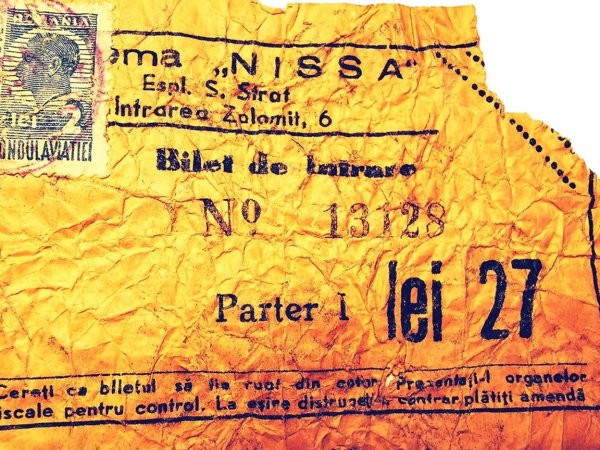
There are also surviving physical objects. An article about Bucharest’s old cinemas published by Historia reproduces an image of an admission ticket to the Nissa cinema from the 1930s. Such objects, together with cinema brochures and programs preserved in private collections, turn an almost forgotten name into a tangible part of interwar Bucharest.
Ultimately, the story of Nissa is the story of a slow disappearance. The theater was not erased from the map of Bucharest in a single moment, but was absorbed by the city’s political, administrative and cultural transformations. First there was Amicitia, then Lido, then Nissa, while the building itself subsequently received other uses.
Nissa has disappeared as a cinema, but its history has not disappeared completely. The address, the documents and the succession of functions within the building still make it possible to reconstruct a small chapter in the history of Bucharest’s cinema culture. And these fragments demonstrate just how much the city has changed: sometimes it is not the walls that disappear, but the names, voices and habits that once gave them life.
We also recommend: Cinema Volga, Studio Martin and today’s ruins. How one of Bucharest’s oldest cinemas disappeared